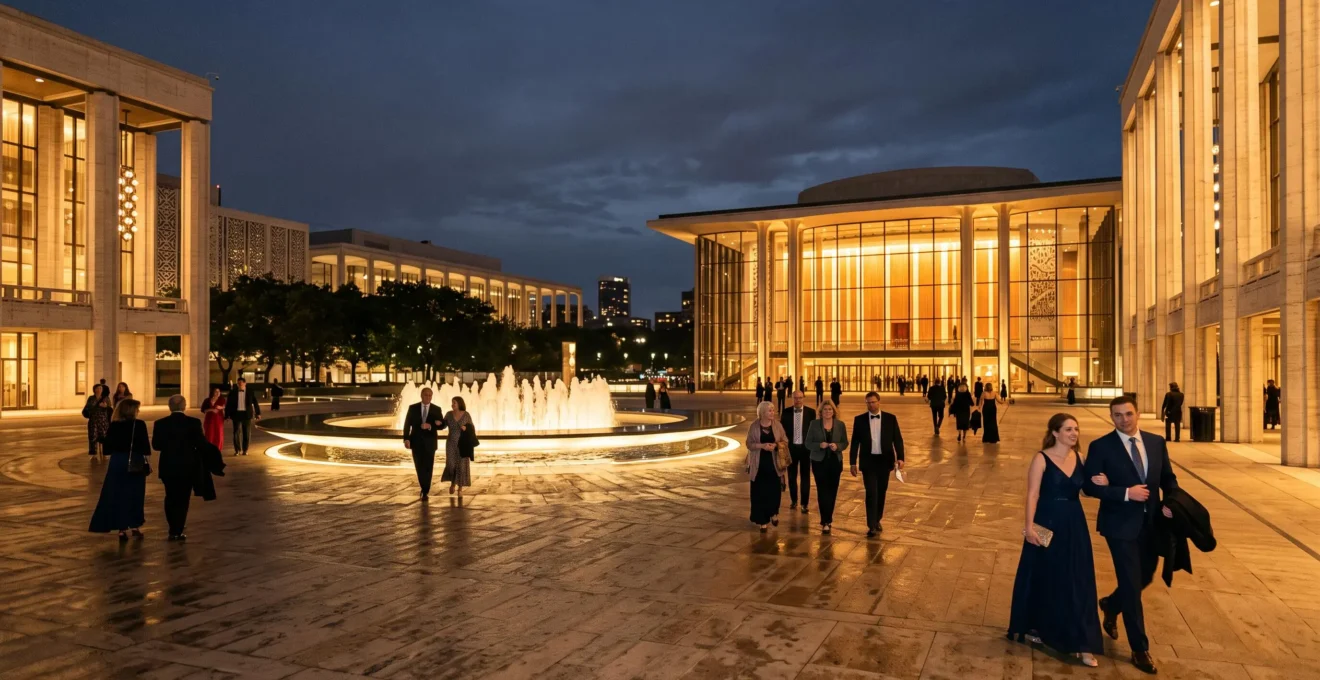
Contrary to the myth that Lincoln Center is exclusively for the wealthy, accessing its world-class stages is more about strategy than spending. This guide demystifies the process, revealing that a grand night of opera or ballet is surprisingly attainable. By understanding the modern systems of digital rush tickets, embracing the relaxed reality of the dress code, and knowing how to choose the right performance, you can turn an intimidating dream into an affordable and unforgettable experience.
The image of Lincoln Center at dusk—its grand plaza illuminated, the fountain dancing—can be as breathtaking as it is intimidating. For many arts lovers, the dream of attending a performance at the Metropolitan Opera or seeing the New York City Ballet is quickly tempered by the perceived costs and formal traditions. It’s easy to assume that such an experience is reserved for seasoned patrons with deep pockets, and that navigating the world of arias and arabesques requires a secret handbook.
Many guides focus on generic advice, but the real key to unlocking this cultural treasure isn’t about finding a single hidden discount. It’s about a shift in perspective. The institution itself has evolved, actively creating pathways for a new, diverse generation of attendees. The stuffy, exclusive atmosphere often depicted in movies has given way to a more welcoming reality, but only for those who know where to look. The true secret lies not in wealth, but in insider knowledge.
This guide rejects the old myths. Instead of focusing on what you *can’t* do, we will explore what you *can*. We will delve into the practical, modern systems that make Lincoln Center more accessible than ever. From securing last-minute tickets on your phone to understanding the true sartorial expectations, you will learn to navigate the experience with the confidence of a seasoned New Yorker. It’s time to demystify the grandeur and claim your seat.
To help you plan your visit from start to finish, this article breaks down every essential step. You’ll find concrete advice on securing affordable tickets, dressing for the occasion, choosing the right show, and even planning your pre-theater meal.
Summary: Your Complete Guide to an Affordable Evening at Lincoln Center
- How to get ‘Rush’ Tickets if you’re under 30?
- Tuxedo or Smart Casual: What’s the Real Opera Dress Code Today?
- Regular Season or Summer Festivals: When to See the Best Companies?
- Met Opera or NYC Ballet: Which Show to Choose for a First Time?
- Where to Eat Near Lincoln Center Without Missing the Curtain?
- Which skyscraper offers the best experience for the persons with reduced mobility?
- How Do Boutique Hotels Curate Works by Neighborhood Artists?
- TKTS Booth or Online Booking: How to Get Cheap Broadway Tickets?
How to get ‘Rush’ Tickets if you’re under 30?
One of the best-kept secrets for affordable access to high culture is the existence of “rush” tickets. These are heavily discounted, same-day tickets designed specifically to fill empty seats and, more importantly, to cultivate a younger audience. Lincoln Center’s constituent organizations have embraced this model with a variety of digital and in-person programs that put world-class art within reach. Forget waiting in long lines for hours; many of these opportunities are now available directly from your phone.
The key is knowing where and when to look. Each venue has its own system, but they all share the goal of making attendance spontaneous and affordable. Whether it’s a digital lottery or a dedicated program for young people, these initiatives are a direct invitation to a new generation. For example, the Metropolitan Opera’s Digital Rush releases a limited number of $25 tickets online on performance days, while the New York City Ballet’s “$30 for 30” program offers day-of tickets to anyone aged 13-30.
These programs are more than just discounts; they are a fundamental part of the institutions’ strategies for cultural access. They ensure that the future of the arts remains vibrant and diverse. Here are some of the most popular options available:
- Metropolitan Opera Digital Rush: According to data compiled by Playbill on classic arts rush policies, these $25 tickets are released online Monday-Friday at noon, four hours before matinees, and at 2pm for Saturday evenings.
- New York City Ballet $30 for 30: This program makes day-of tickets available for patrons aged 13-30, available at the box office or online starting at noon on Tuesdays for that week’s shows.
- Chamber Music Society of Lincoln Center: For lovers of more intimate performances, $10 student rush tickets are often available one hour before the show with a valid student ID.
The impact of these programs is deeply felt by those who use them, transforming a rare splurge into a regular cultural outing. As one young attendee told AOL while attending his first-ever ballet:
“We wouldn’t be here without it — and definitely not on a random Wednesday night, that’s for sure.”
– First-time ballet-goer, AOL News
This approach democratizes the arts, proving that an evening of sublime performance is not a privilege of age or wealth, but an opportunity for anyone with a quick finger and a love for the stage.
Tuxedo or Smart Casual: What’s the Real Opera Dress Code Today?
The question of what to wear to the opera or ballet is often a source of significant anxiety for first-time attendees. Visions of floor-length gowns and black-tie attire from classic films can be intimidating, suggesting a rigid and exclusive dress code. However, the reality of a contemporary evening at Lincoln Center is far more relaxed and personal. While you will certainly see patrons dressed to the nines, especially on opening nights, there is no formal, enforced dress code for the vast majority of performances.
The modern philosophy is one of practical elegance. The goal is to show respect for the occasion, the performers, and the venue, while also ensuring your own comfort for a performance that can last several hours. Think of it less as a costume party and more as dressing for a special, celebratory dinner. For men, this could mean a suit, or simply a blazer and smart trousers. For women, a cocktail dress, a stylish jumpsuit, or an elegant top and skirt are all perfectly appropriate. The key is to feel good and presentable.
Ultimately, the focus should be on the art, not the attire. As seasoned attendees will attest, comfort is a crucial component of enjoying the experience fully. This sentiment was perfectly captured by one regular patron in an interview:
“is about practicality… while I do wear something that is dressy, it has to be comfortable and practical.”
– Opera regular, Substack
So, while you can absolutely use the occasion to wear something special that has been waiting in your closet, you should not let wardrobe anxiety be a barrier. A clean, neat, and respectful “smart casual” outfit will allow you to fit in seamlessly while focusing on the magic happening on stage.
The true essence of the evening is your presence and appreciation, not the label on your jacket.
Regular Season or Summer Festivals: When to See the Best Companies?
Choosing *when* to visit Lincoln Center is as important as deciding what to see. The experience can differ dramatically between the formal regular season and the more relaxed, often experimental, summer programming. Each offers a unique atmosphere and distinct advantages for a budget-conscious culture seeker. The regular season, typically running from fall through spring, is when the resident companies like the Metropolitan Opera and New York City Ballet are in full swing, presenting their grand, canonical works.
This is the time to see the classics in their most polished form. However, tickets can be more expensive and harder to come by. Conversely, the summer months bring a different energy to the plaza. Lincoln Center’s own summer festival, which evolved from the Mostly Mozart Festival, is specifically designed to be more accessible. It often features visiting orchestras, dance troupes, and a plethora of free outdoor events. This programming reflects a conscious push to attract younger and more diverse crowds with new formats and pricing models.
A key feature of this summer reimagining is its radical approach to affordability. For many of its festival performances, Lincoln Center’s own programming page confirms that all seats are available for free or Choose-What-You-Pay pricing. This model completely removes the financial barrier, inviting everyone to experience world-class music in a relaxed setting. It’s a deliberate strategy to demystify the institution and create a more inclusive environment for the performing arts.
For a first-timer, the choice depends on your priority. If your heart is set on a specific, grand opera like *La Bohème* with the Met’s star-studded cast, the regular season is your moment. If you prefer to sample a variety of performances in a vibrant, open atmosphere without a significant financial commitment, the summer festival is an unparalleled opportunity to explore.
Either way, both seasons offer incredible artistic experiences, just with different cultural wrappers.
Met Opera or NYC Ballet: Which Show to Choose for a First Time?
You’ve secured your affordable tickets and planned your outfit; now comes the most exciting decision: what to see? For a newcomer, the choice between the epic scale of the Metropolitan Opera and the kinetic grace of the New York City Ballet can be daunting. Both offer sublime artistry, but they engage the senses in very different ways. The best choice depends entirely on your personal taste.
Opera is a grand fusion of powerful singing, orchestral music, dramatic storytelling, and often lavish stage design. If you love powerful emotions, historical dramas, and music that can shake you to your core, opera is a fantastic starting point. As longtime patrons on TripAdvisor forums often suggest, operas like Bizet’s *Carmen* or Puccini’s *La Bohème* are ideal for beginners because their famous melodies are instantly recognizable and their stories are passionate and easy to follow. Ballet, on the other hand, communicates entirely through movement. It can be narrative, telling a story like *Giselle* or *The Nutcracker*, or it can be abstract, focusing on pure form and musicality, a style famously championed by NYCB founder George Balanchine.
To help guide your choice, it’s useful to know the “personalities” of the resident companies. American Ballet Theatre (ABT), which performs at the Met Opera House, is known for its grand, classical story ballets and international star dancers. New York City Ballet (NYCB), in the adjacent David H. Koch Theater, is celebrated for its athletic, modernist style and deep repertoire of Balanchine’s revolutionary choreography. A ballet fan might favor the front mezzanine at the Koch Theater to fully appreciate Balanchine’s intricate spatial patterns.
Your Action Plan: Choosing Your First Performance
- Assess your interests: Do you gravitate towards epic vocal drama (Opera) or powerful physical storytelling (Ballet)?
- Research beginner-friendly titles: Look for popular, accessible works like *Carmen* (Opera) or *The Nutcracker* (Ballet) for your first visit.
- Consider the company’s style: Do you prefer the classic story ballets of ABT or the modernist choreography of NYCB?
- Watch clips online: Spend a few minutes on YouTube watching excerpts to see which art form and style visually and emotionally resonates with you.
- Book with confidence: Armed with your preference, choose your show and select a seat that matches your viewing style—closer for faces, more elevated for formations.
Ultimately, there is no wrong answer. The best show for your first time is the one that sparks your curiosity the most.
Where to Eat Near Lincoln Center Without Missing the Curtain?
The pre-show dinner is a cherished ritual, but it can also be a source of stress. The race against the clock to enjoy a meal and get to your seat before the curtain rises is a real concern. The area around Lincoln Center offers a wealth of dining options, but knowing which ones are reliable, delicious, and accustomed to the theater-goer’s schedule is key. From classic Italian to upscale Chinese, there are several tried-and-true establishments that cater to the pre-performance crowd.
However, for the truly budget-savvy and creative attendee, one of the most elegant solutions doesn’t involve a restaurant at all. Consider a gourmet picnic. In the warmer months, the plazas around Lincoln Center or the nearby green spaces of Central Park become the perfect dining room. You can curate a beautiful meal from local favorites like Zabar’s or Citarella, combining artisanal cheeses, fresh bread, and a bottle of wine for a fraction of the cost of a sit-down meal. It’s a chic, relaxed, and quintessentially New York way to begin your evening.
If a restaurant is more your style, you need a place that respects your timeline. Fortunately, many local spots are experts in pre-theater service. A recent guide from Exploring the Upper West Side highlighted several dependable choices within a short walk of the theater, ensuring you can savor your meal without anxiety. Here are a few top picks:
- Cafe Fiorello: Located directly across the street, this Italian-American institution is famous for its vibrant atmosphere and extensive antipasto bar.
- Shun Lee West: A long-time favorite for elegant Cantonese and Szechuan cuisine in a dramatic, art-filled setting.
- Tatiana: For a truly immersive experience, this acclaimed restaurant is located inside David Geffen Hall, offering Afro-Caribbean flavors without ever leaving the campus.
- Lincoln Ristorante: Offering refined Italian food in a stunning glass-walled dining room with views of the plaza, it’s an ideal choice for a special occasion.
Whether you opt for a casual picnic or a classic restaurant, a satisfying pre-show meal sets the stage for a wonderful night.
Which skyscraper offers the best experience for the persons with reduced mobility?
Beyond the horizontal sprawl of the Lincoln Center campus, New York’s vertical stages—its iconic skyscrapers—offer their own breathtaking performances of light and perspective. For visitors with reduced mobility, the dream of soaring above the city can be fraught with questions about accessibility. While all major observation decks comply with ADA regulations, the quality of the experience can vary. The best choice is often the one that was designed with accessibility in mind from the outset, rather than one retrofitted to meet standards.
Among the top contenders, the Top of the Rock at Rockefeller Center is frequently praised for its thoughtful design. Its multi-level observation decks are fully accessible via elevators, and its wide, spacious viewing areas, both indoors and outdoors, make navigation in a wheelchair or with a walker relatively seamless. The timed entry system also helps manage crowds, preventing the overwhelming congestion that can be a major challenge at other venues. Furthermore, many of its outdoor glass safety panels are low enough to allow for unobstructed views from a seated position.
In comparison, the historic Empire State Building has made significant upgrades to improve accessibility, but its 1930s architecture can present some inherent constraints, such as narrower corridors. Newer venues like SUMMIT One Vanderbilt offer a hyper-modern, multi-sensory experience, but the use of mirrored floors and immersive art installations might be disorienting or challenging for some visitors. Ultimately, for a classic, comfortable, and dignified viewing experience, the combination of spacious design and excellent crowd management often makes Top of the Rock the most recommended option for visitors with mobility concerns.
This ensures that you can choose the experience that best suits your individual needs, guaranteeing a comfortable and spectacular ascent into the New York City skyline.
How Do Boutique Hotels Curate Works by Neighborhood Artists?
The artistry of New York City is not confined to its grand performance halls and museums; it pulses through the streets and into the very spaces where visitors rest their heads. A growing trend among boutique hotels, particularly in creatively charged neighborhoods like the Lower East Side, Williamsburg, and Bushwick, is to function as living galleries. They achieve this by curating and showcasing works by local, neighborhood artists, creating an authentic connection between the guest, the hotel, and the surrounding community.
This curation process is far more than simple decoration. It’s a deliberate partnership. Hotel management or a dedicated art curator will often build relationships with nearby galleries, artist studios, and community art collectives. They might attend local art fairs or studio open houses to discover emerging talent whose work reflects the spirit and aesthetic of the neighborhood. The goal is to select pieces that tell a story about the location, turning the hotel’s public spaces—and sometimes even the guest rooms—into a rotating exhibition.
For guests, this offers a uniquely immersive cultural experience. Instead of generic prints, they are greeted by original paintings, sculptures, or photographs that offer a genuine window into the local creative scene. Hotels like The Ludlow in the Lower East Side or The Wythe Hotel in Brooklyn have become known for this practice. This approach not only provides a platform for artists to gain visibility and sell their work but also enriches the guest’s stay, transforming the hotel from a place of lodging into a point of cultural discovery. It embodies a modern, more meaningful form of hospitality where the hotel becomes an active participant in its neighborhood’s artistic dialogue.
It’s a testament to how deeply art is woven into the fabric of New York, waiting to be discovered in the most unexpected places.
Key Takeaways
- Embrace modern ticketing systems like digital rush and youth programs to get affordable, last-minute seats.
- Forget the tuxedo myth; the real dress code is “practical elegance,” focusing on comfort and respect for the occasion.
- Choose your timing strategically: the regular season for grand classics, and summer festivals for accessible, often free, performances.
- Select your first show based on personal taste—epic drama (Opera) or dynamic movement (Ballet)—and research beginner-friendly titles.
TKTS Booth or Online Booking: How to Get Cheap Broadway Tickets?
While this guide has focused on demystifying Lincoln Center, your cultural exploration of New York might naturally extend to the dazzling lights of Broadway. The system for securing affordable tickets in the Theater District operates on similar principles of filling seats but has its own distinct methods. For decades, the iconic red steps of the TKTS Booth in Times Square have been the go-to for same-day discount tickets, offering savings of up to 50% on a wide range of shows.
Visiting the TKTS booth is an experience in itself, but it requires flexibility and time, as lines can be long and show availability changes constantly. For the modern, tech-savvy theater-goer, online platforms have become a powerful alternative. Digital lotteries and rush tickets are now standard for almost every Broadway show. Apps like TodayTix centralize many of these offers, allowing you to enter multiple lotteries with a few taps. Additionally, many shows run their own digital lotteries directly on their websites, often for front-row seats at a fraction of the price.
The best method depends on your priorities. If you are flexible on which show you see and enjoy the spontaneous thrill of a same-day decision, the TKTS booth is a classic and reliable option. If you have your heart set on a specific hit musical or prefer to plan from the comfort of your hotel, dedicating some time to entering digital lotteries and checking online rush policies is the more strategic approach. Both pathways lead to the same magical outcome: experiencing the unparalleled energy of a live Broadway performance without paying full price.
Armed with this insider knowledge for both Lincoln Center and Broadway, you are now fully equipped to plan an artistically rich and financially savvy trip to the cultural capital of the world.