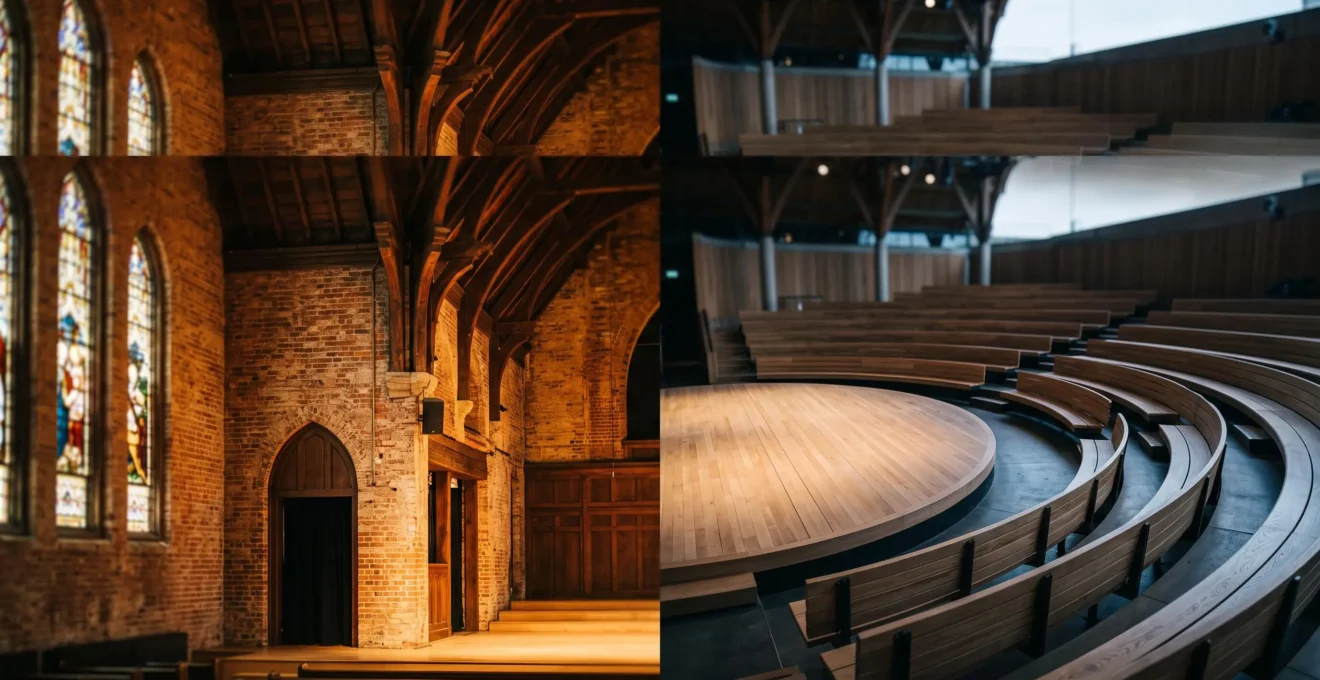
Choosing between the Ryman and the Opry House isn’t about which is “better”—it’s about deciding which chapter of country music’s living history you want to experience firsthand.
- The Ryman Auditorium offers an intimate, almost spiritual connection to the past in the genre’s most sacred space, complete with its original wooden pews.
- The Grand Ole Opry House provides a comfortable, modern, and grand-scale celebration of country music, designed for the perfect broadcast experience.
Recommendation: First-time visitors seeking the full, spectacular scope of the modern Grand Ole Opry show should choose the Opry House. Devotees seeking a historical pilgrimage should choose the Ryman.
For any true country music fan, a trip to Nashville is a pilgrimage. Standing at the crossroads of this journey is a defining choice: do you see a show at the historic Ryman Auditorium, the “Mother Church of Country Music,” or at the modern Grand Ole Opry House, its current and grand-scale home? The internet is full of simple advice, often boiling it down to “the Ryman has history, the Opry House has comfy seats.” But this misses the entire point. This decision goes far deeper than acoustics or architecture.
The confusion is understandable because the Grand Ole Opry is not a place; it’s a show. A living, breathing piece of American history that has had several homes. To make the right choice, you must look past the surface-level comparisons. The real question isn’t about which venue is superior, but about which experience your heart is truly seeking. Are you here to witness a piece of preserved history, feeling the ghosts of legends past in a sacred space? Or are you here to experience the vibrant, polished, and spectacular broadcast that the Opry has become today?
This guide moves beyond the platitudes. We will explore the soul of each venue, examining everything from the seats you’ll sit in to the very structure of the show itself. By understanding the “why” behind each venue’s unique character, you can align your expectations with the experience and ensure your Nashville pilgrimage is everything you dreamed it would be.
To help you make this crucial decision, this article breaks down the distinct character and practical realities of each experience. The following sections will guide you through the traditions, comforts, and unique moments that define a night at either of these legendary venues.
Summary: Ryman Auditorium or Opry House: Where Should You See Country Legends?
- Why Is the Show Interrupted by Live Commercials?
- Backstage Tour: Is It the Only Way to See the Themed Dressing Rooms?
- Jean or Evening Gown: What Is the Dress Code of the Church of Country?
- The Mistake of Choosing the Ryman’s Original Wooden Pews If You Have Back Pain
- Resellers or Official Site: How to Avoid Fake Tickets for Sold-Out Nights?
- Orchestra or Mezzanine: Which Place Offers the Best View for a Country Show?
- No TV Nor AC: Why Historic Charm Implies Less Comfort?
- Is Taking a Tour of RCA Studio B Essential for Music Lovers?
Why Is the Show Interrupted by Live Commercials?
One of the most unique and sometimes surprising elements of the Grand Ole Opry is the presence of live, on-stage commercials read by the show’s announcers between acts. For a first-time visitor, this can feel like an odd interruption. But for the historian, it’s one of the most authentic parts of the experience. This isn’t a modern addition to generate revenue; it’s the very foundation of the show. The Opry is, and always has been, America’s longest-running live radio broadcast. The commercials aren’t an interruption of the show; they *are* the show.
The tradition goes back to its very beginning. The program was created in 1925 as a radio show to advertise insurance policies for the National Life and Accident Insurance Company. It was originally called the WSM Barn Dance. The name “Grand Ole Opry” itself was an impromptu creation by announcer George D. Hay, who, following an hour of grand opera music on the network, famously ad-libbed the transition.
For the past hour we have been listening to music taken largely from Grand Opera. From now on we will present the ‘Grand Ole Opry.’
– George D. Hay, Britannica – Grand Ole Opry
Today, you’ll hear sponsors ranging from Dollar General to a local Tennessee supermarket. Seeing these ads delivered live on stage is to witness the Opry’s unbroken ritual. It connects your experience directly to the millions who have listened on the radio for nearly a century. It’s a charming, living piece of broadcast history that separates the Opry from any other concert you will ever attend.
Backstage Tour: Is It the Only Way to See the Themed Dressing Rooms?
Yes, taking an official backstage tour is the primary and most rewarding way for the public to see the famous themed dressing rooms, walk across the stage, and stand in the sacred circle. While a show ticket gets you into the audience, the tour is what lets you step through the looking glass and see the working heart of the Opry. It transforms you from a spectator into an insider, offering a tangible connection to the legends who have walked those halls.
The Grand Ole Opry House offers several distinct tour experiences, each providing a different lens through which to view its history. You aren’t just getting a single, one-size-fits-all tour. You can choose the experience that best fits your level of interest and schedule. These generally include:
- Daytime Backstage Tour: Explore the dressing rooms, artist entrance, and stage in a calm, historical setting.
- Post-Show Backstage Tour: Step behind the curtain right after the final bows for a livelier, working-venue energy.
- Ladies of Country Tour: A themed daytime experience celebrating the women who shaped the genre.
- VIP Tour: An intimate small-group experience with access to archival footage and rarely-opened dressing rooms.
These tours are more than just a walk-through; they are a curated narrative experience designed to immerse you in the Opry’s legacy.
Case Study: What Visitors Experience on the Guided Backstage Tour
The standard guided tour is a well-oiled machine of storytelling. According to visitor accounts, the journey typically begins with an immersive video narrated by Garth Brooks and Trisha Yearwood, setting the stage for the Opry’s significance. From there, guides lead you through a series of 18 uniquely themed dressing rooms, each celebrating a different facet of country music history. The emotional highlight for many is the chance to step into the famed wooden “Circle” on center stage—the very spot where every Opry legend has performed.
Jean or Evening Gown: What Is the Dress Code of the Church of Country?
The question of what to wear to the Grand Ole Opry is common, precisely because it holds such a revered place in music culture. The simple answer is that there is no official dress code. However, the *right* answer is to dress for the experience you want to have. You are visiting a place that is, for many, a sacred space. While you will not be turned away for wearing jeans and a t-shirt, putting a little thought into your attire is a sign of respect for the institution and enhances your own sense of occasion.
On any given night, you’ll see a wide spectrum of styles. A firsthand account from The Gifted Gabber estimates that about three-quarters of the crowd dresses casually, while the remaining quarter opts for more dressed-up “Sunday best” attire. This mix is part of the Opry’s charm—it’s a show for everyone. As one Nashville visitor FAQ puts it:
There is no particular dress code at the Grand Ole Opry. You’ll see everything from faded jeans to business suits, cowboy hats to your Sunday best.
– Nashville visitor FAQ, Cambria Nashville Airport – Grand Ole Opry FAQ
The best approach is to aim for “smart casual” or what some call “country-adjacent.” You don’t need a costume, but elevating your look beyond basic tourist wear is a great idea. Consider these tips for a comfortable yet respectful outfit:
- Choose dark or medium-wash jeans for a more put-together look than distressed or light-wash denim.
- Cowboy boots are popular but not required; any clean, comfortable footwear like loafers or nice flats works perfectly.
- For men, a button-down shirt paired with dark jeans or chinos is a classic, can’t-miss combination.
- Avoid the extremes: skip both overly formal gowns and athletic wear, shorts, or flip-flops.
The Mistake of Choosing the Ryman’s Original Wooden Pews If You Have Back Pain
Choosing to see a show at the Ryman Auditorium is to choose authenticity over comfort. The venue’s most iconic and historically significant features are its original, curved wooden pews, dating back to its days as the Union Gospel Tabernacle in 1892. Sitting on them is to share a physical space with generations of music lovers and legends. But from a practical standpoint, it is crucial to understand: they are hard, narrow, and unforgiving. For a two-hour show, this can be a significant challenge for anyone with back issues or who simply values modern ergonomic comfort.
This is the central paradox of the Ryman experience. Its magic is inextricably linked to its historical preservation, which includes these pews. The venue itself celebrates this connection, understanding that the physical setting is key to its spiritual atmosphere.
As the Ryman’s own tour description suggests, the pews are part of the transcendent experience:
Slide into one of the Ryman pews, take in the grandeur of the architecture, and peer through the stained glass windows. You’ll understand why this is the soul of Nashville.
– Ryman Auditorium, Ryman.com – Guided Backstage Tour
The tactile reality of the aged wood underpins the entire experience. It’s a direct, physical link to every performance that has ever graced its stage.
So, is choosing a pew a “mistake”? Not if you know what you’re getting into. It’s a mistake only if you expect the cushioned, spacious seating of a modern theater. If you prioritize historical immersion and are willing to trade comfort for an authentic connection to the past, then sitting in a Ryman pew is not a mistake—it’s the entire point. If comfort is a non-negotiable for you, the plush, theater-style seats of the Grand Ole Opry House are unequivocally the better choice.
Resellers or Official Site: How to Avoid Fake Tickets for Sold-Out Nights?
When a show at the Ryman or the Opry House is sold out, the temptation to turn to reseller sites can be overwhelming. This is where fans are most vulnerable to scams, counterfeit tickets, and exorbitant markups. As a historian of the Opry, my most passionate plea is this: protect your pilgrimage. The heartbreak of being turned away at the door with a fake ticket is an experience no fan should endure. The single most important rule is to start—and whenever possible, end—your search at the official source.
Opry Entertainment Group, which operates both venues, has an exclusive partnership with AXS as its official ticket provider. This means that the only 100% verified places to buy primary tickets are through the official websites: Ryman.com and Opry.com. Any other site is a third-party reseller. While some resellers are legitimate, they operate in a secondary market where you have fewer protections and prices are often inflated. Scammers also create copycat websites that look official, making it crucial to be vigilant.
To ensure your tickets are authentic and you’re paying a fair price, a systematic check is essential. Treat buying a ticket with the same care you’d take planning the rest of your trip.
Your Action Plan: A 5-Step Audit for Secure Ticket-Buying
- Identify Points of Contact: Always start at Opry.com or Ryman.com. Be highly skeptical of sponsored links at the top of search results, as these are often costly reseller ads designed to look like the official site.
- Inventory the Information: Legitimate sellers provide clear details. Check that the event date, time, and seating chart are professionally displayed. Vague information or a lack of a detailed seat map is a major red flag.
- Verify for Consistency: Compare the prices on the reseller site to the original prices on the official venue site if they are still visible. If a price seems drastically inflated, you’re dealing with a scalper. If it’s too good to be true, it’s likely a scam.
- Assess the Emotional Tone: Scammers use high-pressure tactics. Be wary of messages like “Only 2 tickets left!” or aggressive countdown timers. The official AXS purchasing process is calm and straightforward.
- Create an Integration Plan: Always, always use a credit card for your purchase. It offers fraud protection that debit cards, wire transfers, or cash apps do not. Once you’ve found the official site, bookmark it for future use.
Orchestra or Mezzanine: Which Place Offers the Best View for a Country Show?
At the Grand Ole Opry House, a venue celebrated for its superb design, the question isn’t about finding a “good” seat—it’s about choosing the *type* of view that best matches your desired experience. With a capacity of over 4,000 seats and top-notch acoustics, there truly isn’t a bad seat in the house. Instead, the choice between the Main Floor (Orchestra) and the Mezzanine/Balcony tiers is a choice between intimacy and perspective.
Do you want to be close enough to see the expression on an artist’s face and feel the energy radiating from the stage? Or do you want a panoramic view that lets you take in the entire spectacle—the multiple bands, the host, the iconic barn backdrop, and the audience’s reaction—all at once? Each location offers a unique and valid way to experience the magic of the Opry.
The following table breaks down the key differences to help you decide which vantage point aligns with your personal concert-going style. This decision is especially important for a first-time visitor trying to capture the full essence of the show.
| Criteria | Main Floor / Orchestra | Mezzanine / Balcony |
|---|---|---|
| Artist intimacy | Best for reading facial expressions and close interaction | More distant but still clear thanks to venue acoustics |
| Full production view | Limited peripheral view of the whole stage tableau | Best vantage point to see the host, multiple bands, and full backdrop |
| Proximity to the wooden circle | Closest physical proximity to the circle where artists perform | Better overall symbolic view of the circle within the full stage |
| Typical atmosphere | Energetic, close to the eight-plus rotating artists each show | Panoramic, ideal for first-time visitors wanting the complete picture |
For the fan seeking an intense, personal connection with the performers, the Main Floor is unparalleled. For the visitor who wants to absorb the grandeur and historical scope of the entire Opry production, the Mezzanine offers a perfect, sweeping vista. At the Ryman, the equation is simpler: due to its smaller size and vertical design, even the balcony feels remarkably close, prioritizing a feeling of shared intimacy throughout the entire hall.
No TV Nor AC: Why Historic Charm Implies Less Comfort?
To step into the Ryman Auditorium is to step back in time, and this experience comes with an implicit agreement: you accept the building on its own historical terms. While the title’s reference to “No AC” is now a part of history—the venue thankfully installed air conditioning in 1994 after a major renovation—the principle remains true. The Ryman’s charm is rooted in its preserved authenticity, which often means sacrificing modern creature comforts we take for granted.
The reason for this is simple: the Ryman is not just an old building; it is a revered artifact. In 2001, the Ryman was designated a National Historic Landmark, cementing a philosophy of preservation over modernization. This means no cup holders in the pews, no sprawling legroom, and narrower walkways. The focus is on maintaining the structural and atmospheric integrity of the building as it was during its golden era. It is treated with the reverence of a museum, one that you are miraculously allowed to sit inside for a live show.
This commitment to preservation is precisely what creates the venue’s legendary, almost spiritual, atmosphere. It is a place that has earned its nickname, “The Carnegie Hall of the South.”
Dubbed the ‘Carnegie Hall of the South,’ this iconic venue has hosted over a century of theater, dance, politics, comedy, magic, and, of course, music. Its legendary acoustics create an unmatched connection between artist and audience, with even skeptics calling it ‘spiritual.’
– Opry, Opry.com – Ryman Auditorium: The Opry’s Most Famous Former Home
The “lesser” comfort is a direct trade-off for a greater sense of connection and history. The world-renowned acoustics aren’t a product of modern science, but of old-world construction: tall ceilings, wooden materials, and curved church-like architecture.
When you choose the Ryman, you are choosing to sit in history itself. The lack of modern amenities isn’t a flaw; it’s a feature. It’s a small price to pay for the profound, unmatched experience of hearing music in a room where so many legends have stood and where the very walls seem to sing along.
Key Takeaways
- The Grand Ole Opry show’s unique format, including live commercials, is a direct and authentic link to its 1925 radio broadcast origins.
- The Ryman Auditorium offers unparalleled historical authenticity in an intimate, spiritual setting, complete with its original (and hard) wooden pews.
- The Opry House provides modern comfort, excellent views from every seat, and the best vantage point for the grand scale of the modern broadcast.
- Your choice isn’t between ‘better’ or ‘worse’; it’s about aligning your visit with a desire for either a preserved artifact (Ryman) or a modern temple to country music (Opry House).
Is Taking a Tour of RCA Studio B Essential for Music Lovers?
After you’ve experienced the live performance, whether at the hallowed Ryman or the grand Opry House, the logical next step for the true music pilgrim is to visit the place where the magic was captured. Taking a tour of Historic RCA Studio B is not just an add-on to a Nashville trip; for a deep music lover, it is an essential pilgrimage. It is the other half of the story. If the Opry is where country music lives on stage, Studio B is the sacred ground where its most iconic sounds were born and immortalized on vinyl.
From 1957 to 1977, this modest-looking building was one of the most important recording studios in the world. It was the cradle of the “Nashville Sound,” a smoother, more polished style of country music that brought the genre to a massive international audience. Over 35,000 songs were recorded here, including more than 1,000 American hits. Standing in this room is to stand where Elvis Presley recorded “Are You Lonesome Tonight?”, where Dolly Parton laid down “Jolene,” and where the Everly Brothers crafted their perfect harmonies.
Unlike a tour of a modern, working studio, a visit to Studio B is a journey into a perfectly preserved time capsule. The original recording equipment, the “x” on the floor marking the sweet spot for vocalists, and even the atmospheric lighting are all maintained to give you the feeling that a legendary session could begin at any moment.
The experience is often profoundly emotional. You don’t just see where the hits were made; you *feel* the creative energy that still lingers in the air. It connects the songs you’ve loved your whole life to a physical space, making them tangible. So, is it essential? If you are merely a casual concert-goer, perhaps not. But if you consider yourself a true lover of music and its history, then missing Studio B is like visiting Egypt and skipping the pyramids. It completes the narrative of your Nashville journey.
Your journey into the heart of country music, whether it unfolds beneath the stained glass of the Ryman or in the grand theater of the Opry House, is a personal one. The next step is to take this knowledge and book the experience that speaks to your soul, ensuring your Nashville story is one you’ll tell for a lifetime.