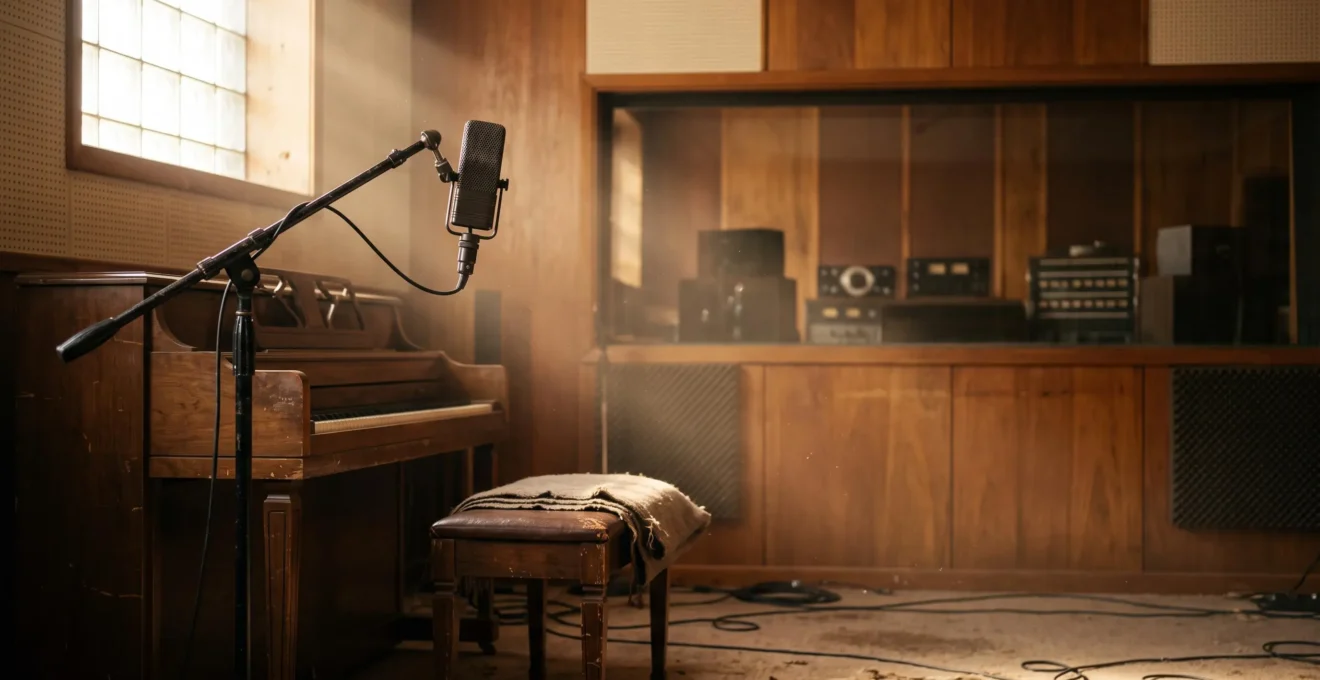
Visiting RCA Studio B is more than a nostalgic tour—it’s the key to understanding how music is made, not just performed.
- The real work happens on Music Row, a B2B creative district, not the B2C entertainment strip of Broadway.
- The studio’s physical architecture was an instrument in itself, deliberately engineered to create the iconic “Nashville Sound.”
Recommendation: Treat the tour as a technical lesson in audio history to truly grasp Nashville’s creative engine, rather than just a photo op.
The moment you step into Nashville, the sound hits you. From every open door on Broadway, a blast of live music spills onto the street, a vibrant, chaotic symphony of cover bands and aspiring stars. This is the Nashville the world knows: a neon-lit playground of honky-tonks, cowboy boots, and non-stop entertainment. For many music lovers, this is the entire point of the pilgrimage. They come to hear music, and the city delivers it in overwhelming abundance. The assumption is that this concentration of performance is the heart of “Music City.”
But what if the true engine of Nashville’s musical legacy isn’t on the stage, but in quiet, unassuming buildings a mile away? This is the fundamental distinction a true music aficionado must grasp. The city operates on two parallel tracks: the spectacle of performance and the business of creation. While Broadway is the storefront (B2C), Music Row is the factory (B2B). A tour of RCA Studio B is not just another tourist stop; it is a rare, authorized glimpse behind the curtain into the factory itself. It provides the essential context to understand that the “Nashville Sound” was not an accident of culture but a feat of engineering, business strategy, and architecture.
This guide will deconstruct the mythology. We will explore the functional geography of Nashville’s music industry, dissect the sounds that were born here, and provide the framework to experience the city not as a tourist, but as an informed insider. Understanding the ‘why’ behind RCA Studio B transforms a simple visit into a profound lesson on how an entire genre was built, recorded, and sold to the world.
This article provides an insider’s look at the machinery of Music City, from the creative hubs where hits are born to the historical forces that shaped its complex sound. The following sections will guide you through the city’s most vital, and often misunderstood, musical landmarks.
Summary: A Producer’s Deep Dive into Nashville’s Music Engine
- Music Row vs Broadway : why the real studios are not where the bars are ?
- Where to listen to “Writers Rounds” to hear the hits before they are famous ?
- Hatch Show Print : why is this print shop a legendary institution ?
- The error of knocking on the door of an active recording studio
- Countrypolitan vs Outlaw : how the sound of the city evolved in the 70s ?
- Memphis, Nashville or New Orleans : which order for a historical logic ?
- Green or blue : how colored backgrounds are replacing physical sets ?
- How to Navigate the Deep South’s Complex History on a Cultural Tour?
Music Row vs Broadway : why the real studios are not where the bars are ?
The most common mistake visitors make in Nashville is confusing the product with the production line. Broadway is the city’s vibrant, consumer-facing storefront, a non-stop party designed for entertainment and consumption (B2C). Music Row, conversely, is a quiet, almost deceptively corporate district of offices and unassuming buildings. This is the industry’s engine room, a B2B ecosystem dedicated to the creation, publishing, and business of music. You don’t come here to party; you come here to work.
The district’s layout isn’t accidental. It began in the 1950s when producers like Owen Bradley established the first commercial studio in a Quonset Hut on 16th Avenue South. Others quickly followed, drawn by affordable real estate and the need for proximity. A songwriter could write a song, walk it to a publisher like Cedarwood, get it recorded at a studio like RCA, and have it pitched to a label, all within a few blocks. This tight-knit geographical cluster was essential for the industry’s efficiency. As one historical account notes, these key locations formed the original triangle of Music Row’s creative core, a physical network that fueled the city’s growth.
This table illustrates the fundamental difference in function and atmosphere between the two areas, a critical distinction for any visitor wanting to understand the city’s true nature.
| Aspect | Music Row | Broadway |
|---|---|---|
| Primary Function | Creation, publishing, and business (B2B) | Live performance and consumption (B2C) |
| Typical Sound | Studio-produced recordings, session work | Live cover bands, honky-tonk sets |
| Typical Audience | Industry insiders, songwriters, students | Tourists, nightlife visitors |
| Atmosphere | Quiet, office-like working district | Loud, festive, neon-lit strip |
Understanding this separation is the first step to seeing Nashville as a producer does. Broadway is where the finished product is celebrated, but Music Row is where the raw material of songs and sounds is painstakingly crafted and monetized. They are two different worlds, operating under entirely different rules.
Where to listen to “Writers Rounds” to hear the hits before they are famous ?
While Broadway’s bands play the hits you know, the real magic for a music insider is hearing a hit *before* it becomes one. This is the unique experience offered by Nashville’s “writers rounds.” These are not typical concerts. They are intimate, often acoustic, showcases where the songwriters themselves perform their original work and, most importantly, tell the stories behind the songs. Venues like The Bluebird Cafe or The Listening Room are revered as quasi-sacred spaces for this tradition. They are the music industry’s equivalent of a research and development lab, where new material is tested in front of a live, attentive audience.
The format, typically three or four songwriters on stage together taking turns, fosters a collaborative and supportive environment. As Bluebird Cafe’s GM Erika Wollam Nichols explained, “It is a room that is really built for very obvious feedback.” This feedback, from both the audience and fellow writers, is a crucial part of the creative process. For a music lover, it’s a chance to witness a song in its purest form, stripped of studio production, and delivered by the person who conceived it. You might hear a song that, six months later, will be a number-one hit for a major country star.
For aspiring songwriters, these nights are more than just a performance; they are a career pathway. The Bluebird, for example, has a structured system where writers who perform well at open-mic nights can graduate to “spotlight” shows, a built-in ladder that has launched countless careers. To experience this authentic slice of Nashville, however, requires following a certain etiquette that is starkly different from a noisy bar on Broadway.
Your Action Plan: Experience a Nashville Writers Round Like a Local
- Book in Advance: Reservations for famous “in-the-round” shows often open online early in the week and sell out in minutes. Plan accordingly.
- Try for Spontaneous Entry: For a last-minute visit, aim for Sunday open-mic nights, which often use a lottery system instead of reservations.
- Respect the Listening Policy: Silence is mandatory during performances. Talking is the quickest way to get asked to leave; this is a concert, not background music.
- Sit Close if Possible: The core of the experience is hearing the songwriter explain the story behind the song from just a few feet away.
- Explore Beyond the Famous Rooms: Look for writers’ nights at smaller, less-touristy venues to find a more intimate version of the same tradition.
Attending a writers round is to witness the very first step in a song’s journey. It’s an exercise in deep listening and a direct connection to the city’s creative soul, far removed from the commercial spectacle of the main tourist drag.
Hatch Show Print : why is this print shop a legendary institution ?
In a city defined by sound, one of its most iconic institutions is surprisingly visual and tactile. Hatch Show Print is more than just a print shop; it is a living museum of graphic design and a chronicler of American entertainment history. Having been operating continuously since 1879, its distinct letterpress style has become as synonymous with country music as the sound of a pedal steel guitar. The posters they created for artists from Johnny Cash and Elvis Presley to modern acts are not just advertisements; they are cultural artifacts.
The shop’s enduring legacy comes from its steadfast commitment to its original craft. In an era of digital everything, Hatch still uses hand-carved wood and metal blocks and old-school presses to create its work. This dedication to a physical, imperfect process gives their posters a texture and character that cannot be replicated on a screen. Each print has a tangible quality, a direct connection to the hands and machinery that made it. This philosophy of “preservation through production” means the craft isn’t just displayed in a glass case; it’s actively practiced and passed down.
As the close-up of a printing block shows, the beauty is in the grain of the wood, the layers of dried ink, and the subtle imperfections of the carved surface. This is the physical DNA of a century of music promotion. For a music producer, Hatch represents a parallel art form: the visual branding of sound. The bold typography and simple, powerful imagery had to convey the energy of a live performance in a single glance. It’s a masterclass in impactful, low-tech communication.
Visiting the shop, now located inside the Country Music Hall of Fame and Museum, offers a chance to see the presses in action and even take a tour to make your own print. It’s a crucial stop for understanding that the music industry has always relied on a powerful visual culture to sell its sound. It’s a tangible link to the entire history of American show business, one ink-stained poster at a time.
The error of knocking on the door of an active recording studio
Walking through the quiet streets of Music Row, it can be tempting for a passionate music fan to want to get closer to the magic. You might see a plaque for a famous publisher or a discreet sign for a legendary recording studio and feel the urge to knock on the door, hoping for a glimpse inside. This is a significant mistake. As the official tourism guide notes, one should “Expect a quiet, working district rather than a tourist strip.” These buildings are not public attractions; they are active workplaces where artists and producers are on the clock, often engaged in expensive and highly focused recording sessions.
Interrupting a session is more than a minor annoyance; it’s a breach of professional etiquette and can be costly. The “red light” outside a studio door means a take is in progress, and any external noise could ruin a potentially perfect performance. The environment inside is one of intense concentration, and unsolicited visitors are not welcome. These are secure, private facilities where creative and business transactions are happening, not public museums.
This is precisely what makes the RCA Studio B tour so essential and unique. It solves the fan’s dilemma by offering a legitimate, respectful way to experience one of these historic creative spaces. Unlike the other studios on the Row that remain private, Studio B has been preserved as a time capsule. It is no longer an active commercial studio but a historical exhibit managed by the Country Music Hall of Fame. The guided tour is the *only* way to enter.
By taking the tour, you get to stand in the exact spots where Elvis Presley, Dolly Parton, and Waylon Jennings recorded their masterpieces. You can see the original equipment, feel the room’s unique acoustics, and learn about the recording techniques used, all without the risk of disrupting a paid session. It is the perfect compromise: it grants access to a legendary space while respecting the professional boundaries of the still-active studios just down the street.
Countrypolitan vs Outlaw : how the sound of the city evolved in the 70s ?
The tour of RCA Studio B is not just a walk through a historic building; it’s an auditory lesson in the evolution of country music. The studio was the epicenter for the creation of the “Nashville Sound,” later dubbed Countrypolitan. This was not an organic folk movement; it was a deliberately engineered product. In the late 1950s and 60s, producers like Chet Atkins and Owen Bradley sought to make country music more palatable to a mainstream, pop audience. They smoothed out the rough edges of traditional honky-tonk music, replacing fiddles and steel guitars with lush string arrangements, smooth background vocals, and polished production. RCA Studio B, with its controlled acoustics, quickly became a cornerstone for producing this polished “Nashville Sound”.
This slick, commercially successful style dominated the charts for years. It was the sound of artists like Patsy Cline and Jim Reeves. However, by the early 1970s, a new generation of artists began to rebel against this polished, formulaic approach. Figures like Waylon Jennings, Willie Nelson, and Kris Kristofferson felt the Nashville establishment was stifling their creative freedom. This rebellion gave birth to the Outlaw country movement.
The Outlaws rejected the studio-controlled system of Music Row. They fought for creative control over their own records, using their own bands instead of session musicians and embracing a rawer, more rock-influenced sound that was closer to their live performances. It was a direct artistic and philosophical challenge to the slick production values of Countrypolitan. This tension between the polished, establishment-approved “Nashville Sound” and the raw, artist-driven “Outlaw” movement defined the city’s music scene in the 1970s. The history of the studios reflect the rise and evolution of Nashville’s country music industry from the 1950s to the 1980s, encapsulating this very conflict.
Visiting Studio B allows you to stand in the very room where the “establishment” sound was perfected. It provides the crucial context for understanding what the Outlaws were fighting against, making their rebellion all the more significant. It’s a story of sonic conformity and the fierce independence that rose to challenge it.
Memphis, Nashville or New Orleans : which order for a historical logic ?
For the music lover planning a pilgrimage through the American South, the question of itinerary is not just about geography; it’s about narrative. To trace the story of American popular music in a historically logical way, a specific route emerges: starting in New Orleans, moving up to Memphis, and finishing in Nashville. This journey follows the music’s chronological and influential flow, from its foundational roots to its commercial industrialization.
1. New Orleans: The Birthplace. The journey begins in the cradle of jazz. The multicultural melting pot of New Orleans at the turn of the 20th century gave birth to the foundational elements of so much of what was to come: blues, ragtime, and improvisation. Experiencing the city’s musical heritage in places like the French Quarter and Preservation Hall provides the essential “source code” for the rest of the trip.
2. Memphis: The Electrification and Fusion. Following the Mississippi River north leads to Memphis, the city that took the raw, acoustic blues of the Delta and plugged it in. This is where rock ‘n’ roll was born at Sun Studio and where soul music found its gritty, powerful voice at Stax Records. Memphis represents the crucial adolescent phase of American music—raw, rebellious, and racially integrated in a way that was revolutionary for its time.
3. Nashville: The Industrialization and Polish. The final leg of the journey leads to Nashville, where country music was refined into a commercial powerhouse. As we’ve seen, this is where the “Nashville Sound” was engineered and where songwriting became a structured profession on Music Row. Nashville represents the maturation and professionalization of music into a streamlined industry. Following a travel narrative that links these cities creates a full arc—from the birth of jazz, through the electrification of the blues, to the industrialization of country music.
This New Orleans-Memphis-Nashville route allows a traveler to experience the evolution of American music as a cohesive story. You start with the soulful origins, witness the explosive energy of its teenage years, and conclude with its transformation into a polished, global business.
Green or blue : how colored backgrounds are replacing physical sets ?
In modern music production, a green or blue screen is a digital blank slate. It allows a producer to create any world they can imagine, dropping an artist into a fantastical landscape or a minimalist void. This technology offers infinite flexibility, but it also represents a fundamental shift away from the principles that built places like RCA Studio B. In the analog era, the recording studio wasn’t a blank slate; it was a physical set whose properties were an integral part of the sound. The room itself was an instrument.
The concept of acoustic architecture was paramount. The dimensions of the room, the materials on the walls (wood, plaster, baffles), and the height of the ceiling were all meticulously chosen to control how sound waves behaved. As an architectural history of the studio notes, RCA Studio B and its adjoining Studio A were purpose-built structures, physically enlarged over time, whose physical characteristics directly shaped the acoustic character of every recording. The natural reverberation of the main tracking room, the isolation of the vocal booth—these were not afterthoughts added with a plugin. They were built-in features of the physical space.
This symbolic image captures the contrast perfectly. On one side, the warm, tactile reality of an analog studio with its wood paneling and physical gear; on the other, the smooth, infinite potential of the digital void. The vintage microphone stands at the boundary, a tool common to both worlds but used in vastly different contexts. When Elvis Presley sang into a microphone at Studio B, his voice was interacting with the real-time physics of the room. The “slapback” echo on his early records wasn’t just an effect; it was the sound of his voice bouncing off the studio walls and being re-captured by the microphone fractions of a second later.
A tour of Studio B is a tangible lesson in this lost art. You learn how producers would physically move musicians around the room to change the sonic balance, using distance and placement instead of a fader on a console. It demonstrates that before digital flexibility, there was architectural intent. The building wasn’t just a container for the music; it was a participant in its creation.
Key takeaways
- The geography of Nashville’s music scene is split: Music Row is the B2B district for creation, while Broadway is the B2C strip for performance.
- The “Nashville Sound” (Countrypolitan) was not an accident but an engineered product, created in studios like RCA Studio B to appeal to a pop audience.
- A tour of RCA Studio B is less a fan pilgrimage and more a crucial lesson in the history of audio technology and acoustic architecture.
How to Navigate the Deep South’s Complex History on a Cultural Tour?
A musical tour through the Deep South is inevitably a journey through its complex and often painful history, particularly concerning race. To appreciate the music fully, one must engage with the social context from which it emerged. Ignoring this is to get only half the story. Nashville, while known as the capital of country music—a genre historically dominated by white artists—also has a deep and vital history of Black music that is essential to understand.
While Music Row was building its empire, Jefferson Street was Nashville’s thriving hub for R&B, jazz, and blues. This was where legends like Little Richard, Jimi Hendrix, and Etta James cut their teeth in vibrant clubs, creating a parallel music scene that offered a crucial counter-narrative to the country-centric story. The National Museum of African American Music in downtown Nashville is a vital starting point for exploring this rich heritage.
Further, the story of southern music is intertwined with the Civil Rights Movement. Stax Records in Memphis is a powerful example. As the home of artists like Otis Redding and Sam & Dave, Stax was a beacon of integration in a deeply segregated city. As the museum’s Executive Director Jeff Kollath stated, the label “provided a company culture that was inclusive and where people of all races and genders worked together like family.” The Stax Museum is now one of a total of 14 Tennessee stops on the U.S. Civil Rights Trail, cementing its importance not just in music, but in American history.
Navigating this history as a visitor requires a conscious effort to seek out these multiple narratives. It means complementing a visit to the Country Music Hall of Fame with time at the NMAAM. It means understanding that the polished sound of Music Row existed alongside the raw soul of Stax and the vibrant R&B of Jefferson Street. A truly meaningful cultural tour is not about seeing one-dimensional landmarks; it’s about understanding the tensions, collaborations, and social forces that produced this incredible, multifaceted soundtrack.
To truly understand Nashville, your next step is to plan a visit that consciously explores both the polished history of Music Row and the vital, complex narratives that surround it.