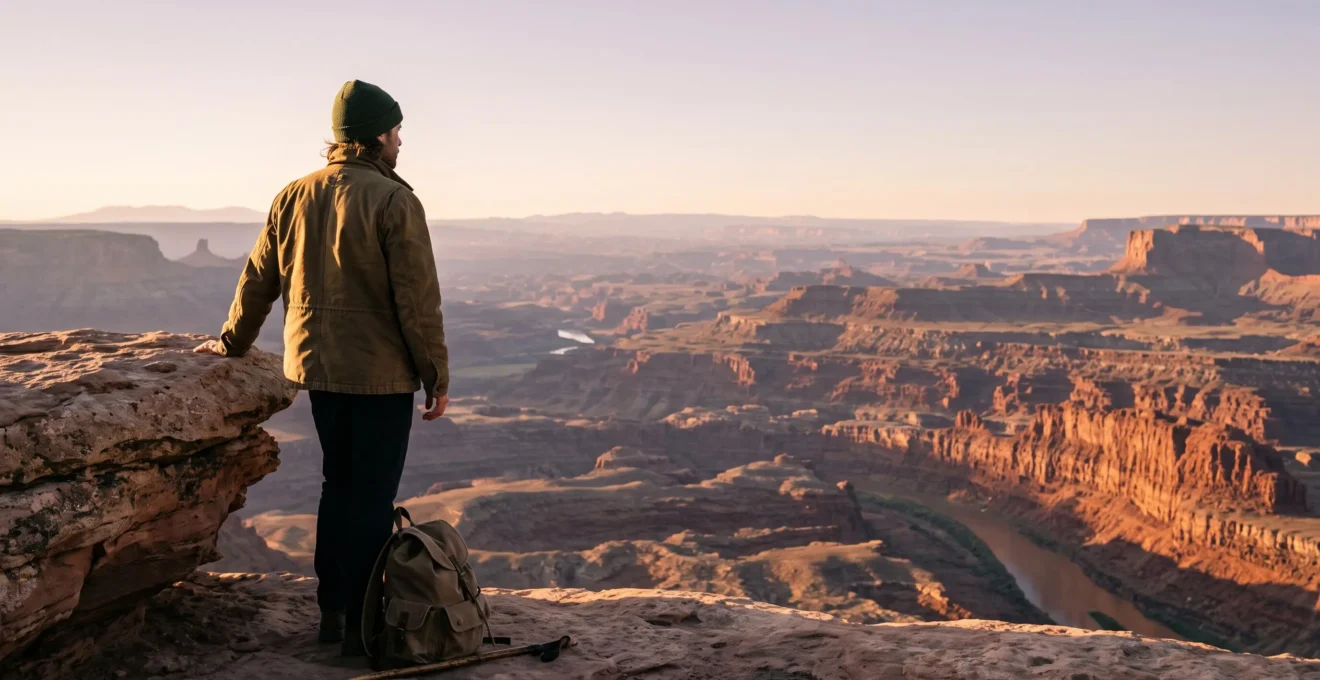
Choosing between the South and North Rim isn’t about finding a ‘better’ side; it’s about deciding on your desired relationship with the Canyon: convenient observation or remote immersion.
- The South Rim is the default for most, hosting 90% of visitors with its year-round access and extensive historic infrastructure.
- The North Rim offers a quieter, wilder experience defined by its higher elevation, dense forests, and a short season that demands a more deliberate journey.
Recommendation: Use this guide to match your personal travel philosophy—not just your schedule—to the right side of this natural wonder.
Planning a trip to the Grand Canyon can feel as vast and overwhelming as the canyon itself. The first, most fundamental question you’ll face is: South Rim or North Rim? For the undecided planner, the internet offers a deluge of facts about accessibility, viewpoints, and lodging, often making the choice even more difficult. You’ll read that the South Rim is crowded and the North Rim is remote, but this barely scratches the surface of their profound differences.
The decision transcends simple logistics. It’s about defining the kind of experience you want. Do you envision a trip filled with iconic vistas easily reached, historic lodges, and a full suite of services? Or are you seeking a quieter, more contemplative journey where the effort to get there is part of the reward? This guide moves beyond a simple checklist of features. It delves into the “why” behind each rim’s unique character—its experiential DNA—shaped by a century of history, geography, and infrastructure.
By understanding not just *what* is different, but *why* it’s different, you can make a choice that aligns with your personal travel style. This isn’t about picking the “better” rim; it’s about discovering which side of the Grand Canyon is the right fit for you.
Summary: Choosing Your Grand Canyon: A Guide to the South and North Rims
- Why is the South Rim crowded while the North Rim stays wild?
- Grand Canyon West and Skywalk: why this is not the national park official?
- How to book a room at Phantom Ranch without winning the lottery?
- The error of trying to go back and forth to the river in one day
- When does the North Rim close for the winter?
- No TV or air conditioning: why historic charm means less comfort?
- California Zephyr: why does this train offer views that the car does not allow?
- How to Secure a Room at a National Park Lodge (and What to Expect)?
Why is the South Rim crowded while the North Rim stays wild?
The disparity in visitor numbers is staggering: a park spokesperson will tell you that roughly 90% of the park’s annual visitors funnel through the South Rim, leaving just 10% to experience the North Rim. This isn’t an accident of nature, but a direct result of “infrastructure as destiny.” The South Rim is significantly easier to access from major highways (I-40) and cities like Phoenix and Las Vegas, and it remains open 365 days a year. The North Rim, by contrast, sits at a higher elevation, receives heavy winter snow, and is a much longer, more deliberate journey from any major metropolitan area. The two rims are only about 10 miles apart as the raven flies, but the drive between them is a 215-mile, 4.5-hour journey.
This modern reality was cemented over a century ago. When the Santa Fe Railway completed its line to Grand Canyon Village in 1901, it transformed a difficult stagecoach journey into an accessible tourist destination. The railway and its partner, the Fred Harvey Company, built the iconic lodges, restaurants, and infrastructure that define the South Rim to this day. This gave the South Rim a hundred-year head start in developing for mass tourism, creating a legacy of convenience and accessibility that the remote, harder-to-reach North Rim never sought to replicate.
The result is two fundamentally different experiences. The South Rim is a well-oiled machine designed for observing the Canyon’s grandeur with maximum convenience. The North Rim is a destination that demands intention, rewarding visitors with a profound sense of solitude and wildness. Its relative inconvenience is not a flaw, but its defining feature. To choose the North Rim is to choose a more participatory relationship with the park, where the journey is as much a part of the experience as the destination itself.
Grand Canyon West and Skywalk: why this is not the national park official?
Many visitors, particularly those coming from Las Vegas, are often confused by Grand Canyon West and its famous glass bridge, the Skywalk. It’s crucial to understand that Grand Canyon West is not part of Grand Canyon National Park. It is a separate tourist destination located on the sovereign land of the Hualapai Tribe. As their official site explains, it is “A sovereign Indian nation that does not receive federal funding.” This distinction is the root of all the practical differences a visitor will encounter.
Because it’s not a national park, your “America the Beautiful” pass or any other National Park Service (NPS) pass is not valid here. Grand Canyon West operates with its own ticketing system, fee structure, and rules. For example, personal cameras and phones are not permitted on the Skywalk itself; you must purchase photos from their official photographers. The experience is more structured and commercial, centered around specific attractions like the Skywalk, a zip line, and helicopter tours.
The views are undeniably dramatic, looking into the western part of the Canyon, but they differ from the classic, expansive vistas of the national park’s North and South Rims. The following table breaks down the essential differences in access and cost, illustrating why it’s important to know which “Grand Canyon” you’re planning to visit.
| Access Point | Ticket / Pass | Approx. Price | What’s Included |
|---|---|---|---|
| Grand Canyon National Park (South/North Rim) | America the Beautiful / Park Entrance Pass | $35 per vehicle | Access to all rim viewpoints, shuttle system, ranger programs |
| Grand Canyon West | General Admission | From $51 per person | Shuttle to viewpoints, does not include Skywalk |
| Grand Canyon West | All-Access Pass | $99 per person | Skywalk, shuttle to all points, Hualapai tours/exhibits, arcade, dining and merchandise discounts |
How to book a room at Phantom Ranch without winning the lottery?
Securing a reservation at Phantom Ranch, the historic oasis nestled on the floor of the Grand Canyon, is one of the most coveted prizes in the National Park system. The primary method is a lottery held 15 months in advance, and with demand far exceeding the limited supply of cabins and dorm beds, most attempts end in disappointment. However, failing to win the lottery doesn’t mean you’re completely out of luck. The key is to understand the system and play the cancellation game with persistence.
Many confirmed reservations are canceled, and this is your window of opportunity. The concessioner, Xanterra, has a strict policy where cancellations must be made well in advance to secure a refund. This creates predictable moments when rooms suddenly become available online. According to Sam Langner, a Xanterra spokesperson quoted by Outside Online, “Finding a last-minute reservation happens all the time.” The secret is knowing when and where to look. It requires dedication, but many hikers successfully snag a spot by being diligent.
Don’t give up after the lottery results. By bookmarking the reservation page and checking it frequently, especially around key cancellation dates, you can turn someone else’s change of plans into your dream trip. This proactive approach transforms the process from a game of pure chance to one of strategy and persistence.
Your Action Plan: Snagging a Last-Minute Phantom Ranch Reservation
- Enter the Lottery: Your first step is always to enter the Phantom Ranch lottery approximately 15 months before your desired stay. Winners are notified the following month.
- Check for Unclaimed Inventory: Bookmark the general reservation page on the Xanterra website and check it regularly. Any unclaimed lottery inventory is released to the public 13 months before the stay month.
- Target the Cancellation Window: The most crucial time to check is the 45-day mark before your target date. Under Xanterra’s 45-day cancellation policy, guests on the fence tend to cancel right around this window to avoid losing their deposit.
- Try the Day-Before Waitlist: As a final resort, if you are already at the South Rim, inquire in person about the day-before waiting list at the Bright Angel Lodge transportation desk.
The error of trying to go back and forth to the river in one day
It is, without question, the most dangerous mistake a visitor can make at the Grand Canyon. Lured by the seemingly easy downhill path and the cool morning air, ambitious hikers often attempt to trek from the rim to the Colorado River and back in a single day. The National Park Service strongly and repeatedly advises against this. The statistics are sobering: more than 250 people are rescued from the canyon each year, many of them from exhaustion and heat-related illness after underestimating the return journey.
The core of the problem is a deceptive illusion. The hike down feels deceptively easy. What takes you two hours to descend can easily take four or five hours to ascend. As you lose elevation, the temperature rises dramatically—it can be 20-30°F (11-17°C) hotter at the bottom of the canyon than at the rim. The pleasant morning hike down becomes a brutal, sun-exposed climb out during the hottest part of the day. There is little shade, and the dry air dehydrates the body with alarming speed. For every one step down, you must take one grueling step back up, fighting gravity and fatigue.
Park rangers have a simple rule of thumb: plan on your hike out taking twice as long as your hike in. The best way to experience the inner canyon is to plan for it with an overnight stay, either by camping (with a permit) or by securing a coveted spot at Phantom Ranch. For day hikers, the NPS recommends a “turnaround time.” A good guideline for summer hiking is to be heading back up by 10 a.m. at the latest, regardless of how far you’ve gone. Your goal is not the river; your goal is to return to the rim safely.
When does the North Rim close for the winter?
Unlike the South Rim, which is open year-round, the North Rim has a very short and distinct operating season. Due to its higher elevation (over 8,000 feet), it receives heavy snowfall and is inaccessible during the winter months. The National Park Service has a firm schedule for its facilities: in a typical year, the North Rim is open only from May 15 to October 15. All lodging, restaurants, and visitor services, including the campground and the Grand Canyon Lodge, shut down on or around October 15.
After October 15, the park enters a transitional phase. While the lodge and other businesses close, the entrance gate may remain open for day use until the first significant snowfall, which usually occurs by late October or early November. Once Highway 67 is closed by the Arizona Department of Transportation for the winter, all vehicle access to the North Rim ceases until the following spring. It’s not uncommon for the road to be impassable from November all the way through to the following May.
This seasonal limitation is the single most important factor when planning a North Rim visit. You have a five-month window, and that’s it. This compressed season concentrates demand, and lodging often books up a year in advance as soon as reservations become available. If your travel plans fall outside of the May-to-October window, your only option for visiting Grand Canyon National Park will be the South Rim.
No TV or air conditioning: why historic charm means less comfort?
Staying in a historic lodge on the rim of the Grand Canyon is an experience steeped in atmosphere and nostalgia. Properties like El Tovar, Bright Angel Lodge, and the Grand Canyon Lodge on the North Rim are destinations in themselves. However, visitors expecting the amenities of a modern hotel chain are often surprised. The reality is that “historic charm” is often a trade-off for modern comfort. Most of these rooms lack televisions and, most critically in the summer, air conditioning.
This isn’t an oversight; it’s a feature of their history. When the El Tovar Hotel opened to the public on January 14, 1905, it was the pinnacle of luxury, but it was built for a different era. The focus was on the grandeur of the location, the craftsmanship of the building, and providing a rustic-yet-elegant base for experiencing the Canyon. Air conditioning was not a consideration, and the design philosophy was about immersion in the natural environment, not distraction by electronic entertainment. These lodges are preserved as part of the park’s history, and renovations that would compromise their historic fabric, like installing central air, are often not permitted.
So, what should you expect? Rooms that are clean, comfortable, but often simple and sometimes small. You can expect fans during the summer, but on a hot August afternoon, the room will be warm. You’ll find a profound sense of place, the creak of old wood floors, and the opportunity to sit on a porch and watch the light change on the canyon walls. You’re not paying for a 5-star hotel room; you’re paying for an unbeatable location and a chance to sleep inside a piece of history. For many, that trade-off is more than worth it.
California Zephyr: why does this train offer views that the car does not allow?
While famous scenic trains like Amtrak’s California Zephyr capture the romance of American rail travel through the Rockies, the Grand Canyon has its own iconic railway journey that offers a unique perspective. The Grand Canyon Railway provides a trip back in time, running from the historic town of Williams, Arizona, directly to the South Rim’s Grand Canyon Village. This heritage railroad allows passengers to see the landscape unfold in a way that simply isn’t possible from a car.
The train crosses a high-desert plateau, traversing through ponderosa pine forests and wide-open prairies. It follows a route inaccessible by car, offering unobstructed views of the San Francisco Peaks and the changing ecosystems as the elevation shifts. More importantly, it completely removes the stress of modern travel. Instead of navigating traffic, searching for parking—a significant challenge at the South Rim—and worrying about logistics, passengers can relax, listen to live music from local musicians, and hear stories about the Old West from the onboard staff. It transforms the journey into a core part of the adventure.
The railway’s historical significance is immense; it’s the very reason the South Rim became the accessible destination it is today. And its popularity endures: the heritage Grand Canyon Railway carries more than 105,000 passengers per year. As Theodore Roosevelt, a key figure in the canyon’s preservation, famously declared, it is “One great sight every American should see.” Riding the train is a nod to that history, an experience that connects you to the first wave of tourism and offers a slower, more deliberate way to arrive at one of the world’s greatest wonders.
Key takeaways
- The South Rim is accessible, crowded, and amenity-rich due to its history as a railroad destination.
- The North Rim is a remote, wild, and seasonal destination offering solitude at the cost of convenience.
- Planning is non-negotiable; lodging and activities for both rims, especially in-canyon, must be booked up to 15 months in advance.
How to Secure a Room at a National Park Lodge (and What to Expect)?
Securing lodging inside any popular national park requires a level of planning that can surprise many travelers, and the Grand Canyon is the ultimate example. Rooms at the historic lodges on the South Rim—El Tovar, Bright Angel, Kachina, Thunderbird, and Maswik—can sell out within minutes of becoming available, often a year in advance. The single lodge on the North Rim faces similarly intense demand during its short season. Success requires strategy, speed, and flexibility.
The first rule is to book directly through the official park concessioners (primarily Xanterra for the South Rim) and to know the exact moment your reservation window opens. Third-party booking sites often show no availability and can add unnecessary fees. The pressure to book is intense; for some highly sought-after experiences like mule trips, South Rim mule rides may be booked 15 months in advance and still fill up early. This illustrates the level of advance planning required across the board.
If your ideal dates are unavailable, consider a split stay. Booking one night in a prime lodge and the rest of your nights in a more available one (or in the gateway town of Tusayan) can be a successful strategy. Also, remember that these are historic properties with fixed policies. Check-in and check-out times are firm, and they are designed to accommodate the constant flow of visitors. Being prepared with a clear strategy is the only way to navigate this competitive booking environment.
Your Action Plan: Reservation Strategy for In-Park Grand Canyon Lodges
- Book Direct: Book directly through Xanterra, the approved concessioner for most in-park South Rim lodging, to get accurate availability and avoid third-party booking fees.
- Be on Time: Be online the moment your target date’s reservation window opens—availability for the most popular lodges disappears almost immediately.
- Consider a Split Stay: Increase your odds by being flexible. Consider a split stay across two lodges, such as one night at a highly sought property and additional nights at an easier-to-book one.
- Know the Rules: Plan around fixed check-in (4:00 p.m.) and check-out (11:00 a.m.) times, and remember guests must be 18 or older to check in.
Frequently asked questions about South Rim or North Rim: Which Grand Canyon Experience is Right for You?
Is the North Rim currently open to visitors?
In July 2025, the Dragon Bravo Fire destroyed approximately 70 structures, including the historic Grand Canyon Lodge, the North Rim Visitor Center, and many guest cabins, so the North Rim’s developed area remains closed to all public access for the remainder of that season.
Will the Grand Canyon Lodge and North Rim facilities reopen?
The National Park Service states that planning is underway for the recovery and rebuilding of visitor facilities, including the Grand Canyon Lodge, although the process will take time.