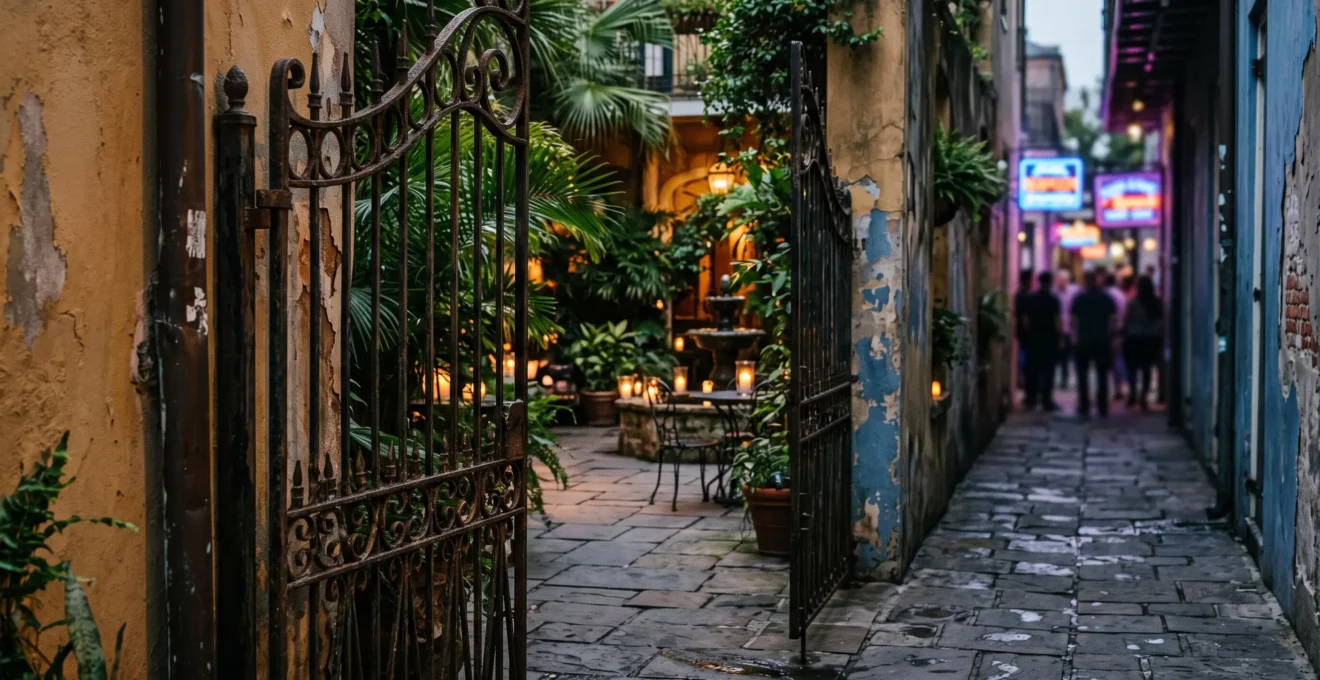
To truly experience the French Quarter, one must trade the chaotic spectacle of Bourbon Street for the subtle, historic rhythms that pulse through its quieter corners.
- Authentic jazz is found not in noisy bars, but in venues where listening is an act of reverence.
- The Quarter’s iconic ironwork tells a rich story, but only to those who know how to read its architectural language.
Recommendation: Embrace the mindset of a cultural custodian, not a consumer. Your goal is to understand the Quarter’s heritage, from its music and architecture to its social etiquette.
The first impression of the French Quarter for many is a sensory assault. The neon glow of Bourbon Street, the cacophony of competing stereos, and the sugary stickiness of the pavement can easily eclipse the neighborhood’s profound soul. For the discerning traveler, the couple seeking a connection to history and art, this version of the Vieux Carré is not just unappealing; it’s a distraction from the main event. The common advice is to simply pivot to Frenchmen Street, but this is only scratching the surface of a much deeper cultural landscape.
Escaping the chaos is not about finding a different street; it’s about adopting a different perspective. It’s about learning to see the Quarter not as a theme park, but as a living, breathing museum where every balcony has a biography and every saxophone note is a conversation with the past. The true experience lies in understanding the unspoken rules, the hidden rhythms, and the architectural DNA that define its character. It requires trading the fleeting thrill of the party for the lasting enrichment of cultural immersion.
But what if the key to unlocking this authentic experience wasn’t in a list of places to go, but in a new way of seeing, listening, and moving through these historic streets? This guide is built on that premise. It is an invitation to step beyond the role of a tourist and become a temporary custodian of the Quarter’s heritage. We will explore how to find sanctuaries of sound, read the stories etched in iron, and navigate the social currents with the grace of a local.
This article provides a curated path through the French Quarter’s most authentic experiences. Follow along as we uncover the secrets to enjoying its most cherished institutions, understanding its unique architecture, and finding tranquility amidst the vibrancy.
Summary: A Discerning Guide to the French Quarter’s Authentic Heart
- Why is Preservation Hall worth the one-hour queue?
- How to do a self-guided architectural tour of the wrought-iron balconies?
- Historic hotel or rental: what to choose to avoid street noise?
- The mistake of betting on ‘where you got your shoes’ with street scammers
- When to go to Café du Monde for beignets without waiting 45 minutes?
- The “silence rule”: in which clubs is it forbidden to whisper during the set?
- New York and the “Local Law 18”: how to know if your rental is legal?
- Blue Note or Village Vanguard: Which NYC Jazz Club Fits Your Vibe?
Why is Preservation Hall worth the one-hour queue?
In a city overflowing with live music, the idea of queuing for an hour might seem counterintuitive. Yet, Preservation Hall is not just another jazz club; it is the consecrated temple of traditional New Orleans music. The wait itself is part of the ritual, a testament to the fact that what lies inside is not background noise for a night of drinking, but a performance demanding your full attention. The venue offers intimate, acoustic concerts over 360 nights a year, featuring artists from a collective of more than 50 local masters. This isn’t a stale reenactment; it is a living, breathing art form passed down through generations.
The experience is intentionally spare. There are no cocktails, no food service, and seating is a mix of rustic benches and floor cushions. This stripping away of distractions forces a deeper connection with the music and its history. The artists who perform here are the direct inheritors of a sacred tradition. As Ben Jaffe, the Creative Director, has noted, the venue’s legacy is profound. In an interview with Heart of Louisiana, he explained the deep historical roots of the musicians:
Many of the artists who played here were contemporaries of Jelly Roll Morton and King Oliver and Sam Morgan.
– Ben Jaffe, Heart of Louisiana interview
To endure the queue is to affirm your role as a respectful audience member, not a mere consumer. The reward is an unamplified, unfiltered connection to the very soul of American music. To optimize your visit, consider going on a weekday evening when tourist traffic is lighter. If your schedule is flexible, the period between December and February is the quietest season, offering the best chance for shorter waits and prime seating. For purists, a Sunday night visit holds special significance, as it is the most likely time to see the renowned Preservation Hall Jazz Band itself perform.
How to do a self-guided architectural tour of the wrought-iron balconies?
The iron-laced balconies of the French Quarter are its most defining visual feature, yet most visitors only grant them a passing glance. To truly appreciate them is to learn their language—to distinguish between the hand-forged elegance of the Spanish colonial era and the mass-produced ornamentation of the later American period. This knowledge transforms a simple walk into an architectural treasure hunt, revealing the economic and social history of the city etched in metal.
The key lies in understanding the difference between wrought iron and cast iron. Wrought iron, dominant in the late 18th and early 19th centuries, was hammered by hand by skilled blacksmiths. Its designs are often simpler, more delicate, and unique from one building to the next. Cast iron, which became popular after the 1850s, was melted and poured into molds, allowing for complex, repeating patterns to be produced more cheaply. This distinction is the secret to reading the Quarter’s “Architectural DNA,” as detailed in the following breakdown based on a comparative analysis of New Orleans ironwork.
| Feature | Wrought Iron (Spanish/French Era) | Cast Iron (American Era) |
|---|---|---|
| Historical Period | Colonial era, roughly 1762–1825 | Predominantly post-1850s |
| Production Method | Hand-hammered and forged by blacksmiths, piece by piece | Poured into reusable molds while molten, enabling mass production |
| Visual Signature | Thinner, more delicate, simpler hand-shaped forms | Bulkier, more ornate, with repeating botanical or figurative motifs |
| Cost & Distribution | Expensive; reserved for wealthy mansions and government buildings | Cheaper to produce; used widely across the Quarter’s townhouses |
The Pontalba Buildings: A Balcony’s Personal Signature
Perhaps the most famous examples of cast iron are the galleries of the Pontalba Buildings, which flank Jackson Square. Commissioned by the formidable Baroness Micaela Almonester de Pontalba between 1849 and 1851, they represent a story of personal resilience. After surviving an attempt on her life by her husband, the Baroness took control of her inheritance and personally oversaw the design of these iconic apartments. The intricate ironwork prominently features her initials, “AP” (Almonester Pontalba), repeated hundreds of times, transforming a decorative element into an indelible and defiant personal mark on the city’s most important public space.
Armed with this knowledge, you can begin your tour. Start at Jackson Square to see the Pontalba galleries, then wander into the quieter residential streets. Look for the delicate, unique scrolls of wrought iron on older buildings and contrast them with the lush, repetitive patterns of cast iron on later townhouses. You are no longer just looking; you are reading the history of the city in its most beautiful language.
Historic hotel or rental: what to choose to avoid street noise?
Choosing your accommodation in the French Quarter is a critical decision that will define your entire experience. The allure of a balcony overlooking the vibrant street life is powerful, but for those seeking charm and tranquility, it’s often a trap. The very energy that makes the Quarter exciting by day can become an unrelenting source of noise by night, particularly on and around Bourbon Street. A vacation rental might offer more space, but it also offers less of a buffer from the city’s 24-hour pulse.
For the traveler prioritized on our elegant, historic escape, the historic hotel often holds the superior advantage. The reason lies in their architecture. Many of the Quarter’s grand old hotels were built as Creole townhouses or mansions, designed with a brilliant, centuries-old solution to urban noise and heat: the interior courtyard. These hidden oases—lush with fountains, ferns, and shaded seating—are the heart of the properties. Requesting an “interior” or “courtyard-facing” room is the single most important secret to securing a peaceful sanctuary.
These rooms may lack a street-view balcony, but they trade it for something far more valuable: serenity. You can enjoy the hotel’s public balconies for a morning coffee or an evening cocktail, and then retreat to a room shielded from the revelry by thick, historic walls and layers of building. While a rental might place you in a charming apartment, you have little control over whether your windows face a quiet lane or a late-night bar’s loading dock. A hotel provides a managed environment, a front desk to address concerns, and, most importantly, these architectural havens designed for escape.
The mistake of betting on ‘where you got your shoes’ with street scammers
Navigating the French Quarter with grace involves more than just knowing where to go; it involves understanding the subtle social codes of its streets. One of the most common and enduring street hustles is the “shoe scam,” an interaction that preys on a tourist’s politeness and curiosity. It’s a performance, and knowing your role—which is to politely decline to participate—is key to a stress-free walk.
The script is almost always the same. As the Viator Travel Editorial Team describes in their guide to local etiquette, the encounter begins disarmingly: ” A friendly-seeming person will walk up to you with a smile and maybe make a bit of small talk before saying, ‘I’ll bet you twenty bucks I can tell you where you got your shoes.’” The trick, of course, is that the answer is always, “You got ’em on your feet on Bourbon Street!” Once you engage, you are caught in an awkward and often aggressive demand for payment. The mistake is not in losing the “bet,” but in agreeing to play the game at all.
The correct response is not to be rude or fearful, but to practice the art of polite disengagement. It is a firm, calm, and final refusal to enter the interaction. This is not a moment for banter or negotiation. The goal is to signal that you understand the game and are not a willing participant, all while maintaining your composure.
Your Action Plan: The Polite Disengagement Script
- Recognize the Opening: Be aware when a stranger approaches near a major tourist hub like Bourbon Street or Jackson Square offering a “bet” or attempting to touch your shoes.
- Do Not Engage: Avoid answering the riddle or making small talk. Any verbal response can be interpreted as an invitation to continue the interaction.
- Deliver a Firm “No, Thanks”: Offer a simple, clear, and smiling “no, thank you” while continuing to walk at your current pace. Do not stop or slow down. Avoid prolonged eye contact.
- Seek a Threshold: If the person persists, do not stop to argue. Continue moving toward a clear destination like a shop entrance, a restaurant, or a hotel lobby.
Mastering this simple, non-confrontational technique allows you to move through the city’s liveliest areas with confidence, appreciating the vibrant street scene without becoming an unwilling part of it.
When to go to Café du Monde for beignets without waiting 45 minutes?
A visit to the French Quarter feels incomplete without the iconic taste of hot beignets and a café au lait from Café du Monde. This 24/7 institution is a cherished ritual for locals and a bucket-list item for visitors. However, this fame comes at a price: notoriously long lines. During peak hours, the wait for a table at the flagship Decatur Street location can be daunting, with lines that can stretch from 30 minutes to over an hour during peak times, particularly on weekends. For the couple seeking a charming moment, not a theme-park queue, this can ruin the experience.
The secret to enjoying this tradition is to master its “cultural cadence.” This means avoiding the predictable 9-to-5 tourist rush and thinking like a local who fits their beignet run into the quieter moments of the day. The most effective strategy is to go during off-peak hours. The sweet spots are either early in the morning (between 6 AM and 9 AM) or late at night (from 9 PM to midnight or even later). On a weekday, these windows offer a completely different, more relaxed atmosphere.
The late-night visit, in particular, can feel magical, with the café glowing under the night sky and the crowds thinned to a trickle. One visitor, writing for AFAR Magazine, perfectly captured this experience after a late walk back from Frenchmen Street.
There was no wait – and I was sitting eating my beignets within 3 minutes from walking in the café!
– A visitor, AFAR Magazine
Another pro-tip is to bypass the dine-in line entirely. There is a separate, much shorter take-out window on the side. With your bag of hot, powdered-sugar-dusted beignets in hand, you can enjoy them on a bench by the Mississippi River or in the relative tranquility of Jackson Square, creating your own perfect, crowd-free moment.
The “silence rule”: in which clubs is it forbidden to whisper during the set?
While Preservation Hall is the most famous example, the principle of “acoustic sanctity” extends to a handful of other serious jazz venues in and around the Quarter. In these clubs, the music is not ambiance; it is the sole reason for gathering. An unspoken but strictly enforced “silence rule” is in effect during performances. This is the ultimate insider’s code, and respecting it marks you as a true music lover, not a casual tourist.
This rule is most palpable in small, intimate settings where the focus is on unamplified or lightly amplified acoustic jazz. Clubs like the Spotted Cat Music Club or Snug Harbor Jazz Bistro on nearby Frenchmen Street often cultivate this atmosphere. During a musician’s solo, the room is expected to fall into a reverent hush. Chatting with your partner, ordering a drink loudly, or even whispering can be met with a pointed stare from a fellow patron or, in some cases, a gentle reminder from the staff or the musicians themselves. This isn’t meant to be hostile; it’s a collective agreement to protect the performance space. It is a shared understanding that the audience is there to listen actively, not talk passively over the music.
For a couple seeking an authentic and romantic musical experience, this is a gift. It creates an environment of shared, focused intimacy. To embrace it, simply follow the lead of the room. Pay attention to the flow of the set. The moments between songs are the appropriate time for quiet conversation or placing an order. When the music starts, let it be the only voice in the room. This act of quiet respect will connect you more deeply to the performance and to the very culture of the city than any loud, boisterous night on Bourbon Street ever could.
New York and the “Local Law 18”: how to know if your rental is legal?
While our hearts may be in the Vieux Carré, the savvy traveler understands that navigating accommodation rules is a universal concern. A cautionary tale from another iconic American city, New York, offers a valuable lesson. NYC’s “Local Law 18” has significantly reshaped the short-term rental market, and its principles are relevant to anyone booking a rental in a major city. The law aims to curb the proliferation of illegal, hotel-like operations in residential buildings.
In essence, Local Law 18 mandates that for a stay of fewer than 30 days, the host must be physically present in the apartment with you, and you can have no more than two paying guests at a time. Furthermore, hosts are required to register with the city. This means that entire-apartment rentals for a weekend trip, which were once common on platforms like Airbnb and Vrbo, are now largely illegal. The goal is to preserve housing for residents and ensure safety standards are met.
How can a traveler verify their booking? First, be wary of any listing for an entire apartment for less than 30 days in NYC. Second, ask the host for their registration number from the Mayor’s Office of Special Enforcement. A legitimate host should be able to provide this. Third, if a host asks you to be discreet, to not mention Airbnb to the doorman, or to pretend you are a “friend,” consider this a major red flag. This indicates the rental is likely operating outside the law, putting your stay at risk of sudden cancellation if the operation is discovered. While New Orleans has its own set of rules, the NYC example highlights a growing trend: cities are cracking down, and the responsibility is shifting toward travelers to ensure their stays are compliant.
Key Takeaways
- The most rewarding French Quarter experiences require embracing its cultural rhythms, such as visiting landmarks at off-peak hours.
- True appreciation of the area’s heritage comes from learning to “read” its history in architectural details like ironwork.
- Navigating the social landscape with grace, from respecting musical performances to disengaging from street scams, is essential for a positive visit.
Blue Note or Village Vanguard: Which NYC Jazz Club Fits Your Vibe?
Just as a traveler to New Orleans must choose between the historic reverence of Preservation Hall and the lively energy of Frenchmen Street, a jazz lover in New York City faces a similar choice of “vibe.” Two of Greenwich Village’s most legendary clubs, the Blue Note and the Village Vanguard, offer world-class music but cater to distinctly different experiences. Understanding this difference is key to crafting your perfect musical night out.
The Blue Note is an institution known for its high-profile headliners—jazz legends and crossover stars often grace its stage. It operates more like a supper club, with a full menu and a polished, internationally recognized brand. The atmosphere is vibrant and can feel more “produced.” It’s an excellent choice for a visitor who wants to see a specific, big-name artist in a comfortable setting. It is, in a sense, the more accessible and tourist-friendly of the two, guaranteeing a high-quality show in a polished environment.
The Village Vanguard, by contrast, is a jazz purist’s pilgrimage site. A descending staircase leads you into a wedge-shaped, subterranean room that has changed little since it opened in 1935. The focus here is entirely on the music. There is no food, only drinks, and the room’s acoustics are legendary. The Vanguard is where history was made—countless iconic live albums were recorded on its stage. The vibe is serious, intimate, and deeply historic. It’s the place you go not just to hear jazz, but to feel its history seep from the walls. It demands the same kind of reverent silence as Preservation Hall, a space for deep, uninterrupted listening.
Your choice depends on your goal. For a guaranteed great show with a famous artist and the comforts of a full-service club, choose the Blue Note. For a deep, historical, and sonically pure immersion in the art form, where the room itself is part of the experience, the Village Vanguard is unparalleled.
Ultimately, whether in New Orleans or New York, the most memorable travel is an act of thoughtful engagement. By applying these principles of looking deeper, listening closer, and moving with intention, you can transform any trip from a simple visit into a meaningful connection with a place’s true soul. To begin planning your own authentic journey, the first step is to identify the cultural cornerstones you wish to explore.