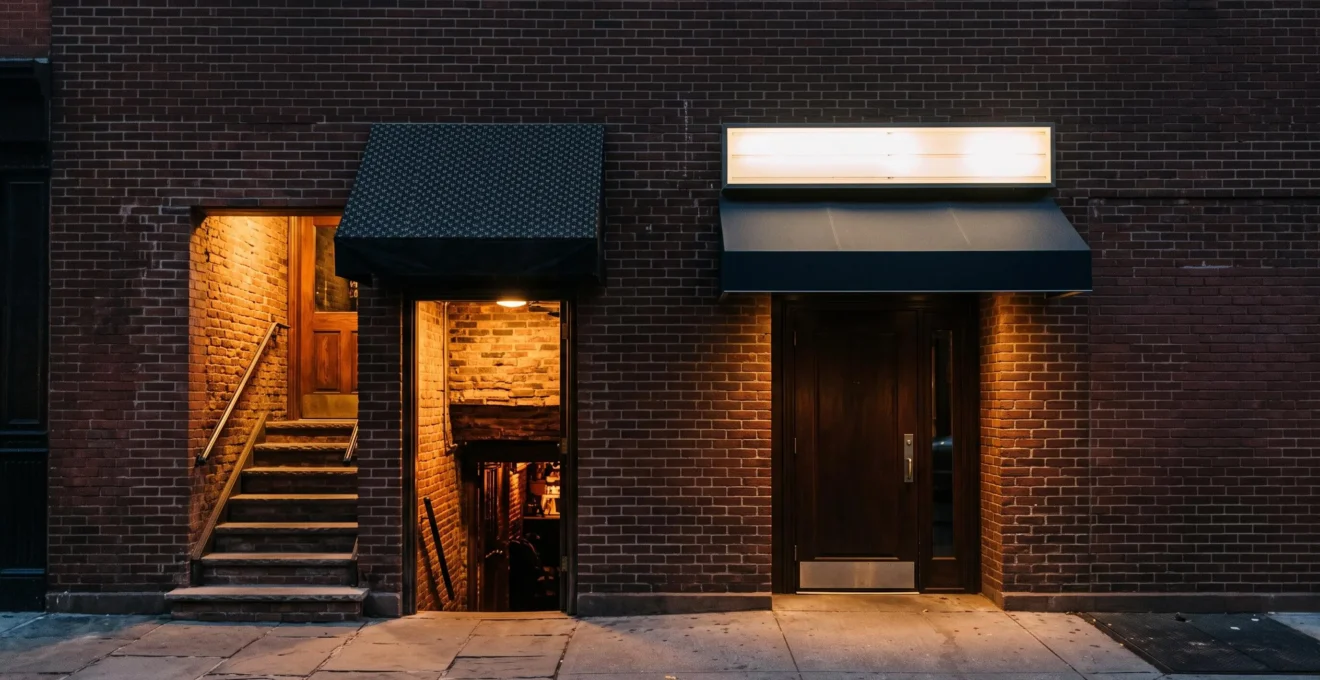
Choosing between the Blue Note and the Village Vanguard isn’t about which is ‘better’—it’s about matching the club’s unwritten rules and energy to your ideal night.
- The Village Vanguard is a sacred, silent temple for the serious jazz devotee.
- The Blue Note is a world-class dinner-and-a-show venue to see legendary names.
Recommendation: Decide if you want to worship the music in hushed reverence (Vanguard) or enjoy a premier show in a bustling, high-end supper club (Blue Note).
You’re in Greenwich Village. The sun has dipped below the crooked rooftops, and the air is buzzing with the promise of the night. You want to see some real New York jazz, the kind you’ve heard on records your whole life. And right here, within a few blocks of each other, are the two titans: the Blue Note and the Village Vanguard. Every tourist guide has an opinion, usually boiling it down to a simple, tired binary: the Vanguard is for purists, the Blue Note is for tourists. That’s not the whole story. As a musician who’s played the city’s stages and spent countless nights in its smoky corners, I can tell you the choice is more nuanced.
The secret isn’t in the lineup, the ticket price, or even the history. It’s in the club’s operational DNA—the unwritten rules, the physical layout, and the economic model that shape the entire experience. It’s about understanding whether you’re walking into a concert hall that happens to serve drinks, or a restaurant that happens to have a stage. One is a temple for listening; the other is a platform for performance. Neither is better, but one is definitely better for *you* and the kind of night you’re picturing.
This guide will pull back the curtain on these legendary rooms. We’ll decode everything from the table minimums and the unspoken “silence rule” to the different energies of the early and late sets. By the end, you won’t just be picking a club; you’ll be making an informed choice about the soul of your New York jazz experience.
Summary: Decoding the Vibe of NYC’s Legendary Jazz Clubs
- Why is there a ‘table minimum’ in addition to the ticket price?
- The ‘silence rule’: in which clubs is it forbidden to whisper during the set?
- When to book to get a front-row table?
- 8 PM or 10:30 PM set: which one offers the most authentic atmosphere?
- The mistake of paying $50 for a soulless tourist club
- Why is Preservation Hall worth waiting in line for an hour?
- Why are Ace or Hoxton hotel lobbies co-working spaces?
- How to Experience the French Quarter Beyond Bourbon Street Chaos?
Why is there a ‘table minimum’ in addition to the ticket price?
First things first, let’s talk about the money. You buy a ticket, and then you see that fine print: “table minimum” or “drink minimum.” It can feel like a bait-and-switch, but it’s a crucial part of what I call “vibeonomics.” This isn’t just a fee; it’s the club’s business model, and it directly shapes the atmosphere. For these small, historic venues, ticket sales alone often just pay the musicians. The minimums keep the lights on and, more importantly, dictate the kind of experience you’re about to have.
The difference between the Blue Note and the Village Vanguard is a perfect example of this in action. Each has a minimum, but they function in completely different ways, signaling a different philosophy. The Blue Note has a consumption minimum that can be met with food or drinks, while the Vanguard sticks to a simple drink minimum, as detailed in this breakdown based on their policies.
| Club | Cover / Ticket | Minimum Type | Estimated Cost | Food Service |
|---|---|---|---|---|
| Blue Note | Varies by artist | Consumption minimum per person | $20 per person | Full dinner menu & bar |
| Village Vanguard | $25 weeknights / $30 weekends | One drink minimum per person | ~$8–$12 per drink | No food served |
The Blue Note’s model encourages a full dinner-and-a-show experience. You’re meant to settle in, order a meal, and enjoy a polished performance. The Vanguard, on the other hand, is not a restaurant. You can’t get food there at all. The one-drink minimum is a formality, a small price to occupy a seat in a room built for one thing: listening. The club explicitly states its policy requires a $25–$30 cover plus one drink minimum per person, a model that prioritizes access to the music over a dining experience.
The ‘silence rule’: in which clubs is it forbidden to whisper during the set?
If the table minimum is the economic DNA of a club, the policy on talking is its soul. This is where the Vanguard truly distinguishes itself and becomes what musicians call a “Listening Room.” It’s not just a suggestion; it’s a foundational rule. At the Vanguard, you are there to bear witness to the music. Chatting during a set isn’t just frowned upon; it will get you shushed by the staff or, more likely, by the person next to you. The club’s own policy, often quoted by regulars and critics, makes it crystal clear.
As one review in The Fordham Ram noted, the club’s ethos is direct and uncompromising:
During performances, QUIET IS ENFORCED. We’re a jazz club, not a chat room.
– Village Vanguard (official club policy)
This isn’t to be elitist; it’s a pact of respect between the audience and the musicians on that tiny, triangular stage. The artists know the room is with them on every note. For the audience, it creates an intense, almost spiritual level of connection to the performance. The Blue Note, with its supper-club layout and the clatter of forks and knives, is inherently a more social space. While you’re expected to be respectful, the low hum of conversation is part of the ambient texture. The Vanguard demands your complete, undivided attention.
This visual captures the essence of the Vanguard experience. It’s a place for deep, internal immersion in sound. If your idea of a great night involves catching up with a friend over music, the Blue Note is your spot. If you want to feel the music in your bones without a single distraction, you belong at the Vanguard.
When to book to get a front-row table?
In New York, “intimate” is often a euphemism for “tiny,” and in the case of the Village Vanguard, it’s the gospel truth. The legendary room is a sharp triangle in a basement, and its size is a defining feature of the experience. It’s not just about being close to the music; you’re *in* the music. But this also means that every seat counts, and getting a good one requires a strategy.
The urgency to book isn’t manufactured hype. With a capacity of only around 130 people, shows for big-name artists sell out weeks in advance. The Blue Note is larger, but its tiered pricing for “table” vs. “bar” seating creates a similar dynamic. For either club, if you want a front-row seat, the rule is simple: book online the moment tickets go on sale. There’s no secret handshake. For the Vanguard, this can be a month or more in advance. For the Blue Note, it depends on the fame of the artist.
Even with a reservation, seating is almost always first-come, first-served. This means arriving early is non-negotiable if you care about your vantage point. To make the most of your night and avoid a view blocked by a support pillar, here is a practical game plan.
Your Booking Game Plan: Securing a Seat
- Book Ahead for Headliners: For Village Vanguard, Blue Note, and Birdland, book online as soon as you know your dates. Weekend shows sell out fast.
- Embrace Spontaneity for Smaller Clubs: If you prefer to go with the flow, know that authentic spots like Smalls and 55 Bar often have room for walk-ins.
- Arrive Early, Always: Even with a ticket, the best seats go to the early birds. The rooms are tight, and a 30-minute head start can mean the difference between the front and the back.
- Plan a Village Night: A great strategy is to have dinner in Greenwich Village, then decide between the early or late set based on how you feel and what the lines look like.
8 PM or 10:30 PM set: which one offers the most authentic atmosphere?
One of the most overlooked factors in choosing your jazz night is the set time. Most clubs offer two shows, typically around 8 PM and 10 or 10:30 PM. They feature the same musicians playing for the same length of time, but the Set Energy can be worlds apart. Understanding this difference is an insider’s key to unlocking the right vibe.
The 8 PM set is the “dinner set.” The audience is often a mix of tourists, couples on a date night, and people who have to get up for work the next day. The energy is great, but it’s more structured. People are eating, they’re on a schedule, and the band is often just warming up. According to its schedule, at the Blue Note doors open at 6 PM for performances that start at 8 PM and 10 PM, catering directly to this dinner crowd. It’s a fantastic show, but it’s a show nonetheless.
The 10:30 PM set is the “musician’s set.” By this time, the dinner crowd has cleared out. The room fills with night owls, locals, and other musicians coming from their own gigs. The atmosphere gets looser, deeper. The band has played a full set already; their chops are warm, and they start to take more risks. This is often where the real, unscripted magic happens—the unexpected detours, the extended solos, the palpable feeling of artists pushing each other. For many, the early show is a great, well-planned experience, but the late set can feel more raw and spontaneous.
One attendee recalled watching the early show on a Friday with the Chris Dave, Pino Palladino, and Isaiah Sharkey trio, noting they had very good seats and that the music was great, illustrating the more relaxed, well-planned nature of the early set.
– A visitor’s experience
So, which to choose? If you want a guaranteed great performance as part of a planned evening, the 8 PM set is perfect. If you’re chasing that elusive, electric, only-in-New-York moment and don’t mind a late night, the 10:30 set is where you’re most likely to find it.
The mistake of paying $50 for a soulless tourist club
Let’s clear something up: a high cover charge doesn’t make a club “soulless.” The most authentic musical experiences can be expensive. “Soul” in a jazz club has nothing to do with price; it has everything to do with intent. A club has soul when the room—the staff, the audience, and the musicians—is united in a singular purpose: to honor the music. The mistake is paying top dollar for a place where the music is treated as background entertainment rather than the main event.
The legendary trumpeter Wynton Marsalis perfectly captured the soul of the Vanguard’s audience in his notes for a live album recorded there. He understood that the people in that line were not just consumers; they were pilgrims.
those people in that Vanguard line with you out there… are people who want to hear some musicians get up on that bandstand and perform
– Wynton Marsalis, wyntonmarsalis.org
This is the litmus test. Is the club a gathering place for listeners, or is it a branded entertainment venue? The Blue Note, for all its glory, walks a fine line. It’s a premier stage that attracts the biggest names, but its commercial success means Blue Note has since expanded into a global brand with multiple venues across the world. This can sometimes dilute the raw, hyper-local feel that defines a true musician’s hangout. For a taste of that undiluted soul, you often have to look to the smaller, grittier clubs.
Case Study: Smalls Jazz Club, The Hyper-Local Alternative
Described as a cramped, sweaty, glorious room that serious jazz fans swear by, Smalls Jazz Club is known for legendary late-night jam sessions starting around 1 AM. It offers visitors a chance to hear working musicians push each other in an intimate, musician-driven setting rather than a polished tourist show. It’s less of a performance and more of a “hang”—the absolute essence of a club with soul.
Key Takeaways
- The Village Vanguard is a hallowed Listening Room where silence is mandatory and the focus is 100% on the music.
- The Blue Note is a premier Showcase Stage and supper club, offering a more social, high-energy “dinner-and-a-show” experience with world-famous artists.
- The choice comes down to your primary goal: deep, reverent listening (Vanguard) or a lively, polished show with amenities (Blue Note).
Why is Preservation Hall worth waiting in line for an hour?
To truly understand the DNA of a place like the Vanguard, it helps to look at its spiritual cousins elsewhere. Let’s take a trip down to New Orleans. If you’ve ever walked through the French Quarter, you’ve seen the line snaking out of Preservation Hall. There are no reservations, no comfortable seats, and no drinks. You wait, sometimes for over an hour, for a 45-minute set on a wooden bench. So why do people do it?
Because the line is not a bug; it’s a feature. It’s a self-selecting filter for devotion. The people who are willing to stand on a hot New Orleans street for that long aren’t there by accident. They are there for one reason: to hear unamplified, traditional New Orleans jazz played by masters. The line ensures that the tiny room is filled only with people who share that singular purpose. It purges the casual tourist looking to kill time, creating an audience of true believers.
This is the exact same principle as the Vanguard’s strict silence rule. Both are mechanisms that protect the sanctity of the musical experience. They are rituals that demand a small sacrifice from the audience—of time, of comfort, of conversation—in exchange for a moment of pure, unadulterated musical connection. Waiting in that line is the price of admission to a sacred space, and everyone inside knows it. That shared commitment is what creates the legendary energy in both rooms.
Why are Ace or Hoxton hotel lobbies co-working spaces?
Now, let’s look at the other end of the spectrum. To appreciate a dedicated Listening Room, you have to understand its opposite: the social hub. Think about the lobbies of modern boutique hotels like the Ace or The Hoxton. They are masterfully designed spaces. There’s music playing, people are talking, laptops are open, and drinks are flowing. They are vibrant, cool, and full of energy. But the music is not the focal point; it’s the soundtrack.
These lobbies are designed for ambient sound and multi-tasking. The music is curated to create a mood, to facilitate conversation and work, not to demand your full attention. No one is sitting in silent reverence of the playlist. It is, by design, high-quality sonic wallpaper. This isn’t a criticism; it’s a different function entirely. It’s a space where human connection is the main event and music is a supporting character.
This “social hub” model is a useful framework for understanding different types of venues. A mediocre jazz club is essentially a hotel lobby with a live band—the music is secondary to the drinking and socializing. The Blue Note sits somewhere in the middle; it’s a high-end social hub that elevates the music to a starring role, but the social buzz remains part of the appeal. The Vanguard is the antithesis of the hotel lobby. It has stripped away every social function until only the music remains. Understanding where a venue falls on this spectrum from “social hub” to “listening room” is key to aligning its vibe with yours.
How to Experience the French Quarter Beyond Bourbon Street Chaos?
So, we come back to the original question. Blue Note or Village Vanguard? By now, you see that it’s not just a choice between two clubs. It’s a lesson in how to be a smarter, more fulfilled traveler. It’s the same challenge you face when you’re standing in New Orleans, wondering how to find real music beyond the chaos of Bourbon Street.
The mistake is thinking the most famous street holds the most authentic experience. The tourist on Bourbon Street, slushy drink in hand, is listening to a cover band playing “Sweet Home Alabama.” The traveler who does their homework is a few blocks away on Frenchmen Street, or waiting in line at Preservation Hall, or in a tiny club like the Spotted Cat. They’ve learned to look for the signals: the line of devoted fans, the room with no food, the late-night jam session filled with local musicians.
This is the skill you’re honing when you choose between the Blue Note and the Vanguard. You’re learning to read the DNA of a place. You’re asking yourself: Am I looking for a world-class, comfortable show, a “greatest hits” of the New York jazz scene? That’s the Blue Note. Or am I looking for the deep cut, the intense, devotional experience where the music is the only thing that matters? That is the Village Vanguard. Your answer reveals what kind of experience you’re truly after, not just tonight, but in every city you visit.
Ultimately, the best advice a fellow musician can give you is this: go to both. Go to the Blue Note to see a legend hold court. Then go to the Vanguard to feel the history in the walls and give yourself over to the sound. See which one feels like home. That’s the one that fits your vibe.
Frequently Asked Questions about NYC Jazz Club Policies
Is Blue Note’s $20 minimum per person or per table?
It applies per seated guest, not per table.
Does the Village Vanguard’s drink minimum apply per person too?
Yes — the club’s FAQ states that in addition to door admission, there is a one drink minimum per person, which even includes soft drinks, juices, and bottled water.
Can a couple split one drink to meet the Vanguard minimum?
No, since the policy is enforced individually rather than as a shared table total.