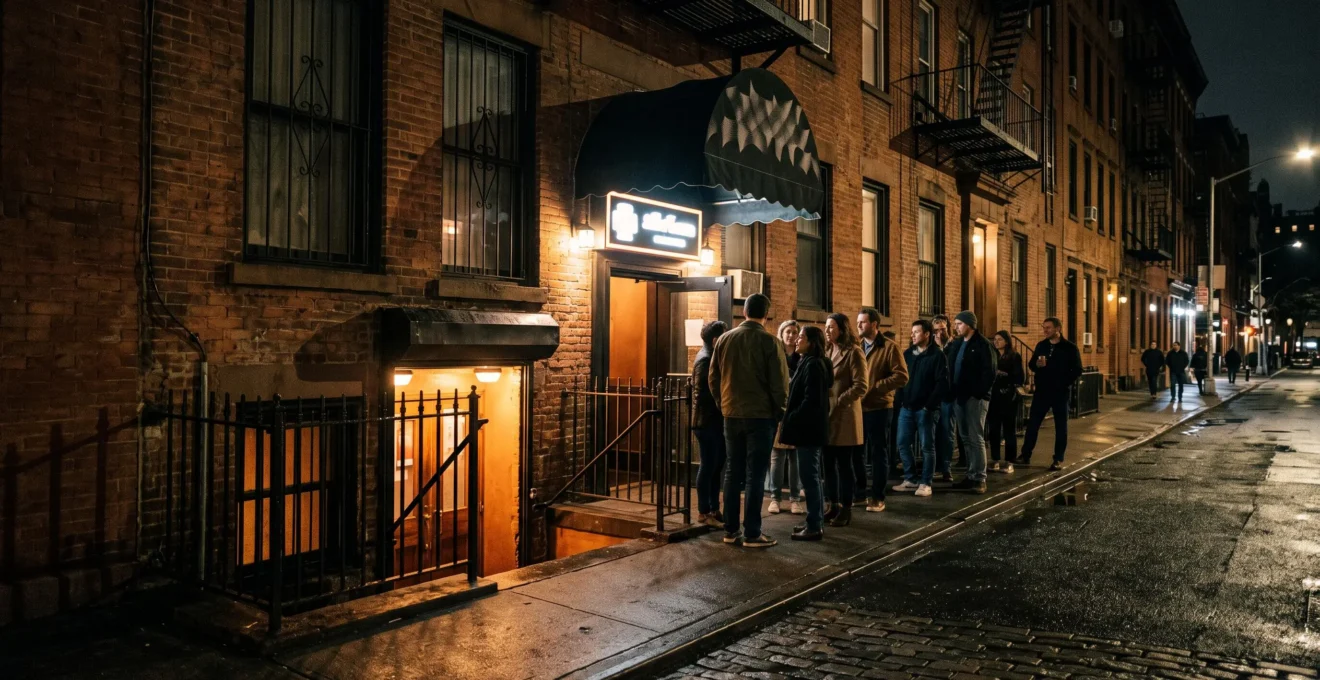
Getting into the Comedy Cellar without a reservation isn’t about luck; it’s about playing the game smarter than a tourist.
- Be a small, low-maintenance party, arrive early on a weeknight, and be prepared for the standby line.
- Understand the club’s rules are about protecting the show and the artists, not punishing the audience.
Recommendation: Your goal isn’t just to get a seat, but to be the kind of audience member the club wants back—attentive, respectful, and ready for a great show.
So you’re standing on MacDougal Street, staring at that iconic red brick and black awning. You’ve heard the stories, you’ve seen the specials, and now you want in. But you didn’t plan months ahead, and every reservation slot is booked solid. The common wisdom says to just get in the standby line and pray, or that it all comes down to dumb luck. That’s tourist thinking. Getting a seat at the Comedy Cellar, especially without a reservation, is less about luck and more about understanding the unwritten rules of the club’s ecosystem. It’s about knowing why the rules exist and how to position yourself as the perfect solution to a host’s seating puzzle.
This isn’t just a venue; it’s a living, breathing workspace for some of the best comedians on the planet. The rules—from locking up your phone to the seating arrangement—are all designed to create the perfect environment for comedy. Once you understand that, you stop seeing them as obstacles and start seeing them as part of the game. Most shows run a tight 60 to 90 minutes, and the goal is to pack as much world-class comedy into that window as possible. Your job as a potential audience member is to prove you’re not going to be a disruption. This guide will break down the club’s logic from an insider’s perspective, giving you the street-smart strategy you need to turn a long shot into a memorable night.
This article breaks down the essential strategies and unwritten rules for navigating one of the world’s most famous comedy clubs. The following sections will guide you through everything from club policies to insider tips for maximizing your chances of getting in and having an incredible experience.
Summary: Your Guide to Conquering the Comedy Cellar
- Yondr Pouch: Why Will Your Phone Be Locked Away During the Show?
- The ‘Two-Item Minimum’ Rule: How Does It Work If You Don’t Drink Alcohol?
- The Mistake of Wanting to Choose Your Own Table and Ending Up in the Back
- Heckling: Why Interrupting the Comedian Will Get You Kicked Out Immediately
- Which Weeknights Do Stars Come to Test Out New Jokes?
- Last Call at 2 AM or 4 AM: How Do the Laws Vary by City?
- The Mistake of Choosing a Trendy Hotel Above a Club If You Want to Sleep Early
- Open Mics and Underground Clubs: Where to Find Raw Comedy Talent?
Yondr Pouch: Why Will Your Phone Be Locked Away During the Show?
The first thing you’ll notice when you get inside isn’t the brick wall or the cramped tables; it’s the staff handing you a small, gray pouch. This is a Yondr pouch, and your phone is going inside it until the show is over. Don’t fight it. Don’t argue. This isn’t a suggestion; it’s the price of admission. The reason is simple: it’s about respect for the art form. Comedians, especially the world-famous ones who drop in here, are constantly working on new material. An out-of-context joke filmed on a phone and posted online can be disastrous for an act.
This policy became widespread after pioneers like Dave Chappelle implemented it to protect their creative process. As Forbes reported, the move to phone-free venues created a better environment for both performers and the audience. It reduces the risk of leaked material and, more importantly, it forces everyone to be present. As Yondr themselves state, ” phones disrupt the comedian’s creative process, and unwanted recording is problematic for artists trying out new jokes.” You get a better, more engaged show, and the comedian gets a safe space to work. It’s a win-win.
Think of that sealed pouch not as a cage for your phone, but as a ticket to an authentic, unfiltered experience. For 90 minutes, you’re disconnected from the outside world and plugged directly into the mind of a comedian. It’s a rare thing, and it’s what makes a night at the Cellar so special. Embrace it.
The ‘Two-Item Minimum’ Rule: How Does It Work If You Don’t Drink Alcohol?
Alright, let’s talk money. The cover charge is one thing, but the rule that trips up most newcomers is the “two-item minimum.” Yes, it’s real, and yes, it’s per person. But here’s the inside track: it does not mean “two alcoholic drinks.” The club is a business, but it’s a comedy club first and a bar second. The minimum can be met with any two items from the menu. That includes food, soft drinks, coffee, or even bottled water. So if you’re not a drinker, don’t sweat it. Two Diet Cokes or an order of fries and a Pellegrino, and you’re golden.
The key is to handle it smoothly. Don’t wait until the end of the show to frantically order two things. Get your first order in as soon as you sit down. Order the second around the middle of the show. This keeps your server happy and shows you know the drill. A visitor’s write-up of the club experience noted that while drinks are around $10, the venue also enforces a three-drink maximum. This is a crucial detail. It proves the goal isn’t to get you drunk; it’s to keep the business running while ensuring the audience stays attentive and respectful, not sloppy.
Your Action Plan for the Two-Item Minimum
- Know the Rule: Every guest must order two items—food or drink. Alcohol is optional.
- Order Early: Place your first order as soon as you’re seated to get it out of the way.
- Pace Yourself: Order your second item mid-show to avoid the end-of-show rush.
- Food Counts: Two appetizers or a dessert and a soda fully satisfy the requirement.
- Plan Your Payment: The club limits parties to a maximum of two cards, so be ready to split the bill simply.
The Mistake of Wanting to Choose Your Own Table and Ending Up in the Back
When the host finally calls your name from the standby list, your first instinct will be to scan the room and mentally pick out the “best” table. Kill that instinct immediately. You don’t choose your table at the Comedy Cellar; the host chooses it for you. Trying to negotiate or asking for a different spot is the fastest way to get on their bad side and guarantees you a seat by the kitchen or the bathroom. The seating is a high-stakes game of Tetris, and the host is the grandmaster. They know the room, they know the reservations, and they know which party sizes fit into which tiny, jigsaw-puzzle-piece tables.
Your best strategy is to be a “low-maintenance party.” The ideal walk-in is a party of two. A group of two is easy to slot into a small, open table that a larger reserved party couldn’t use. A group of four is harder. A group of six without a reservation? Forget about it. The club’s official policy explicitly states that it will not honor multiple reservations made to form a large group because, even with the best intentions, large parties are inherently noisy and disruptive. They’ve learned this from years of experience.
The smartest thing you can do is show up early, keep your party small, and when your name is called, follow the host quickly and gratefully to wherever they lead you. The room is so intimate that there’s truly no bad seat. Being easy-going and efficient makes the host’s job easier, and they’ll remember that. Arguing about a table ensures they’ll remember you for all the wrong reasons.
Heckling: Why Interrupting the Comedian Will Get You Kicked Out Immediately
This should be obvious, but in a room as intimate as the Cellar, it needs to be said in no uncertain terms: do not talk to the comedian unless you are spoken to. Do not “help” with a punchline. Do not shout “woo!” after a joke you liked. And absolutely, under no circumstances, should you heckle. The Comedy Cellar has a zero-tolerance policy for this, and you will be thrown out without a refund before the comedian even has a chance to roast you. This isn’t a rowdy bar show where the comic is battling the TV in the corner. This is the premier comedy club in the world.
The audience is there to see the performers, not to hear your witty commentary. An eyewitness account of a show described how infuriating it was for everyone when a nearby table kept talking amongst themselves. The staff had to intervene directly. Interrupting the show is the ultimate sign of disrespect, not just to the person on stage, but to every single person in the room who paid to be there. The comedians are there to work, and the audience is there to watch them work. That’s the contract.
The comedians we talked to are excited about the policy [of locking up phones], because they no longer have to fear that their set is being recorded, but more importantly, the audience will be focused completely on the show without distracting alerts from their phones.
– The Interrobang, New York’s Comedy Cellar Using Phone Lock Up Bags in Regular Shows
That focus is sacred. Any action that breaks it, from a phone lighting up to a voice shouting from the crowd, shatters the environment. Being a good audience member is simple: laugh when it’s funny and be quiet when it’s not. That’s it. Breaking that rule is an offense that gets you expelled from the comedy ecosystem, swiftly and permanently.
Which Weeknights Do Stars Come to Test Out New Jokes?
So, what’s the payoff for following all these rules? The magic. The chance that you’ll be sitting ten feet away from a comedy legend working out the bits for their next Netflix special. This isn’t a marketing gimmick; it’s the entire purpose of the Comedy Cellar’s existence. It is, as some call it, the “Harvard of comedy clubs.” It’s a gym where the heavyweights come to train. The question isn’t *if* stars will drop in, but *when*.
While there’s no guaranteed formula, your best bet is to aim for a weeknight—Monday, Tuesday, or Wednesday. Weekends are for polished, crowd-pleasing sets. The real work happens early in the week when the stakes are lower and the audiences are composed of more discerning comedy nerds. This is when a star might pop in unannounced to run a new ten minutes or polish a closing chunk. They’re not there for the glory; they’re there because the Cellar’s audience is sharp, and the feedback they get from the room is invaluable.
The revered Greenwich Village club is known as the spot where megastars like Louis C.K., Dave Chappelle, Amy Schumer and Aziz Ansari are liable to drop in unannounced to try out new material.
– Time Out New York, Time Out — Comedy Cellar, The Nasty Show
This is the “drop-in lottery” you’re playing when you wait on the standby line. You might just see the scheduled lineup of killer comics. Or, you might see Chris Rock or Jerry Seinfeld walk on stage with a notepad. Going on a weeknight doesn’t just increase your chances of getting a seat; it increases your chances of witnessing a piece of comedy history in the making.
Last Call at 2 AM or 4 AM: How Do the Laws Vary by City?
As the last comedian takes a bow, you might start thinking about where the night goes from here. It’s important to understand New York City’s rhythm, which runs later than most of America. While many states mandate a 2 AM last call for alcohol, New York City is a different beast. Legally, bars and clubs can serve until 4:00 AM, a late-night luxury shared by only a handful of places nationwide.
This puts NYC in a unique category, far beyond the 1 AM or 2 AM cutoffs common elsewhere, and only surpassed by outliers like Alaska or the 24/7 culture of Nevada and parts of Louisiana. Here’s a quick comparison to put it in perspective:
| City / State | Legal Last Call |
|---|---|
| New York City | 4:00 AM |
| Most U.S. states (default) | 2:00 AM |
| Nevada & Louisiana | No mandated closing time |
| Alaska (statutory ceiling) | 5:00 AM |
| Utah, Nebraska, Connecticut | 1:00 AM |
However, here’s the crucial insider tip: the legal 4 AM last call is irrelevant inside the Comedy Cellar. The *real* last call is whenever the waitstaff drops your check, which is typically just before the final comedian finishes their set. The club runs a tight ship to turn the room over for the next show. You need to have your payment ready and settle up quickly. Don’t be the table that holds up the process. Plan your after-show move separately, knowing you have the entire Greenwich Village and its late-night haunts at your disposal until 4 AM.
The Mistake of Choosing a Trendy Hotel Above a Club If You Want to Sleep Early
Where you stay is as much a part of your strategy as when you show up. A common tourist mistake is to find a hotel that looks “close to the action” on a map without understanding what that really means. Greenwich Village, and particularly the blocks surrounding the Comedy Cellar, is the historic, beating heart of New York’s nightlife and stand-up scene. It’s not a quiet, residential area with a few bars; it’s a loud, energetic, round-the-clock destination.
Choosing a hotel right on MacDougal or Bleecker Street means you are choosing to be immersed in that energy. If your plan is to see a 7:30 PM show and be in bed by 10, you are setting yourself up for failure. The noise from the streets, the crowds, and the general buzz of the city’s premier nightlife district will be the soundtrack to your night, whether you want it to be or not. A guide to comedy in New York highlights this very distinction, positioning the Village as the energetic core against quieter, more tourist-focused areas like Midtown.
If a good night’s sleep is a priority, consider lodging in a nearby but quieter neighborhood like the West Village (a few blocks west) or NoHo. You’ll still be within a short walk or subway ride, but you’ll have a sanctuary to retreat to. If you want to be in the thick of it 24/7, then by all means, book that room above the club. Just know what you’re signing up for: a full immersion in the city that never sleeps.
Key Takeaways
- The club’s rules (Yondr pouches, assigned seating) are designed to create the best possible show, not to inconvenience you. Respecting them is key.
- Your best chance as a walk-in is to be a small, easy-to-seat party (ideally two people) on a weekday night when stars are more likely to drop in.
- The magic of the Cellar is its unpredictability. The standby line is a lottery ticket for a chance to see comedy legends testing new material.
Open Mics and Underground Clubs: Where to Find Raw Comedy Talent?
Getting into the Comedy Cellar is a pinnacle experience for any comedy fan. But for the true aficionado, it’s just the beginning. The Cellar presents polished, professional comedy at its highest level. To find the next generation of stars and see comedy at its most raw and experimental, you have to venture beyond the famous brick wall and explore the city’s vast network of indie shows and open mics. These are the real laboratories of comedy.
While Manhattan has its spots, the modern underground scene thrives in Brooklyn. Neighborhoods like Bushwick and Williamsburg are filled with back rooms of bars, basements, and multi-purpose art spaces where rising talent is honing its craft. A comprehensive guide to NYC’s comedy scene points specifically to this distinction, highlighting venues that offer a completely different vibe. A place like Union Hall in Park Slope, for example, combines a library bar, bocce ball courts, and a legendary basement stage that hosts both established comics and complete unknowns in a more laid-back, indie atmosphere.
The difference is crucial: an open mic is a comedian’s gym, a place to practice and fail. A booked indie show is a curated lineup of comics you should be watching. Exploring these scenes gives you a more complete picture of what makes New York the comedy capital of the world. After you’ve seen the masters at the Cellar, go see the apprentices in Brooklyn. You might just discover your new favorite comedian before they even have an agent.
Now that you have the insider’s playbook, your next step is to put it into practice. Go beyond just being an audience member and become a true student of the art form by exploring the diverse comedy offerings across the city.
Frequently Asked Questions About NYC’s Wider Comedy Scene
Where can I find underground or indie comedy shows outside the major clubs?
Brooklyn neighborhoods such as Bushwick and Williamsburg host edgier, alternative comedy, with venues like Union Hall known for combining a laid-back bar atmosphere with underground stand-up.
How long does a typical NYC comedy show last?
Most comedy shows across the city run between 60 and 90 minutes, with headliner sets sometimes running a bit longer.
What’s the real difference between an open mic and a booked indie show?
An open mic functions as a comedian’s practice space where new, unpolished material is tested and can fail in front of a small crowd, while a booked indie show at a known venue guarantees a curated, more polished lineup for the audience.