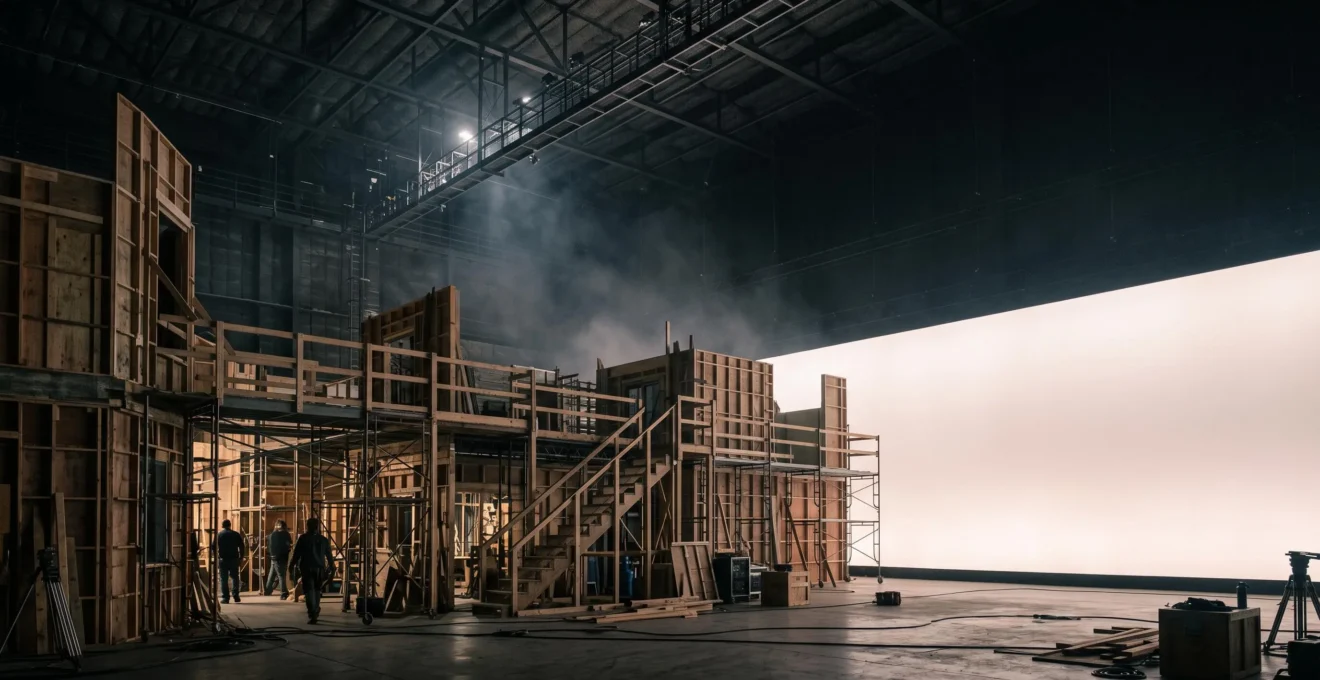
Contrary to the image of a simple ‘black box,’ a soundstage is a complex piece of engineering designed for total environmental control. It is not merely a large room but a purpose-built machine for manufacturing reality. This article deconstructs the technical systems—from water management and acoustic precision to the overhead grids and LED walls—that allow filmmakers to meticulously build, control, and capture imaginary worlds as if they were real.
The awe of watching a blockbuster often comes from being transported to another world—a storm-tossed ocean, a distant alien planet, or a fantastical cityscape. We credit actors, directors, and visual effects artists for this magic, but the silent, unsung hero of these illusions is the soundstage itself. Many assume these are just giant, empty warehouses where sets are built. While not entirely wrong, this view misses the fundamental truth: a soundstage is one of the most sophisticated and controlled environments on Earth.
The common understanding revolves around green screens and large-scale construction. But the real work lies in the invisible engineering that allows for absolute control over every element of physics. It’s an engineered ecosystem designed to manipulate light, sound, and even weather on command. The key isn’t just about what you can build inside it, but what the structure itself allows you to control. This is the difference between a warehouse and a world-building machine.
This article will deconstruct that machine. We will explore the deliberate engineering choices that turn an empty space into a versatile tool for storytelling. From the floor designed to be flooded to the ceiling capable of supporting tons of equipment, we will dissect the anatomy of a soundstage and reveal the technical logic that makes the impossible, possible on screen.
To understand how these blank canvases are transformed into cinematic reality, this guide breaks down their core components and functions. The following sections explore the specific systems and techniques that define a modern soundstage, revealing the technical artistry behind the spectacle.
Summary: The Technical Secrets of Blockbuster Soundstages
- How do studios create rain and floods on demand?
- Why is absolute silence vital despite the insulated walls?
- Green or blue: how do colored backgrounds replace physical sets?
- The mistake of trying to sneak onto an active set (and the legal consequences)
- Grids and catwalks: why is the ceiling the most important part of the studio?
- Why is a visit to the Warner Bros. prop department a must-see?
- No WiFi or 4G: how to download your maps and entertainment before you arrive?
- Warner Bros or Universal Studios: Which Tour Shows Real Moviemaking?
How do studios create rain and floods on demand?
Creating water effects is a fundamental challenge in controlling reality on a soundstage. It requires more than just a hose; it demands a system of precise, repeatable, and safe water management. For smaller-scale effects like a downpour, productions use “rain towers” or rigs attached to the ceiling grid. These systems are fed by either massive water trucks parked outside or, more commonly, by tapping directly into local fire hydrants. This process is a significant logistical operation that involves permits and coordination with municipal water authorities to ensure the water usage is tracked and approved.
For more dramatic sequences involving floods or ocean scenes, the soundstage itself must be transformed. Some stages are purpose-built with enormous, integrated water tanks. However, any large stage can be converted. A prime example is the production of The Perfect Storm, which required immense, turbulent ocean scenes. For this, Stage 16 at Warner Bros. was retrofitted to house a 20-foot-deep water tank. Inside this controlled flood zone, a full-scale ship mockup was mounted on a six-axis hydraulic gimbal to simulate the violent pitching of a vessel at sea. This combination of a deep tank and motion-control technology allows directors to capture the chaos of an ocean storm in a perfectly repeatable and safe studio environment.
Action Plan: Creating Legal Rain Effects
- Identify the water source: Productions choose between expensive water trucks or, more practically, fire hydrants, which requires official coordination.
- Secure permits: The production must coordinate with the local water department, rent a meter to track usage, and have all rain machines approved in the location agreement.
- Develop a technical plan: This includes the number of rain machines, their placement on a location map, the expected coverage area, and a detailed schedule of use.
- Assess environmental risks: A plan must be in place to manage water runoff and prevent the creation of stagnant water, which can pose environmental and health issues.
- Ensure safety on set: All electrical equipment must be properly grounded and protected from the water to prevent catastrophic accidents.
Why is absolute silence vital despite the insulated walls?
Soundstages are famous for their massive, sound-insulated walls, designed to block out the noise of the outside world, from passing airplanes to distant traffic. But if most of a film’s final sound mix—music, sound effects, and even some dialogue—is added in post-production, why is absolute silence on set so non-negotiable? The answer lies in protecting the integrity of the on-set dialogue and capturing a crucial, invisible element: room tone.
Even in a “silent” room, a unique ambient sound exists. This “sonic fingerprint” is composed of subtle noises like the hum of lights or the sound of air moving through the vast space. This is room tone. After a scene is filmed, the sound mixer will ask for 30 to 60 seconds of complete silence to record this ambient sound. Everyone on set must remain perfectly still. This recording is essential for post-production. When editing dialogue, there are often gaps between spoken lines. If these gaps were filled with pure digital silence, the change would be jarring to the human ear. Instead, audio editors use the recorded room tone to patch these gaps, ensuring the background sound remains consistent and the edits are seamless.
As the team at SetHero, a film production software company, aptly puts it in their terminology guide:
Sound professionals call room tone “the mortar between bricks.”
– SetHero editorial team, SetHero, film set terminology guide
Without this clean sonic foundation, mixing and editing dialogue becomes a nightmare. Any unwanted noise during a take, like a cough or a falling tool, can render the dialogue unusable, forcing expensive Automated Dialogue Replacement (ADR) sessions where actors re-record their lines in a studio. Capturing pristine on-set audio and a clean room tone is therefore a matter of economic efficiency and creative quality.
Green or blue: how do colored backgrounds replace physical sets?
For decades, the answer to creating impossible backgrounds was chroma keying. This technique involves filming actors against a solid-colored background—typically bright green or blue—which is then digitally replaced with a different image in post-production. The choice between green and blue is a technical one; green screens are more common today because digital cameras are more sensitive to green, providing a cleaner key. Blue is often reserved for scenes where a character or costume is green. This method has been the backbone of visual effects for years, allowing filmmakers to place characters anywhere imaginable.
However, chroma keying has its limitations. The intense, flat lighting required can look unnatural, and actors are forced to react to an empty, colored void, making performances challenging. A technological revolution is now changing the game: LED Volumes. Pioneered on shows like The Mandalorian, this method replaces the passive green screen with massive, curved LED walls that display the digital background in real-time during filming. It’s a game-changer that has seen the industry explode to roughly 300 LED stages worldwide, up from only three in 2019.
Case Study: The Mandalorian’s “Volume”
For The Mandalorian, Industrial Light & Magic built the “Volume,” a 20-foot-high, 270-degree curved LED video wall topped with an LED ceiling. This setup wrapped the physical set pieces and actors in a photorealistic, computer-generated environment. The key benefit is creating in-camera effects. The digital background provides realistic, dynamic lighting and reflections on actors’ costumes and props directly during the take, something impossible with a green screen. This allows the cast and crew to see the final shot as they film it, resulting in more grounded performances and a more seamless integration of the real and virtual worlds.
The mistake of trying to sneak onto an active set (and the legal consequences)
The allure of a movie set is powerful, and the temptation to get a glimpse behind the curtain can be strong. However, attempting to enter an active soundstage without authorization is not a harmless adventure; from a production manager’s perspective, it’s a significant security breach with serious legal and safety consequences. A film set is legally a closed, private workplace, and unauthorized entry is considered trespassing.
The primary concern is safety and liability. An active soundstage is a hazardous construction zone. It is filled with high-voltage electrical cables, heavy lighting equipment suspended overhead, complex rigging, and moving machinery. A person unfamiliar with the set’s layout and safety protocols could easily walk into a dangerous area, leading to serious injury or death. The production’s insurance does not cover unauthorized individuals, creating a massive liability risk for the studio.
Beyond the physical danger, there are critical legal and financial reasons for the tight security. The content being filmed is a highly valuable, confidential asset. An unauthorized person could leak plot spoilers, character designs, or set photos, causing irreparable financial damage to the project and violating the non-disclosure agreements signed by every single crew member. This is a form of intellectual property theft. Because of these combined risks, studios employ robust security measures. Anyone caught trespassing will be removed, potentially banned from the studio lot for life, and can face legal prosecution.
Grids and catwalks: why is the ceiling the most important part of the studio?
When you walk onto a soundstage, the immense, open floor space is what first catches your eye. But for a production crew, the most critical part of the studio is above your head. The ceiling of a soundstage is an intricate web of steel I-beams, catwalks, and rigging points known as the lighting grid. This is not just a ceiling; it is the structural backbone of the entire production, a modular and immensely strong framework designed for maximum flexibility.
Its primary function is, of course, lighting. Gaffers (lighting technicians) and grips use the grid to hang, position, and power hundreds of lights, from massive 20K lamps that simulate sunlight to small, precise fixtures for targeted effects. The network of catwalks allows technicians to move safely above the set to make adjustments without disrupting the activity on the floor. This ability to position any light anywhere in the three-dimensional space of the stage is fundamental to the art of cinematography.
But the grid’s role extends far beyond lighting. It is a certified, load-bearing structure used to support a vast array of equipment. It can be used to fly in set walls, hang green screens, or support complex camera rigs for dynamic overhead shots. Crucially, it is also the anchor point for stunt work. When a superhero needs to fly or an actor needs to be suspended on wires, the rigging is all secured to the steel grid. The ceiling’s immense load-bearing capacity and modular design are what transform the empty floor from a simple space into a dynamic, controllable volume where almost any physical scenario can be safely engineered.
Why is a visit to the Warner Bros. prop department a must-see?
While soundstages show you where movies are made, the prop department shows you what they are made of. A visit to the Warner Bros. prop department, a highlight of their studio tour, is less like a warehouse visit and more like a pilgrimage to a living museum of cinematic history. This is where the tangible pieces of storytelling—the objects that characters hold, use, and fight for—are stored, preserved, and given new life.
What makes this experience so compelling is the sheer density of narrative history. You are surrounded by thousands of objects, from furniture and lamps that have appeared in countless classic films to iconic “hero props” that defined a character. A hero prop is any item that is handled by a main actor and seen in close-up, and it is crafted with an incredible level of detail. Seeing these items in person reveals a layer of artistry that is often lost on screen.
You can appreciate the deliberate scratches on a futuristic weapon, the authentic weathering on a pirate’s treasure chest, or the specific weight and balance of a detective’s revolver. These are not just objects; they are storytelling tools, meticulously designed and aged to convey character and history silently. The prop department is a testament to the thousands of hours of unseen craftsmanship that go into building a believable world. It’s an opportunity to get inches away from the physical artifacts of your favorite stories and appreciate the artistry that makes them feel real.
No WiFi or 4G: how to download your maps and entertainment before you arrive?
One practical surprise for many visitors on a studio tour is the sudden disappearance of their cell signal. It’s common to find that inside a soundstage or deep within a backlot, both WiFi and 4G/5G service become weak or non-existent. This isn’t a technical oversight by the studio; in many cases, it’s a deliberate feature of the environment. A soundstage is an area designed for the ultimate control of electronic signals.
During filming, production crews rely on a wide range of wireless technology, including wireless microphones for actors, remote focus-pulling systems for cameras, and wireless video feeds for the director’s monitor. Any outside radio frequency (RF) interference can disrupt these critical systems, potentially ruining a take by causing a crackle in the audio or a drop in the video signal. To prevent this, soundstages are constructed with materials—like thick concrete and steel reinforcement—that effectively block external radio waves, turning them into partial Faraday cages. This electronic silence is as important to a modern film shoot as acoustic silence.
For a tour guest, this professional requirement has a simple side effect: your phone may become a paperweight. Therefore, the best practical advice is to prepare before you arrive at the studio. If you are relying on digital tickets, maps of the studio lot, or ride-sharing apps to get home, be sure to download everything you need for offline access. Save tickets to your phone’s wallet, take screenshots of maps, and download a few podcasts or a movie for any potential downtime. This small bit of preparation ensures that the studio’s need for electronic control doesn’t disrupt your visit.
Key Takeaways
- Soundstages are not just rooms but highly engineered systems for controlling physics, from weather to light.
- Absolute silence is vital for capturing clean ‘room tone,’ the unique sonic fingerprint of a location that is essential for seamless audio editing in post-production.
- Virtual production using LED Volumes is revolutionizing the industry by replacing passive green screens with active, photorealistic backgrounds that create effects in-camera.
Warner Bros or Universal Studios: Which Tour Shows Real Moviemaking?
After exploring the technical complexities of soundstages, the natural question is: how can I see this for myself? Los Angeles offers several studio tours, but they provide vastly different experiences. The choice often comes down to what you want to see: the spectacle of movie magic or the authentic process of moviemaking. The two most famous tours, Warner Bros. and Universal Studios Hollywood, represent this divide perfectly.
Universal Studios Hollywood masterfully combines a working studio backlot tour with a full-fledged theme park. The experience is geared toward entertainment and thrills, featuring staged events like the King Kong 360 3-D and Fast & Furious—Supercharged rides. While you do travel through real backlot sets, the focus is on spectacular demonstrations of special effects rather than the quiet, methodical work of an active production. It is an exciting, family-friendly experience that celebrates the final product of Hollywood magic.
In contrast, the Warner Bros. Studio Tour offers a more grounded, behind-the-scenes look at a working studio. The tour is less about rides and more about a guided exploration of quiet backlots, real exterior sets, and, when productions are not active, the inside of soundstages. It places a heavy emphasis on the craft itself, with extensive exhibits on prop design and costume creation. For a film enthusiast or a technically curious visitor, it provides a much clearer view of the day-to-day process. As the following comparison shows, your choice depends entirely on your interest in spectacle versus process.
| Studio Tour | Format | Focus / Authenticity | Best For |
|---|---|---|---|
| Warner Bros. | Guided walking tour of working backlots and soundstages | Authentic, real production spaces and quiet soundstages | Seeing genuine ‘how-it’s-made’ moviemaking |
| Universal Studios | Tram-based tour through an active backlot combined with theme park rides | Staged special-effects demonstrations and spectacle | Family entertainment and thrilling simulated effects |
| Sony Pictures | Small-group walking tour (typically no more than twelve people) | Intimate, historical, working lot on the former MGM site | Classic Hollywood history and a personal, low-crowd experience |
For those seeking an even more intimate and history-focused experience, the Sony Pictures tour offers a fantastic alternative. As a walking tour on the historic former MGM lot, it provides a deep dive into the Golden Age of Hollywood while still being an active, working studio.
To truly appreciate the complex engineering and artistry discussed, the next logical step is to see it for yourself. Choose the tour that best fits your curiosity and book your visit to the heart of moviemaking.