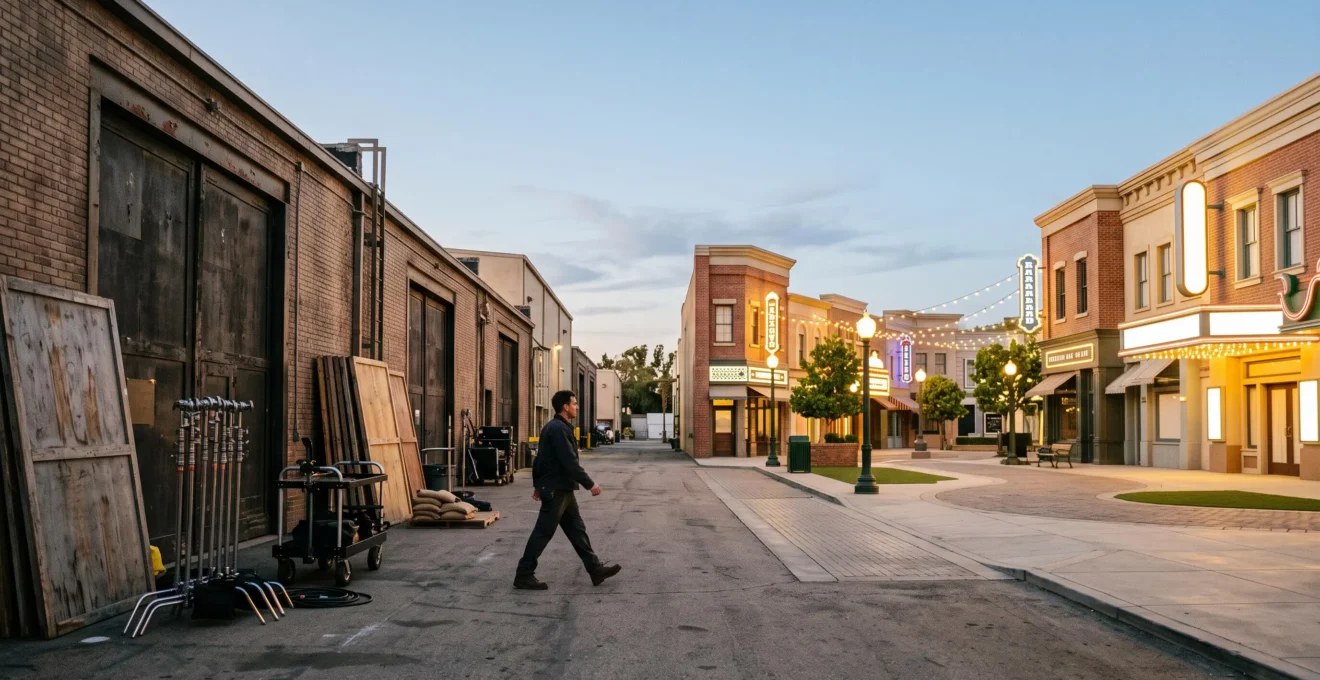
For the true film lover, the choice between Warner Bros. and Universal isn’t about attractions; it’s about separating industrial craft from manufactured spectacle.
- Warner Bros. offers an immersive dive into a working lot’s daily operations, from active prop houses to authentic backlot streets.
- Universal’s Studio Tour is fundamentally integrated with its theme park, prioritizing entertainment and staged events over operational authenticity.
Recommendation: Choose Warner Bros. for an authentic, “below-the-line” look at the craft of filmmaking. Choose Universal if you want a world-class theme park experience that includes a movie-themed tram ride.
For any cinephile making the pilgrimage to Los Angeles, the question is inevitable: which studio tour is the real deal? The city is flooded with options, all promising a peek behind the curtain of “movie magic.” But this generic promise often masks a fundamental difference in philosophy. One path leads you into the heart of a functioning, industrial craft, a place of work where stories are built from the ground up. The other leads you into a meticulously designed theme park, where the illusion of filmmaking is a form of entertainment in itself. The distinction is not one of quality, but of purpose.
Most guides will give you a simple checklist of features, comparing the DC Universe exhibit to the Wizarding World of Harry Potter. They might dangle the vague possibility of a celebrity sighting. But they miss the essential question for the purist: am I seeing a film set, or a set built for tourists? Am I observing the process, or am I part of a staged show? The goal of this analysis is to move beyond the surface-level attractions and dissect the operational authenticity of these tours. It’s about understanding that a true studio tour isn’t a passive experience of seeing famous things, but an active lesson in the logistics, history, and raw craftsmanship of cinema.
This isn’t about declaring a “winner.” It’s about providing a critical framework so you can choose the experience that aligns with your intent. Are you seeking the thrill of a staged earthquake and a photo with a CGI dinosaur, or do you want to stand on the worn floorboards of a century-old soundstage and smell the paint, dust, and history? This guide is for those who choose the latter.
To navigate this landscape, we’ll deconstruct the key elements that define an authentic studio experience, from the workshops where props are born to the logistical realities of booking a tour on an active production lot. This framework will help you look past the marketing and identify the true nature of the tour you’re considering.
Summary: Decoding the Authentic Studio Tour Experience
- Why is the visit to the Warner Bros. prop department a must-see?
- The mistake of thinking you’ll shake Brad Pitt’s hand in the cafeteria
- Standard or Deluxe 5-hour tour: is the investment worth it?
- Why is it impossible to buy a same-day ticket at Sony Pictures?
- Where to take the photo of the “Friends” couch without 50 people behind you?
- How do studios create rain and floods on demand?
- The mistake of not booking your time slot 2 weeks in advance
- How Do Massive Soundstages Create Artificial Worlds for Blockbusters?
Why is the visit to the Warner Bros. prop department a must-see?
The prop department—or “prop house”—is the heart of a studio’s material history and its working future. Unlike a curated museum display, this is a living, breathing warehouse, a vast library of objects waiting for their next role. A visit here is essential because it reveals the industrial scale of filmmaking. You are not seeing the *one* Maltese Falcon; you are seeing aisles upon aisles of chairs, lamps, globes, and gadgets, categorized with a librarian’s precision, that have appeared in hundreds of productions. This is not spectacle; it’s logistics as storytelling.
This is where you can see the difference between a “hero prop” (a detailed object handled by an actor) and a “background prop” (set dressing). You can touch the history in the scuffs on a piece of furniture or the patina on a vintage telephone. The department functions as an active, revenue-generating part of the studio’s business, renting props to other productions. It’s a place of work, not just exhibition. The value here is in understanding that every single object on screen, no matter how mundane, was a conscious choice made by a team of artisans and designers. It demystifies “movie magic” and replaces it with an appreciation for deliberate craftsmanship.
To the purist, this is more thrilling than any staged explosion. It’s a tangible connection to the physical process of building a world. The prop house is where you realize that a film is not just a collection of images, but a curated assembly of physical objects, each with its own story.
As you can see in this detailed view, the story of a prop is written on its surface. The layers of paint, the carefully applied scratches, and the aged texture are the work of skilled artists. This is the “industrial craft” in action, a level of detail that separates an authentic working lot from a tourist attraction.
Ultimately, the prop department isn’t just a highlight of the Warner Bros. tour; it is the philosophical core of what makes a working studio tour invaluable. It proves that the most compelling “magic” is found in the tangible, everyday labor of filmmaking.
The mistake of thinking you’ll shake Brad Pitt’s hand in the cafeteria
One of the most persistent myths sold by the Hollywood dream machine is the casual celebrity encounter. Tour brochures and blogs often hint at the possibility, creating an unrealistic expectation that you’ll be bumping into A-listers between soundstages. This is a fundamental misunderstanding of a working studio lot. For actors and high-level crew, the studio is a workplace, and productions operate with tight security and schedules to protect their efficiency and privacy.
The reality of a “sighting” is far more mundane and fleeting. You might catch a glimpse of a recognizable actor being shuttled from their trailer to a set, or see a crew member you recognize from a behind-the-scenes documentary. As one visitor realistically noted, they saw what they believed was “a recording artist and dancers for a music video walking out, a little faster when they saw a tour was nearby.” This is the authentic version: a brief, unobtrusive glance into an active work environment. The studio itself manages this expectation directly. In their official communications, Warner Bros. is clear on the matter.
There is always the possibility of seeing key studio personnel, including well known faces. However, we cannot guarantee you will see celebrities during your tour.
– Warner Bros. Studio Tour Hollywood, Official Studio Tour FAQ
This is not a failure of the tour; it’s a sign of its authenticity. A real working lot prioritizes production, not staged meet-and-greets. The true “stars” of an authentic studio tour are the “below-the-line” professionals: the gaffers, the grips, the set dressers, and the prop masters whose work is visible everywhere. Focusing on their craft provides a much deeper and more rewarding insight into moviemaking than a blurry photo of a celebrity ever could. The mistake is looking for movie stars instead of looking for the artistry of the people who make them shine.
Therefore, approach the tour with the mindset of a respectful observer in a high-security office park, not a fan at a convention. The rewards are far greater.
Standard or Deluxe 5-hour tour: is the investment worth it?
The decision between a standard tour and the significantly more expensive Deluxe option hinges on one question: are you interested in a survey of filmmaking, or do you want a deep dive into its specific crafts? The standard tour offers an excellent overview of the backlot, a few soundstages, and the interactive exhibits. For many visitors, this is more than enough. But for the cinephile, the Deluxe tour’s value isn’t just about more time; it’s about access to departments that are off-limits on the standard route.
The key differentiators of the Deluxe tour are visits to the working Property Department and the Costume Department. These are not museum exhibits; they are the functional hubs where the physical assets of filmmaking are managed, maintained, and created. This is where the investment pays off for a purist. You get to spend extended time with the craftspeople, ask detailed questions, and see the tools of the trade up close. The included lunch at the Warner Bros. Fine Dining commissary also offers a more authentic glimpse into the daily life of the lot, a place where studio employees actually eat, as opposed to a tourist-focused cafe.
The time commitment is substantial; while the standard tour is two hours, the Deluxe version is a six-hour deep dive into the studio’s operations, as travel guides note. This extended duration allows for a more relaxed pace and unscripted moments that simply can’t happen on a tightly scheduled standard tour. The breakdown is clear:
| Feature | Standard/Classic Tour | Deluxe Tour |
|---|---|---|
| Price | $69 adult / $59 child | $295 per person |
| Duration | ~2-3 hours | ~6 hours |
| Includes | Backlot, Stage 48, props & costume exhibits | Extended backlot access, continental breakfast, lunch, Property & Costume Department visits |
So, is it worth it? If your goal is to see the ‘greatest hits’ and take a photo on the Central Perk set, the standard tour is perfect. If your goal is to understand the industrial craft of filmmaking by visiting its real, working departments, the Deluxe tour is not just an investment, but a necessary pilgrimage.
Why is it impossible to buy a same-day ticket at Sony Pictures?
The inability to purchase a same-day ticket for the Sony Pictures Studio Tour is not a flaw in their system; it is a direct consequence of the tour’s core philosophy. Unlike the high-capacity, tram-based tours at Universal or even the guided-cart system at Warner Bros., the Sony tour is an intimate, two-hour walking tour. This format fundamentally changes the experience and imposes strict logistical constraints. The groups are kept small to foster interaction with the guide and to minimize disruption to the active productions on the lot.
Because it’s a walking tour on a historic and busy lot, every guest must be accounted for and security-cleared in advance. The schedule is rigid, with only 4 fixed departure times per day on weekdays, and the tour does not operate on weekends when the production lot is quieter. This operational model has no capacity for walk-ups. It signals that Sony Pictures prioritizes the integrity of the on-lot work environment over maximizing tourist volume. This stands in stark contrast to theme-park-adjacent tours that are designed to process thousands of guests per day.
As Frommer’s guide notes, while it may not have the same historical name recognition as Paramount for some, “a lot of movie history was made at this Culver City lot,” from *The Wizard of Oz* to modern blockbusters. The limited, reservation-only access is a testament to its status as a genuine workplace, not a purpose-built attraction.
| Studio | Format | Reservation Policy |
|---|---|---|
| Sony Pictures | 2-hour walking tour, small groups | Reservation required, limited daily slots, weekdays only |
| Warner Bros. | Guided cart + walking, larger groups | Reservation recommended, walk-ups sometimes accepted |
For the cinephile, this “inconvenience” is actually a seal of authenticity. It guarantees a less crowded, more personal, and more respectful glimpse into the heart of a legendary studio still very much at work.
Where to take the photo of the “Friends” couch without 50 people behind you?
The iconic orange couch from Central Perk is one of Hollywood’s most sought-after photo opportunities. At the Warner Bros. Studio Tour, this is primarily located in Stage 48, an interactive, self-guided soundstage exhibit. Here, a meticulous recreation of the Central Perk set allows guests to line up and take their picture on a replica of the couch. While a fun experience, its very nature means you’ll be sharing the moment with dozens of other fans, making a clean, personal shot nearly impossible.
However, the insider’s secret—and the purist’s preference—lies beyond this staged photo-op. The true spirit of *Friends* lives on the studio backlot, specifically on a street known as “Midwest Street.” While the show’s interior scenes were filmed on a soundstage (Stage 24, which is now home to *The Big Bang Theory*’s sets), many exterior shots and transitional scenes were filmed on the lot itself. Your tour guide will point out the building facades that served as the exterior of the Gellers’ Long Island home or the street corner where Phoebe ran awkwardly.
The real opportunity for a unique photo is here. During the walking portion of the tour, you are often allowed to explore these backlot neighborhoods. Instead of a crowded, indoor replica, you can frame a shot on the very steps or in front of the exact patch of “New York” that appeared on screen. It’s an infinitely more authentic and less crowded alternative. This approach offers a photo that tells a deeper story—not just “I was on the couch,” but “I was on the actual street where they filmed the show.” It’s about choosing a connection to the production environment over a connection to a replica prop.
So, by all means, get your picture on the couch in Stage 48. But for a more memorable and unique photograph, keep your eyes open when you step out onto the backlot. The best photo op is the one that places you within the real-world canvas of the show, far from the crowd.
How do studios create rain and floods on demand?
Creating weather is one of the most fundamental illusions of cinema, a blend of brute-force plumbing and delicate artistry. On a studio backlot or inside a soundstage, rain doesn’t come from the sky; it comes from a complex system of pipes, sprinklers, and towers known as “rain rigs” or “rain bars.” These are not your garden-variety sprinklers. They are meticulously designed to control the size, density, and angle of the water droplets to simulate anything from a light drizzle to a torrential downpour.
A special effects technician’s job is to “paint” with water. They will use different nozzle heads to create various effects—finer mists for atmospheric shots, heavier streams for dramatic impact. The water is often heated, especially for long shoots involving actors, to prevent hypothermia. For larger-scale floods, studios use massive “dump tanks.” These are essentially giant containers, holding thousands of gallons of water, positioned above the set. On cue, a pneumatic gate opens, releasing a controlled torrent of water that can simulate a breaking dam, a tsunami, or a flooded street with terrifying realism. The key is control and repeatability, allowing the director to capture the perfect shot over multiple takes.
On a tour that visits a backlot or a special effects stage, you might see these rigs firsthand. You’ll notice the large water mains running alongside buildings or the massive drainage grates built into the streets, designed to clear thousands of gallons of water quickly for the next take. This is the unseen infrastructure of illusion. It’s a powerful reminder that in filmmaking, even an act of nature is a feat of engineering.
Seeing these systems demystifies the magic on screen, replacing it with a profound respect for the practical problem-solving and physical labor that underpins every cinematic world.
The mistake of not booking your time slot 2 weeks in advance
In the age of on-demand everything, it’s easy to assume you can fit a major attraction into your vacation schedule on a whim. This is a critical error when it comes to booking an authentic studio tour. Unlike a museum or a theme park with rolling admissions, working studio tours operate on a strict schedule with limited capacity. They are not built for massive crowds; they are built to coexist with active film and television productions. As the travel blog Travel Caffeine bluntly puts it, “Tour slots fill up days-to-weeks in advance.”
The reasons are purely logistical. Each tour group requires a guide and, at Warner Bros., a multi-car tram. There are only so many guides and vehicles available. Furthermore, the tour route itself can change daily or even hourly depending on what areas of the lot are “hot”—meaning they are in active use for filming. This requires careful coordination that makes accommodating last-minute arrivals nearly impossible, especially during peak seasons like summer and holidays. Trying for a walk-up ticket is a gamble that rarely pays off.
Booking at least two weeks in advance is not just a recommendation; it’s a strategic necessity. It guarantees your spot and, more importantly, gives you the widest selection of tour times. An early morning tour often provides a different experience than a late afternoon one, with different levels of activity on the lot. By booking ahead, you take control of your experience rather than leaving it to chance. Treat it like a reservation at an exclusive restaurant, not a ticket to a movie theater.
Your Pre-Tour Booking Strategy Checklist
- Check Calendars (3-4 Weeks Out): Compare the tour schedules of your target studios (e.g., Warner Bros., Sony, Paramount). Note that some, like Sony, are weekdays only.
- Identify Peak Times (2-3 Weeks Out): Research if your travel dates fall within school holidays, summer break, or major events in Los Angeles, and add an extra week to your booking window if they do.
- Book Directly Online (2 Weeks Out): Secure your preferred date and time slot directly through the studio’s official website. This avoids third-party complications and ensures you receive all pre-tour communication.
- Confirm Your Itinerary (1 Week Out): Check your confirmation email for any specific instructions regarding arrival time, parking, and items that are not permitted on the lot.
- Set a Reminder (24 Hours Before): Re-read the rules and logistics. A working studio has strict security protocols; being prepared ensures a smooth entry.
Ultimately, the booking process itself is a clue to the tour’s authenticity. The more difficult it is to get in, the more likely it is that you’re entering a real place of work, not just another stop on the tourist trail.
Key Takeaways
- An authentic studio tour’s value is in its access to working departments (prop houses, costume shops) not just exhibits.
- Manage expectations: celebrity sightings are rare and brief. The real stars are the “below-the-line” craftspeople.
- The booking policy is a major clue: limited slots and advance reservations signal a real working lot, not a high-capacity attraction.
How Do Massive Soundstages Create Artificial Worlds for Blockbusters?
Soundstages are the cathedrals of cinema. From the outside, they are nondescript, colossal warehouses, identified only by a large number painted on the side. But inside, they are cavernous, lightless voids with soaring ceilings, designed for one purpose: total environmental control. Their most critical feature is not what they have, but what they lack: windows, external noise, and unpredictable weather. This blank canvas allows filmmakers to construct entire worlds, from a New York apartment to the interior of a spaceship, with absolute authority over every element.
The magic is in the infrastructure. The ceiling is a complex metal grid, a steel sky from which tons of lighting equipment, speakers, and set pieces can be hung. The floors are perfectly level concrete, strong enough to support elaborate sets and heavy equipment. The walls are soundproofed to an extreme degree, isolating the production from the roar of a nearby airplane or a passing tour cart. When you step onto a working soundstage, the silence is often the first thing you notice. It’s an environment engineered for the microphone.
Today, this traditional craft is merging with cutting-edge technology. The rise of Virtual Production, particularly using massive LED screens known as “The Volume,” is revolutionizing what’s possible. Instead of building a physical set or using a green screen, productions can now display photorealistic, 3D-rendered environments on these walls. This technology, famously used on *The Mandalorian*, allows actors to see and react to their digital surroundings in real time. It was reported that over 50% of The Mandalorian’s first season was filmed using this method, proving its viability. This transforms the soundstage from a passive container into an active, dynamic part of the image itself.
Whether through physical construction or digital illusion, the soundstage remains the ultimate tool of the filmmaker. It is the controlled space where light, sound, and performance are forged into a new reality, proving that the most convincing worlds are not found, but meticulously built from the ground up.