In summary:
- Your night on Broadway is a tactical mission, not a casual stroll. Success depends on planning, not luck.
- Timing is everything. Arriving in the afternoon (2-4 PM) offers better music and fewer crowds than the 10 PM chaos.
- Bring cash for tipping bands and have a clear exit strategy (rideshare zones) before your first drink.
- For international visitors, especially from the UK, your physical passport is the only guaranteed form of ID. No passport, no entry.
Alright, listen up. You see the neon lights of Lower Broadway and you think it’s just a party. You and your friends are ready to dive in, but you’ve got that look in your eye—a little excited, a little intimidated. You’ve heard the stories. The crowds, the noise, the sheer scale of it all. You’ve probably read some blog that told you to “wear comfy shoes” and “have fun.” That’s cute, but it won’t save you when it’s 1 AM and the streets are a sea of people.
I’ve stood at the door of these bars for years. I’ve seen the groups that have the night of their lives and the ones that end up lost, frustrated, or paying four times the price for a ride home. The difference is never luck. It’s about having a playbook. Most people just wander in, following the loudest music. That’s a rookie mistake. They treat it like a theme park, but it’s a living, breathing creature with its own rules and rhythms.
Forget what you think you know. The key to conquering Broadway isn’t about drinking more or shouting louder. It’s about being smarter than the crowd. It’s about understanding the unspoken rules of the tip bucket, knowing the tactical advantage of showing up at 2 PM instead of 10 PM, and having an exit strategy before you even order your first round. This isn’t just another travel guide. This is my playbook, the one I wish I could hand to every person who steps onto this street. Pay attention, and I’ll make sure your crew not only survives the night but actually owns it.
This guide breaks down the mission into critical stages, from managing your money to getting out safely. Consider this your official briefing on how to navigate the glorious chaos of Nashville’s Honky-Tonk Highway without becoming another casualty of the night.
Summary: The Bouncer’s Tactical Guide to Nashville’s Broadway
- Le seau à pourboires : combien donner quand le groupe joue votre chanson ?
- Quels bars privilégier pour éviter les groupes de “Bachelorettes” bruyants ?
- Bottes de cowboy ou baskets : que porter pour tenir debout toute la nuit ?
- Pourquoi aller sur Broadway à 14h est souvent mieux qu’à 22h ?
- Uber ou Taxi : comment quitter le centre-ville quand les rues sont bloquées ?
- Comment tipper un bartender pour être servi rapidement la prochaine fois ?
- Centre-ville ou banlieue : quel quartier choisir pour la sécurité et le prix ?
- Why Do UK Travellers Often Get Rejected at US Bars Despite Being Over 21?
Le seau à pourboires : combien donner quand le groupe joue votre chanson ?
First things first, let’s talk money. You need to understand the economy of this street. Most of these bars don’t charge a cover to get in. That means the incredible musicians you see on stage are playing almost entirely for the cash you put in that plastic bucket. Thinking you can just enjoy three hours of live music for free is the biggest rookie mistake on Broadway. On my watch, we respect the talent.
So, how much is enough? Don’t overthink it. The rule is simple: if you like a song, you tip. If you stay for a set, you tip. A good baseline is to follow the local custom of tipping musicians $1–5 per song you enjoy or dropping $5–10 per hour you’re listening. If you’re going to make a request, you walk up between songs with at least a $20 bill in your hand, and for the love of all that is holy, make sure it’s a song the band actually plays. Don’t ask a classic country band to play Dua Lipa.
Here’s a pro move for your group: bring cash. Don’t rely on an ATM with a massive fee at 11 PM. Have a stash of ones, fives, and tens ready to go. Even better, use the group-tip method. Have each person in your crew buy a round of drinks in turn. While they’re at the bar, they’re also in charge of tipping the band for that hour. It keeps it fair and ensures the musicians get paid for the energy they’re pouring out on that stage. This is how you show you’re not just another tourist.
Treating the band right isn’t just good karma; it’s part of the experience. It’s the transaction that keeps this whole beautiful, chaotic machine running. Don’t be the person who stiffs the band.
Quels bars privilégier pour éviter les groupes de “Bachelorettes” bruyants ?
Alright, let’s address the elephant in the room, often draped in a pink sash. You want a classic honky-tonk experience, but you’re worried about getting stuck in the crossfire of a dozen bachelorette parties. This isn’t about hating on their fun; it’s about tactical avoidance so you can find the vibe you’re looking for. With an estimated 13,000+ bachelorette parties a year, you need a strategy.
The first step is situational awareness. Before you enter any bar, stop on the sidewalk and do a vibe check. Look at the crowd. Listen to the music. Is it a five-piece band playing Johnny Cash, or is it a DJ dropping Taylor Swift remixes? Are people line dancing, or are they crowded around a neon “Let’s Get Nashty” sign for a photo op? Don’t just be a moth to a neon flame; read the room before you commit.
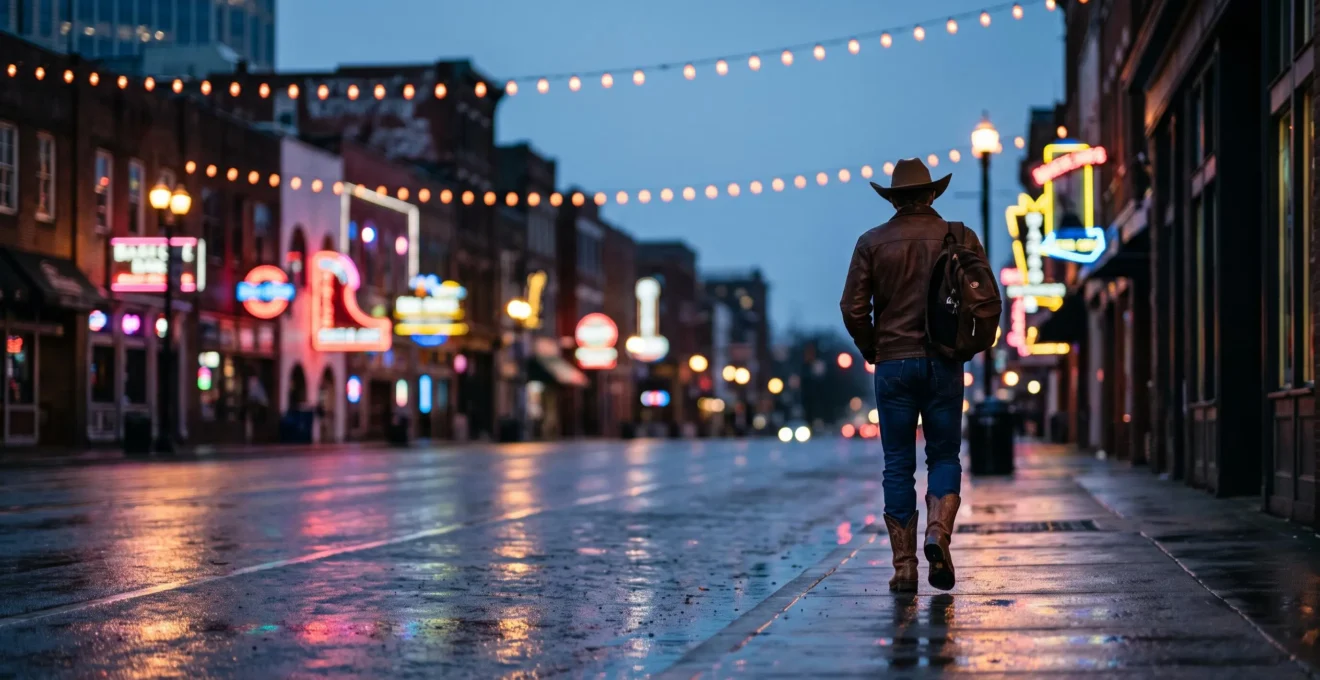
As the scene above shows, you can tell a lot from the outside. Certain activities are bachelorette magnets. A prime example is the pedal tavern. One operator reported that roughly 80 percent of the company’s business comes from bachelor and bachelorette groups. This is your intel. If you see a bar that’s a popular drop-off spot for these taverns, or one heavily promoted on bachelorette blogs (like the celebrity-owned bars with multi-level rooftops), you know what you’re getting into. For a more traditional, music-focused night, aim for the smaller, historic honky-tonks like Robert’s Western World or the Bluegrass Inn.
Your mission is to find the right environment for your crew. Choosing a bar is an active decision, not a random one. Use your eyes and ears, and you’ll find your spot.
Bottes de cowboy ou baskets : que porter pour tenir debout toute la nuit ?
This might seem like a small detail, but it’s not. What you put on your feet will make or break your night. I see people hobbling down the street at midnight, their faces a mask of pain because they chose style over substance. Don’t be that person. The floors in these bars are a sticky, treacherous battlefield of spilled beer and broken dreams. Your footwear is your armor.
The absolute, non-negotiable rule is to wear closed-toe shoes. The floors are packed, and people will step on you. It’s not a matter of if, but when. Leaving your toes exposed is asking for a trip to the emergency room. Now, the classic debate: cowboy boots or sneakers? Both can work, but you need to know the trade-offs. If you just bought a new pair of boots, do not—I repeat, do not—wear them for a twelve-hour Broadway marathon. You need to break them in first.
To make the right call, you need to think like a pro. It’s a balance of protection, comfort, and how well they’ll survive the night. Here’s a breakdown to help you make a tactical decision:
| Metric | Cowboy Boots | Sneakers |
|---|---|---|
| Comfort (after break-in) | High, once broken in | High from the first wear |
| Protection (spills, glass, stepped-on toes) | Best — closed, sturdy leather | Good if closed-toe, weaker sole protection |
| ‘Stick-Proofness’ on honky-tonk floors | Good — leather sole cleans easily | Mixed — mesh uppers can absorb spills |
| Style fit for the scene | On-theme, classic Broadway look | Neutral, functional |
Ultimately, a broken-in pair of boots is the champion, but a sturdy pair of leather sneakers is a close second. The wrong choice won’t just hurt your feet; it’ll end your night early. Choose wisely.
Pourquoi aller sur Broadway à 14h est souvent mieux qu’à 22h ?
Here’s the single best piece of advice I can give you: the timing of your arrival dictates your entire experience. Most tourists think the party starts at 10 PM. They’re wrong. By 10 PM, the battle for Broadway is already lost to long lines, packed floors, and maximum chaos. The pro move, the one that guarantees you a better time, is to start your day early.
As the experts at Visit Music City point out, “If you head to Lower Broadway during the day, the Honky Tonks are not as packed and the music is just as good.” In fact, it’s often better. The daytime bands are full of world-class musicians, often the same people who play in the big-name touring acts. You can get a front-row seat, actually have a conversation without screaming, and the bartenders have time to talk to you. You get all the talent with none of the hassle.
The vibe of Broadway shifts dramatically as the day goes on. You need to understand this timeline to deploy your crew at the optimal moment. Think of it as choosing your level of difficulty.
| Time Window | Atmosphere | Best For |
|---|---|---|
| 12 PM – 4 PM | Chill, acoustic, uncrowded | Music lovers, photography, easy bar seating |
| 4 PM – 8 PM | Energy builds, dinner crowds arrive | Families, early diners |
| 8 PM – 12 AM | Peak party, high energy, long lines | Bachelorette groups, big-night-out crowds |
| 12 AM – 3 AM | Chaos, last-call rush | Survival mode only |
Show up in the early afternoon, find a bar you love, and post up. You can enjoy hours of amazing music, then step out into the 8 PM madness for a little while just to see it, and be back at your hotel before the real amateur hour begins. Work smarter, not harder.
Uber ou Taxi : comment quitter le centre-ville quand les rues sont bloquées ?
This is the most critical phase of your mission: the extraction. You’ve had your fun, but now it’s time to get your crew home safely. This is where most people fail. They wander out of the bar at 2 AM, pull out their phone, and are shocked to find that they can’t get a ride and prices are through the roof. This cannot be an afterthought; it must be part of the plan from the beginning.
At peak times, the streets of Lower Broadway are often closed to traffic. Trying to get a rideshare to pick you up right on the strip is a fantasy. It won’t happen. The drivers can’t get to you, and the app will just spin. On top of that, you’ll be hit with astronomical surge pricing. Research shows that Lower Broadway on a Saturday night routinely hits 3-4x surge, a massive jump from normal fares. Don’t get caught in that trap.
The solution requires two things: walking and planning. The city of Nashville knows this is a problem, and they’ve created a solution you must use. In response to the chaos, the Nashville Department of Transportation is rolling out 24 designated rideshare pickup and dropoff zones downtown. These zones are your salvation. Before you even leave your hotel, open your map and identify the closest designated pickup zone to where you plan to be. It will likely be a few blocks away from the main strip.
When you’re ready to leave, don’t even try to order the car from inside the bar. Walk as a group directly to your pre-identified pickup zone. Find a well-lit corner, away from the main crush of people. Only then should you order your ride. The driver will have a clear, accessible place to find you, and you will have bypassed 90% of the chaos. This is non-negotiable for a safe and efficient exit.
A successful night on Broadway ends with everyone getting back safely, not with a two-hour struggle to find a ride. Plan your exit before you even enter.
Comment tipper un bartender pour être servi rapidement la prochaine fois ?
Let’s get one thing straight. The person behind the bar is your gatekeeper to a good night. How you treat them on your first order will determine the service you get for the rest of the evening. In a place as busy as Broadway, bartenders have to triage. They are going to serve the people who are efficient, respectful, and who understand the system.
You need to understand that their income depends on you. With a tipped minimum wage of $2.13/hr versus a $7.25 regular minimum, your tips aren’t just a bonus; they are their livelihood. This isn’t just some casual cash transaction; in many established bars, it’s part of a formal system where bartenders receive benefits like health insurance and retirement plans, and an accounting system forces them to report and pay taxes on their tipped income. Your tip is part of their professional compensation.
So, how do you get on their good side? It’s a simple three-step process:
- Know your order. When you get to the bar, have your entire group’s order ready. Don’t make the bartender wait while you ask five friends what they want.
- Pay with cash if possible. It’s faster than running a card, especially for a single round.
- Tip well on the first round. The standard is $1 per beer and $2 per cocktail. If you get a round of four cocktails, leave a $10 bill. Make eye contact, say “thank you,” and leave the tip.
That’s it. You’ve just signaled that you’re a pro. The next time you approach the bar, they will see you, they will remember you, and you will likely get served before the five people who have been waving their credit cards in the air for ten minutes.
This isn’t about buying friendship; it’s about showing respect for a professional doing a very difficult job. That respect will be returned in the form of fast, efficient service all night long.
Key takeaways
- Strategic Timing: Your experience is defined by when you go. An afternoon start (2-4 PM) beats the 10 PM chaos for better music and access.
- The Economic Rules: Broadway runs on tips. Bring cash for bands and bartenders; it’s not optional, it’s the cost of entry.
- Plan Your Exit: Your night isn’t over until you’re home. Identify your rideshare pickup zone before you leave your hotel to avoid being stranded.
Centre-ville ou banlieue : quel quartier choisir pour la sécurité et le prix ?
Your Broadway mission begins before you even smell the beer and hear the music. It begins with where you choose to set up your base of operations. This decision—staying downtown versus in a nearby neighborhood—is the most important one you’ll make. It’s a direct trade-off between price, convenience, and your end-of-night safety plan.
Staying in a downtown hotel, within walking distance of Broadway, is the premium option. It’s also the most expensive. A trip to Nashville can easily run from $800 to $1,500+ per person, and a huge chunk of that is accommodation. The massive advantage, however, is that you eliminate the biggest risk factor of the night: the journey home. When your hotel is a ten-minute walk away, you are not at the mercy of surge pricing or the chaos of finding a ride.
If your budget doesn’t allow for a downtown stay, you can find more affordable options in neighborhoods like The Gulch, Midtown, or East Nashville. This can save you hundreds of dollars, but it introduces a new logistical challenge. You are now dependent on transportation. This means your exit strategy (as we discussed in the Uber/Taxi section) becomes ten times more critical. You cannot just “wing it.” You must factor in the cost and time of getting to and from Broadway each night.
As one local guide puts it, “Walkability is the deciding factor.” If you stay downtown, you pay a premium for the ability to walk home safely. If you stay further out, you save money on the room but must have a rock-solid, pre-planned strategy for getting back. For a group that’s nervous about the late-night scene, the peace of mind that comes with a walkable hotel might be worth every penny.
Consider your group’s priorities. Is it budget above all, or is the security of a simple walk home more valuable? Make this decision with your eyes open, and your entire Nashville experience will be smoother.
Why Do UK Travellers Often Get Rejected at US Bars Despite Being Over 21?
Alright, a special briefing for my friends coming from across the pond. I’ve seen this happen a hundred times. A group from the UK, all clearly over 21, steps up to the door. They hand me a UK driving licence, and I have to turn them away. The frustration is real, and it’s completely avoidable if you understand the rules from my side of the door.
Here’s the deal: it’s not personal. It’s about liability. Tennessee has extremely strict laws about serving alcohol to minors. For a bar, a single violation can result in a fine of up to $1,500 and the potential loss of our liquor license. As one legal guide bluntly states, “Ignorance is not a valid defense—if an employee sells alcohol to a minor, the business remains liable.” We are trained to identify specific, acceptable forms of ID, and a foreign driver’s license that we are not familiar with is a massive risk we simply cannot take.
Your foreign driving licence, no matter how official it is back home, is not on the list of approved IDs here. So what do you do? You follow the playbook. The one and only document that will work for you 100% of the time is your physical passport. Not a picture of it on your phone. Not a photocopy. The actual, government-issued booklet.
Your ID Checklist to Get Past the Door
- Primary ID: Always lead with your physical passport. It is the universally accepted form of identification that every bouncer is trained to recognize.
- Backup ID: Keep a secondary photo ID, like your UK driving licence, with you just in case, but never offer it first.
- Secure Carry: Do not carry your passport loosely in a pocket. Use a secure crossbody bag or an internal jacket pocket. During the day, leave it in the hotel safe.
- Group Check: Before you leave for the night, make sure every single person in your group has their physical passport. Don’t let one person’s mistake ruin the night for everyone.
- No Phone Photos: A photo of your passport on your phone is not a valid ID. Do not even try to present it.
It feels like a hassle to carry your passport, I get it. But it is the only way to guarantee entry. Follow this rule, and I’ll be happy to welcome you in. Argue with it, and you’ll be spending your night on the sidewalk. The choice is yours.