Stop thinking your rejection at a US bar is personal—it’s pure business liability.
- Your UK driving licence is often rejected not because it’s foreign, but because it’s easily faked and puts the bar’s liquor license at severe financial and legal risk.
- Tipping isn’t a “thank you”; it’s the core of a bartender’s income due to a federal tipped minimum wage that can be as low as $2.13 per hour.
Recommendation: Always carry your passport as primary ID for nightlife, tip at least $1 per drink in cash, and accept that the doorman’s decision is final and absolute to protect the establishment.
You’ve landed in the States, you’re over 21, and you’re ready for a night out. You walk up to a bar, confidently present your UK driving licence, and the bouncer gives you a flat “No.” It feels arbitrary, insulting, and confusing. You’re of legal age. The ID is government-issued. What’s the problem? The common assumption is that the bouncer is on a power trip or simply unfamiliar with foreign documents. That’s where you’re wrong.
From my side of the bar, let me be perfectly clear: we are not in the business of making you feel welcome at the expense of our livelihood. The American hospitality industry, especially when it comes to alcohol, operates under a constant and crushing threat of legal liability. Every single rule, from ID checks to dress codes, is a calculated business decision designed to mitigate risk. It has almost nothing to do with you personally and everything to do with state liquor authorities, insurance premiums, and the potential for financially ruinous lawsuits.
Forget what you know about the relaxed atmosphere of a British pub. This isn’t a social agreement; it’s a heavily regulated transaction. The real key to navigating US nightlife isn’t just knowing the rules, but understanding the high-stakes logic that created them. This guide is your briefing from the inside. I’ll explain why your ID gets rejected, how our tipping culture actually works, and why the house always has the final say, so you can spend less time arguing at the door and more time enjoying your trip.
This article breaks down the unwritten rules and legal realities that govern American nightlife. The following sections will guide you through the critical points of friction for UK travellers, from the front door to the last drink of the night.
Summary: Decoding the Strict Code of American Nightlife for UK Visitors
- Passeport ou permis : pourquoi votre permis de conduire britannique peut être refusé ?
- Dernière commande à 2h ou 4h : comment varient les lois selon les villes ?
- Comment tipper un bartender pour être servi rapidement la prochaine fois ?
- L’erreur de porter des baskets dans les clubs de Las Vegas ou Miami
- Cover charge : pourquoi faut-il payer juste pour entrer dans un bar vide ?
- Comment consommer le cannabis légalement sans enfreindre les règles fédérales ?
- Les 3 restaurants “typiques” que les locaux évitent absolument
- How to Visit Major US Cities Like NYC or Chicago without Spending £200 a Day?
Passeport ou permis : pourquoi votre permis de conduire britannique peut être refusé ?
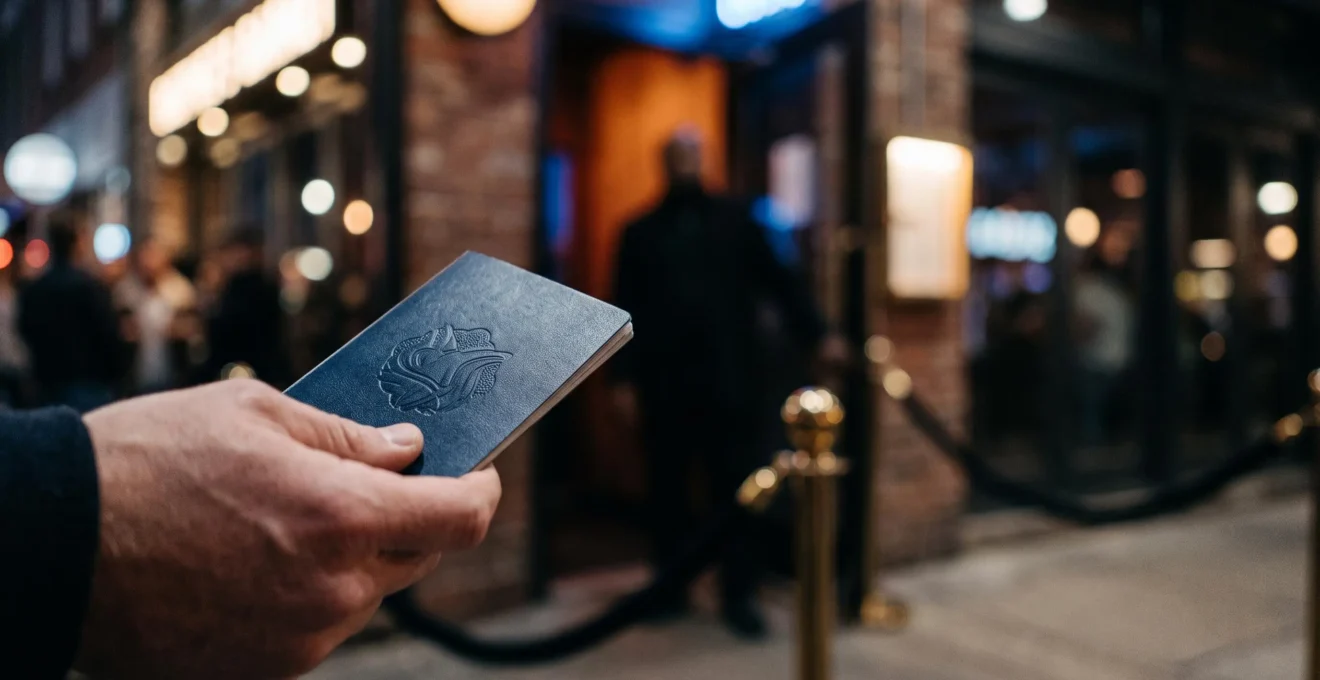
Let’s get this straight first: your UK driving licence is not a universally accepted form of identification for purchasing alcohol in the United States. Period. The reason is not ignorance; it is risk mitigation. For a bar or club, accepting an unfamiliar ID is a massive gamble. Fake IDs are a huge problem, and our staff are trained to spot inconsistencies in local and national US IDs. They are not trained to be experts on the security features of documents from dozens of different countries. If a bartender makes a mistake, the consequences are severe.
The legal framework here is known as “Dram Shop Law,” which holds an establishment financially liable for the actions of an intoxicated person they served, especially if that person is underage. A single error can lead to a catastrophic lawsuit that shutters the business. As one real-world example shows, a bartender was held personally liable after serving an underage guest who used a fake ID; this isn’t just a business risk, it’s a personal one. At a wedding reception, a bartender failed to catch a fake ID and served an underage guest; the server was later held financially liable for the incident.
This is why the passport is the gold standard for international visitors. It is a federally recognized, highly secure document that every bouncer and bartender is trained to accept. Presenting anything else, including a UK licence, forces the staff member to make a judgement call. Given that repeated violations can lead to fines and even jail time for staff, the safest call for them is always to say no. Don’t take it personally. They are protecting their job and the business’s liquor license. Your convenience is not their priority; legal compliance is.
Action Plan: Your ID Pre-Flight Check
- Point of Contact: Identify all situations where you’ll need ID (bars, clubs, cannabis dispensaries, buying alcohol in a store).
- Inventory: Make a physical or digital copy of your passport for backup, but understand that only the original physical passport is guaranteed to be accepted.
- Consistency Check: Does your appearance reasonably match your passport photo? If you’ve drastically changed your look, be prepared for extra scrutiny.
- Memorability: Do not put your passport in a back pocket or loose bag. Treat it as you would a large sum of cash. Losing it will ruin your holiday.
- Integration Plan: Make checking for your passport part of your “going out” routine, just like your phone and wallet. Never leave it in the hotel.
Dernière commande à 2h ou 4h : comment varient les lois selon les villes ?
Once you’re inside, the next point of confusion is often “last call.” Unlike the UK, where closing times can be more fluid, US cities have hard, legally mandated cut-offs for serving alcohol. These times are not suggestions; they are the law. The most common last call time across the country is 2:00 AM. This is the standard in major cities like Los Angeles, San Francisco, Philadelphia, and Boston.
However, this is not a federal rule, and it varies significantly by state and even by city. This patchwork of regulations is a classic example of American federalism. For example, New York City and Chicago are famous for their 4:00 AM last calls, contributing to their reputations as cities that never sleep. Miami Beach pushes it to 5:00 AM. On the other end of the spectrum, some states or counties are “dry” or have much earlier closing times, like 1:00 AM or even midnight, especially in more rural or conservative areas.
Why the variation? It’s a balance between business interests (bars wanting to sell for longer) and public policy concerns (reducing drink-driving incidents and public disorder). The 2:00 AM standard is a widely adopted compromise. When you hear the bartender shout “last call for alcohol!” about 30 minutes before the cut-off, it is your final chance to order. Do not argue or try to plead for “one more.” At the legal cut-off time, all drinks must be off the tables, and the establishment must begin clearing out. It’s a hard stop, and we are legally obligated to enforce it.
Comment tipper un bartender pour être servi rapidement la prochaine fois ?
This is the most critical cultural difference you will face. In the US, tipping your bartender is not optional, and it is not a small gesture of thanks for exceptional service. It is the primary component of their salary. The economic reality is stark: according to federal law, tipped employees in the U.S. must receive a minimum wage of $2.13 per hour, a figure that has been frozen for decades. While some states mandate a higher tipped wage, the system is built on the assumption that tips will make up the bulk of a server’s income.
For a UK visitor, this means you must recalibrate your thinking entirely. The standard, baseline tip for good service at a bar is $1 per drink (for beer or wine) or $2 per complex cocktail. Alternatively, you can aim for 15-20% of the total bill. The easiest way to handle this is with cash. When you order your drinks, leave a dollar bill on the bar for each one. This is more than a transaction; it’s a signal. You are acknowledging the system and showing respect for the bartender’s work.
This simple act will get you noticed. In a crowded bar, a bartender’s attention is their most valuable commodity. They will prioritize customers who they know are tipping. A good tip on the first round establishes a relationship. By the second or third round, you’ll find your glass is filled faster, and you might even get a subtle nod of recognition. Fail to tip, and you will become invisible. It’s not malicious; it’s just business. The bartender will focus on the 20 other customers who are paying their wages.
The state-level variations in this system can be complex, as the tipped minimum wage is not the same everywhere. It’s a patchwork of local economic realities. This is demonstrated by a recent analysis of tipped wages, which shows the dramatic differences a bartender might face depending on their location.
| State | Tipped employee minimum wage | Combined minimum with tips |
|---|---|---|
| Idaho | $3.35/hr | $7.25/hr |
| Maryland | $3.63/hr | $15.00/hr |
| Florida | $9.98/hr | $13.00/hr |
| Hawaii | $12.75/hr | $14.00/hr |
L’erreur de porter des baskets dans les clubs de Las Vegas ou Miami
The dress code, particularly in high-end nightclubs in cities like Las Vegas, Miami, or New York, is another rule that feels arbitrary but is a calculated part of the business model. It is not about personal comfort; it is about vibe curation. The club is selling an exclusive, high-energy, aspirational experience. The crowd is part of the product, and the dress code is the quality control mechanism.
Wearing the wrong thing—specifically athletic wear—signals that you don’t understand or respect the environment. For men, this is especially strict. The general rules for most upscale clubs are clear:
- No shorts, regardless of how hot it is.
- No athletic sneakers (running shoes, basketball shoes).
- No flip-flops or sandals.
- No baggy t-shirts, tank tops, or athletic jerseys.
- No hats.
For men, the safe bet is always a pair of dark jeans or trousers, a collared shirt (button-down or a smart polo), and dress shoes. For women, the code is often more relaxed, but the expectation is still “dress to impress.”
Now, what about “designer” sneakers? This is a grey area where the ultimate rule of US nightlife comes into play: the doorman has absolute discretion. A pristine pair of £400 leather sneakers might be acceptable, while a scuffed pair of trainers will get you rejected instantly. The doorman is the final arbiter of style and their decision is non-negotiable. As club promoter C. Nez Byrd states, entry is always at the doorman’s discretion, regardless of the written code. Arguing is pointless and will only guarantee you’re not getting in. Their job is to build a room that looks and feels a certain way. If you don’t fit the picture, you’re out.
Cover charge : pourquoi faut-il payer juste pour entrer dans un bar vide ?
You arrive at a bar or club, perhaps early in the evening, and it looks nearly empty. Yet, the person at the door asks for a $10 or $20 “cover charge.” Your immediate reaction is likely “Pay to get into an empty room? No thanks.” This is a misunderstanding of what the cover charge is for. It is not a payment for the current atmosphere; it is an investment in the atmosphere that is being created.
A cover charge serves several business functions. First and foremost, it helps cover fixed operational costs that exist whether the bar is full or empty. This includes the salary for the DJ or the band who is about to start playing, the security staff at the door and inside, and the general overhead of running a large venue. You are not paying for what the bar is, but for what it is about to become in an hour.
Second, it acts as a form of demand management and crowd filtering. A cover charge, even a small one, creates a barrier to entry. It tends to filter out people who are not committed to staying and spending money, which can lead to a better-quality crowd later in the night. It also helps manage capacity. If a popular DJ is scheduled, the cover charge captures some of the value they bring and can be adjusted to control the number of people who enter. Seeing a bar as empty and refusing to pay the cover is a bit like seeing an empty theatre an hour before a show and refusing to buy a ticket because the actors aren’t on stage yet.
Comment consommer le cannabis légalement sans enfreindre les règles fédérales ?
This is one of the most confusing legal areas for any visitor. You’ll see cannabis dispensaries operating openly in states like California, Colorado, and Nevada, and you might assume it’s legal everywhere, just like alcohol. This is a dangerous assumption due to the massive conflict between state and federal law.
At the federal level—the national government level—cannabis remains a Schedule I controlled substance, meaning it is illegal. However, many individual states have passed their own laws legalizing it for recreational or medical use. This creates a confusing duality. You can walk into a licensed shop in Las Vegas and legally buy cannabis, but the moment you step onto federal property (like a national park, a federal courthouse, or even some federal agency buildings), you are subject to federal law, and possession is a crime.
The most critical rules for a tourist are:
- Do not cross state lines with it. Transporting cannabis, even between two states where it is legal, is a federal crime. Consume it in the state where you bought it.
- Do not smoke in public. Just like open container laws for alcohol, public consumption of cannabis is almost universally illegal. This includes parks, sidewalks, and especially in your rental car.
- Hotels and rental cars have strict no-smoking policies. Violating them can result in hefty cleaning fees. Edibles are a more discreet option.
- You cannot fly with it. Airports are under federal jurisdiction. Bringing cannabis into an airport is a federal offense, even if you are flying between two “legal” states.
In short, if you choose to partake, buy from a licensed dispensary (you’ll need your passport), consume it privately within that state, and do not attempt to travel with it.
Les 3 restaurants “typiques” que les locaux évitent absolument
As a visitor, you want an “authentic” American experience, but the places that market themselves most aggressively as “typical” are often the ones any local would tell you to avoid. It’s not about snobbery; it’s about value and quality. As a bar manager, I see tourists fall into the same traps every night. Here are the three archetypes of restaurants that are, in reality, tourist traps.
First is The Times Square Chain Experience. This applies to any major tourist hub, not just NYC. Think of those massive, brightly-lit chain restaurants that you can find in any major city in the world, but this one has a giant guitar or a fake rainforest inside. You are paying a 50% premium for mediocre, mass-produced food in exchange for a familiar name and a location you stumbled upon. Locals avoid these because they know they can get far better food for half the price three blocks away.
Second is The “Authentic” Gimmick. This is the restaurant that leans so hard into a theme it becomes a caricature. The “Old West” steakhouse with plastic cacti, the “1950s Diner” where the staff seem miserable in their costumes. The focus is entirely on the decor and the gimmick, while the food is an afterthought—often frozen, microwaved, and overpriced. Real authenticity is found in places that don’t need to shout about it.
Finally, there’s The Restaurant With The View. In any city with a skyline or a waterfront, there will be restaurants with breathtaking views and, sadly, breathtakingly bad food. These places know that their location is the main draw. They can charge exorbitant prices for subpar cuisine because tourists will pay for the photo opportunity. A local’s trick is to go to the bar at that restaurant for one drink to see the view, and then go have dinner at a place known for its food.
Key Takeaways
- Your ID is a liability assessment for the bar, not a simple age check. Your passport is the only guaranteed pass.
- Tipping is not a bonus for good service; it is the fundamental payment structure for service staff. Tip at least $1 per drink.
- The house rules are absolute. The doorman’s discretion, the dress code, and last call are non-negotiable extensions of the bar’s legal and business strategy.
How to Visit Major US Cities Like NYC or Chicago without Spending £200 a Day?
It seems like a contradiction, but the secret to enjoying America’s expensive cities on a budget is to fully absorb the lessons from the nightlife rules. The same logic applies: avoiding the obvious, understanding the underlying system, and seeking genuine value over marketed “experiences.” Spending a fortune is easy; being smart takes a little more effort but is infinitely more rewarding.
The tourist who spends £200 a day is the one who eats at the Times Square chain, pays cover at the flashy nightclub, and takes Ubers everywhere. The savvy traveller understands the system. They eat at the small, family-run taco shop a local recommended. They find a great dive bar with a good jukebox and cheap beer instead of a club with a cover charge and £20 cocktails. They learn the public transit system instead of relying on ride-sharing apps for every trip.
Ultimately, navigating a US city affordably is about acting less like a tourist and more like a resident. Look for happy hours. Find the neighborhoods where real people live and eat. Acknowledge the local customs, like tipping, not as an annoying expense but as part of the social and economic fabric. When you understand and respect the system—from the bouncer’s strict ID check to the bartender’s reliance on tips—it stops being a barrier and becomes your guide to a more authentic and affordable trip. You don’t need a massive budget to have a great time; you just need to be smart.
By understanding these rules not as obstacles but as a reflection of a different system, you can navigate your American journey with confidence. Apply these insights, and you’ll not only avoid frustration but also discover a more genuine side of the cities you visit.