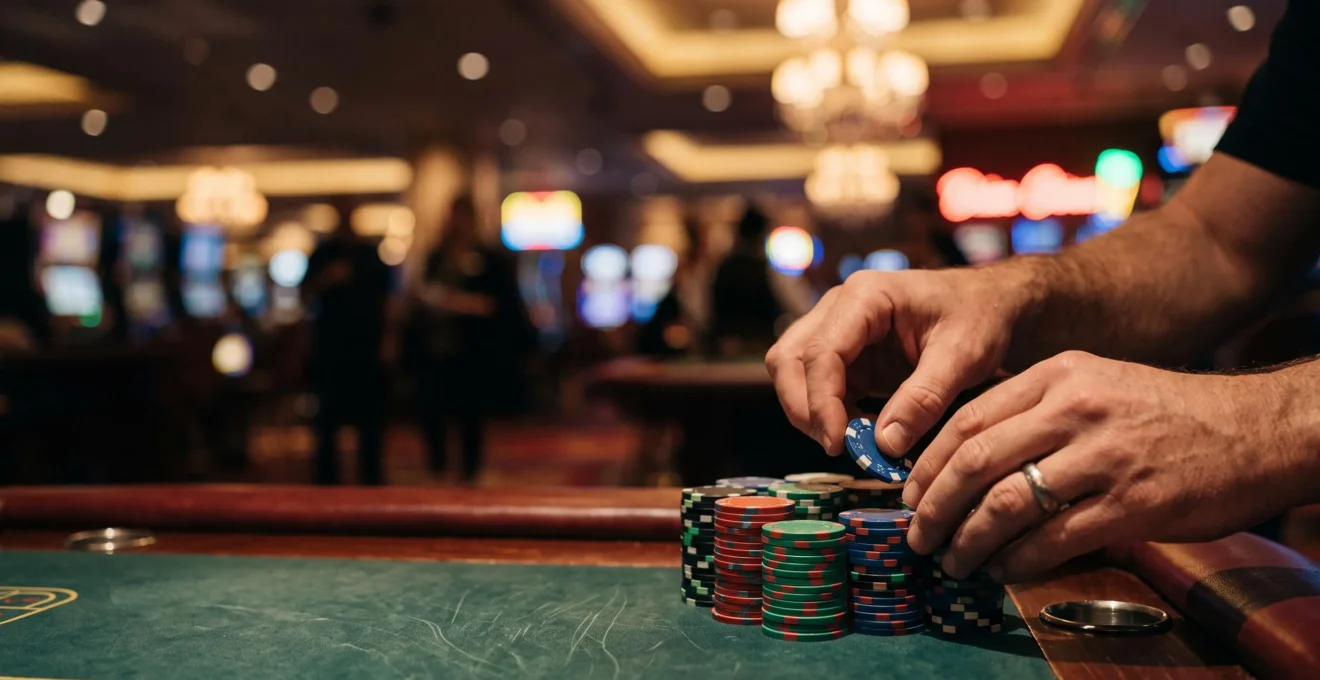
The secret to surviving Las Vegas isn’t luck; it’s understanding that the casino is a system engineered to separate you from your money, and your bankroll is your only defense.
- Your ’stop-loss’ limit isn’t a suggestion; it’s an unbreakable rule designed to combat a documented psychological flaw called ’loss chasing’.
- Choose games based on cold math (Blackjack’s ~0.5% house edge) not blind hope (Roulette’s 5.26% house edge).
- Recognize that “free” perks are calculated costs: free cocktails impair judgment, and mandatory resort fees drain your budget before you even play.
Recommendation: Treat your bankroll as a strategic tool for managing risk within a hostile environment, not as disposable entertainment money.
The first time you step onto a Las Vegas casino floor, it’s a sensory assault. The chorus of slot machines, the absence of clocks, the maze-like layout—it’s all designed for a single purpose: to make you lose track of time and, eventually, your money. You’ve probably heard the standard advice: “set a budget,” “only bet what you can afford to lose,” “know when to walk away.” As a former croupier who has spent thousands of hours on the other side of the felt, I can tell you that advice is dangerously incomplete.
Those platitudes rely on willpower, and willpower is the first thing to evaporate under the Vegas lights. The casino isn’t a game of chance; it’s a meticulously engineered system of psychological and mathematical traps that shapes every corner of an insider’s guide to the Las Vegas Strip. Free cocktails aren’t generosity; they’re a tool to lower your inhibitions. The constant opportunity for small wins isn’t luck; it’s a mechanism to keep you hooked. Your bankroll isn’t just a pile of chips; it’s your psychological armor, your lifeline in an environment designed to drain it.
But what if you could understand the system from the inside? What if, instead of fighting the casino with sheer willpower, you could use its own logic against it? This guide won’t give you superstitious tricks to win. It will give you a mathematical and psychological framework, built from an insider’s perspective, to deconstruct the casino’s playbook. We will move beyond the generic advice and focus on the mechanics of the games, the real cost of “free” amenities, and the cognitive biases the house preys on. The goal isn’t to get rich; it’s to have the most fun possible and walk out with your dignity and your wallet intact.
This article will provide a structured approach to protect your bankroll. By dissecting the common pitfalls and understanding the underlying mathematics, you will be equipped to navigate the casino floor like a seasoned regular, not a vulnerable tourist.
Summary: A Croupier’s Guide to Vegas Bankroll Management
- Tipping the Dealer: How Much to Give Without Looking Like an Amateur?
- Blackjack or Roulette: Which Game Offers the Best Statistical Odds?
- Why Free Cocktails Are the Casino’s Most Costly Trap
- The Mistake of Trying to ’Win Back’ a $200 Loss
- Players Club: How to Get Free Meals Even When Playing Little
- The Budget Oversight That Costs Families £500 on an American Road Trip
- Club Level: Are the Included Meals and Drinks Worth the Room Upgrade Cost?
- Resort Fees and Hidden Costs: The Real Price of a Vegas Hotel Stay
Tipping the Dealer: How Much to Give Without Looking Like an Amateur?
First, let’s clear the air with some hard numbers. You might feel immense social pressure to tip the dealer after every winning hand, but from my side of the table, I can tell you the reality is different. Many players, especially at lower-stakes tables, are focused on their own bankroll, and that’s exactly what they should be doing. In fact, a well-known gambling etiquette guide suggests that less than 40% of the people who play blackjack tip the dealer. Tipping is a gesture of goodwill, not a mathematical obligation. You will not be judged for protecting your budget.
That said, if you’re having a good run and want to share the good fortune, there’s a smart way to do it that insiders respect. Instead of just sliding a chip forward, place a “bet for the dealer.” This is how it works: you place a chip for the dealer next to your own bet (not on top of it) and clearly state, “This one’s for you.” If the hand wins, the dealer gets your original bet plus the winnings as their tip. It makes the dealer a partner in your success for that one hand. It’s a sign of class that separates you from amateurs who just throw money.
How much? A dollar chip on a winning hand at a $10-$25 table is perfectly acceptable. On a hot streak, or after a big blackjack payout, maybe a $5 chip. The key is consistency and sincerity, not extravagance. Remember, the primary function of your bankroll is to keep you in the game, not to fund the casino staff. A good dealer understands and respects that.
Blackjack or Roulette: Which Game Offers the Best Statistical Odds?
This is the most fundamental question a player must answer, and the choice you make has a bigger impact on your bankroll than any lucky charm. The answer isn’t a matter of opinion; it’s cold, hard math. As a croupier, I saw fortunes evaporate on the simple misunderstanding of this principle. Your enemy is the “house edge”—a built-in mathematical advantage the casino has on every single bet.
Let’s break it down. Roulette is a game of pure chance. Once the ball is spinning, you have zero influence on the outcome. An American Roulette wheel, with its “0” and “00”, gives the house a staggering 5.26% edge. That means for every $100 you bet, you are statistically expected to lose $5.26 over the long run. In contrast, Blackjack is a game of skill and strategy. Your decisions—to hit, stand, split, or double down—directly impact your odds. A player using perfect basic strategy can reduce the house edge to as low as 0.5%. This is not a typo. The difference is tenfold.
This table illustrates the stark reality of your choice. A game like Blackjack offers you a fighting chance, while American Roulette is designed to slowly but surely grind your bankroll down.
Here is a direct comparison of the mathematical advantage the casino holds in these popular games:
| Game | Typical House Edge | Player Influence on Odds |
|---|---|---|
| Blackjack (basic strategy, 3:2 payout) | 0.5% – 0.61% | High (decisions affect outcome) |
| European Roulette (single zero) | 2.7% | None (pure chance) |
| American Roulette (double zero) | 5.26% | None (pure chance) |
The crucial takeaway is that while Blackjack’s low house edge is appealing, it’s contingent on you making the right mathematical decision every time. This introduces a psychological trap: the “illusion of control.” You can make choices, but any deviation from basic strategy out of gut feeling or frustration will instantly inflate the house edge back in the casino’s favor. Your job is to play the math, not your emotions.
This visual of dice and chips underscores the tangible nature of risk. Choosing your game is the first, and most critical, bet you’ll make. Choosing Blackjack over Roulette is the strategic equivalent of wearing armor into battle. It doesn’t guarantee victory, but it dramatically improves your odds of survival.
Why Free Cocktails Are the Casino’s Most Costly Trap
The cocktail waitress approaches your table, offering a complimentary drink. It feels like a perk, a reward for your patronage. It is the single most effective and insidious tool the casino uses to dismantle a player’s strategy. From the house’s perspective, that “free” drink is an investment with a calculated, positive expected return. For you, it’s a liability that silently sabotages your most valuable asset: your judgment.
The effect of alcohol on gambling behavior is not anecdotal; it’s a well-documented phenomenon. The science is clear: even moderate amounts of alcohol have a disinhibiting effect. One study confirmed that alcohol can have a disinhibiting effect on gambling behaviour, in terms of bet size and persistence. This means that after just one or two drinks, you are statistically more likely to bet larger amounts, play for longer than you planned, and chase losses more aggressively. You’re no longer playing against a 0.5% house edge in Blackjack; you’re playing against your own impaired brain.
The mechanism is a simple hijacking of your brain’s reward system. As researchers from the Judgment and Decision Making journal noted when studying the Iowa gambling task:
“impaired decision-making during alcohol intoxication … stems from heightened sensitivity to immediate rewards.”
– Study authors, Judgment and Decision Making journal
In casino terms, this means the short-term thrill of a potential win becomes far more attractive, while the long-term risk to your bankroll fades into the background. That “free” cocktail costs you your discipline. The most successful players I’ve ever seen, the ones who treated it like a profession, drank water or coffee. They understood they needed their wits fully about them. Your rule should be simple: if you are betting, you are not drinking alcohol. If you want a drink, cash out your chips, leave the table, and go to a bar. Separating the two activities is a non-negotiable piece of your psychological armor.
The Mistake of Trying to ’Win Back’ a $200 Loss
This is the most dangerous moment on the casino floor. It’s not a big win or a big loss, but the first significant dip in your bankroll. You came with $500, and after an hour, you look down and you only have $300. An alarm goes off in your head. The fun stops, and a new, desperate mission begins: “I just need to get back to even.” This emotional reaction is the single greatest accelerator of financial ruin in a casino, and it has a clinical name: loss chasing.
Loss chasing is not a sign of weak character; it is a predictable cognitive bias that the entire casino environment is designed to trigger and exploit. When you lose money, your brain processes it as a mistake that needs to be corrected. You increase your bet size and take bigger risks, not out of a desire to win more, but out of a desperate need to erase the previous loss. The casino knows this. The house loves a player who is trying to “get even.” That player is no longer thinking rationally; they are bleeding money.
This isn’t just folk wisdom; it is a recognized symptom in the study of gambling disorders. As neuroscience research on gambling disorder confirms that “In GD [Gambling Disorder], this matches well with the clinical phenomenon of loss chasing, where GD patients continue to gamble after severe losses.” You, as a recreational player, are susceptible to the exact same psychological mechanism. That $200 loss stings, and your instinct is to fight. This is where your pre-defined rules become your only salvation.
This is why your “stop-loss” limit is the most important rule of all. Before you ever place a bet, you must decide on a number—the amount of money you are willing to lose in a single session—and treat it as an unbreakable law. If your stop-loss is $200, the moment your stack dips to that level, you get up and walk away. No “one last hand.” No switching to a “luckier” table. The session is over. This isn’t quitting; it’s a strategic retreat. It is the only effective circuit breaker for the loss-chasing short-circuit in your brain.
Players Club: How to Get Free Meals Even When Playing Little
Every casino employee will push you to sign up for the Players Club card. The marketing pitch is that it’s your ticket to “comps”—free meals, hotel rooms, and show tickets. Most tourists believe comps are based on how much you win or lose. This is a fundamental misunderstanding of the system. As an insider, let me tell you the truth: the casino doesn’t care if you win or lose; it cares how much you play.
The Players Club card is, first and foremost, a tracking device. When you insert it into a slot machine or hand it to the pit boss at a table game, you are allowing the casino to monitor your “action.” The key metric they track is called “coin-in” or “total handle.” This is the total amount of money you wager, regardless of the outcome. For example, if you sit at a video poker machine with $100 and play for an hour, cycling through that money several times, you might generate $1,000 in “coin-in” even if you walk away with the same $100 you started with.
Comps are calculated as a small percentage of your theoretical loss to the casino, which is based on your total action. So, how do you get free meals while playing little? You exploit this system. You choose a low-volatility game with a very low house edge, like specific versions of video poker (e.g., Jacks or Better with a full-pay table). You then play that game slowly and methodically, for a long period of time. Your actual monetary risk is minimal, but you are racking up a significant amount of “coin-in.”
The casino’s algorithm sees your extended playtime and high action and flags you as a valuable player, even if your actual losses are close to zero. After a few hours of this, you can go to the Players Club desk and ask, “Do I have anything for a buffet pass?” More often than not, the answer will be yes. You’ve used the casino’s own tracking system to your advantage, generating comps by trading time instead of money. It’s the smartest way to get a “free” lunch in Vegas.
The Budget Oversight That Costs Families £500 on an American Road Trip
While the title might seem oddly specific, the principle is universal and directly impacts your gambling bankroll: hidden costs. Many visitors arrive in Vegas with a carefully planned budget for gambling, food, and shows. What they fail to account for is the gauntlet of mandatory fees that drain that budget before they ever place a single bet. Your bankroll doesn’t start at zero; in Vegas, it starts in the negative.
The most significant of these is the mandatory resort fee, but the issue is compounded by a constant upward trend in all auxiliary costs. The price you see advertised is almost never the price you pay. This discrepancy between the expected cost and the real cost is a major source of financial strain that can lead to poor decisions on the casino floor. When your food and lodging budget is suddenly squeezed by unexpected fees, the temptation to “win it back” at the tables becomes dangerously high.
Consider the cumulative effect. The resort fee adds a significant amount per night. Parking is no longer universally free. Even a bottle of water in the hotel room can cost as much as a small meal elsewhere. These costs add up, creating a “budget bleed” that can easily amount to hundreds of dollars over a short trip. This is money that is no longer available for entertainment or, more importantly, for your gambling session bankrolls.
Protecting your bankroll starts long before you reach the casino. It begins with meticulous planning that treats these “hidden” costs as fixed and non-negotiable parts of your budget. By accounting for them upfront, you prevent the psychological shock of seeing your funds deplete faster than expected, a shock that often sends people running to the ATM and breaking their most important gambling rules.
Club Level: Are the Included Meals and Drinks Worth the Room Upgrade Cost?
Many hotels in Las Vegas offer “Club Level” or “Concierge Floor” upgrades, promising a more exclusive experience with perks like a private lounge, complimentary breakfast, afternoon snacks, and evening cocktails. The marketing is seductive, painting a picture of effortless luxury. But as with everything in Vegas, you must ignore the marketing and do the math. The question is not whether it’s “nice”; the question is whether it has a positive or negative expected value for your specific needs.
This is a simple but crucial bankroll management calculation. First, find out the exact cost of the room upgrade per night. Let’s say it’s an extra $150. Now, you must honestly assess the value of the included amenities *to you*. Be realistic. How much would you actually spend on breakfast? $30? Are you going to be back at the hotel for the afternoon hors d’oeuvres, or will you be out exploring? Let’s value that at $20, if you even use it. What about the evening drinks? If you would normally have two cocktails at a hotel bar for $20 each, that’s $40 in value.
So, your calculation looks like this:
- Breakfast: $30
- Snacks: $20
- Evening Drinks: $40
- Total Daily Value: $90
In this scenario, you are paying $150 for $90 worth of benefits. This is a negative expected value (-EV) decision. You are losing $60 per day on that deal. It feels luxurious, but you are effectively lighting money on fire. Conversely, if you are traveling with a family that will absolutely crush the breakfast buffet, and you plan to use the lounge as your primary source of drinks and snacks throughout the day, the value might exceed the cost, making it a positive expected value (+EV) decision.
Do not be swayed by the “all-inclusive” feeling. Break down the components, assign a realistic dollar value based on your actual planned consumption, and compare it to the upgrade cost. This simple, unemotional calculation is a core principle of managing your overall Vegas budget, which in turn protects your gambling bankroll from being raided to cover poor purchasing decisions elsewhere.
Key Takeaways
- Your bankroll is a strategic tool, not disposable entertainment money; its primary function is to keep you in the game under your own terms.
- Math always beats emotion: stick to low house-edge games like Blackjack (with basic strategy) and adhere to a pre-defined, unbreakable stop-loss limit.
- Nothing in Vegas is truly “free”; account for the psychological cost of “free” cocktails and the direct financial drain of mandatory resort fees in your total budget.
Resort Fees and Hidden Costs: The Real Price of a Vegas Hotel Stay
Of all the hidden costs that attack your bankroll, the mandatory resort fee is the most brazen. It is a compulsory daily charge added to your hotel bill for amenities you may or may not use, such as Wi-Fi, gym access, or local calls. It is a way for hotels to advertise a deceptively low room rate while ensuring a much higher final price. For a bankroll manager, understanding and accounting for this fee is not optional; it’s a critical first line of defense.
The numbers are significant and directly impact the money you have available for gambling. A 2025 analysis showed that on the Las Vegas Strip, resort fees typically range from $45 to $55 per night before tax, climbing to around $62 with tax at luxury properties. If you book a four-night stay at a hotel with a $50 nightly fee, that’s an extra $200 (plus tax) that has been siphoned from your budget before you’ve even seen a playing card. Your gambling bankroll for the trip has effectively been cut by that amount from the very beginning.
This practice is widespread, and the advertised room rate is almost meaningless without factoring in this additional cost. The table below shows examples from various properties, illustrating how these fees can make a “budget” hotel nearly as expensive as a mid-tier one once the full cost is calculated.
Your Action Plan: Neutralizing Resort Fees
- Compare the ’True Nightly Cost’ (room rate + resort fee + tax on both) across hotels before booking, since a cheaper-looking rate can hide a higher total cost.
- Consider Treasure Island (TI), one of the few major Strip properties that stands out as one of the only major Strip hotels with no resort fee.
- At check-in, politely ask which amenities covered by the fee are actually available that day, and request a reduction for anything closed (e.g., a shut pool).
- Remember that a ’$49/night’ hotel room often costs $88-$104/night once you add the resort fee; always budget from this all-in figure, not the advertised rate.
Ultimately, the resort fee is a non-negotiable part of the Vegas ecosystem for most properties. Ignoring it is not an option. The only strategic move is to treat the “room rate + resort fee” as the true cost of your room, and build your entire trip budget—including your daily gambling allowances—from that realistic, all-in number. To do otherwise is to start your trip with a self-inflicted wound to your bankroll.
Now you possess the insider’s framework. You understand that the games have a mathematical bias, the “free” items have a psychological cost, and your own brain has predictable flaws. The final step is not learning another trick, but exercising discipline. Go have fun, play smart with the knowledge you now have, and walk away from the table on your own terms. That is the only way to truly win in Las Vegas.