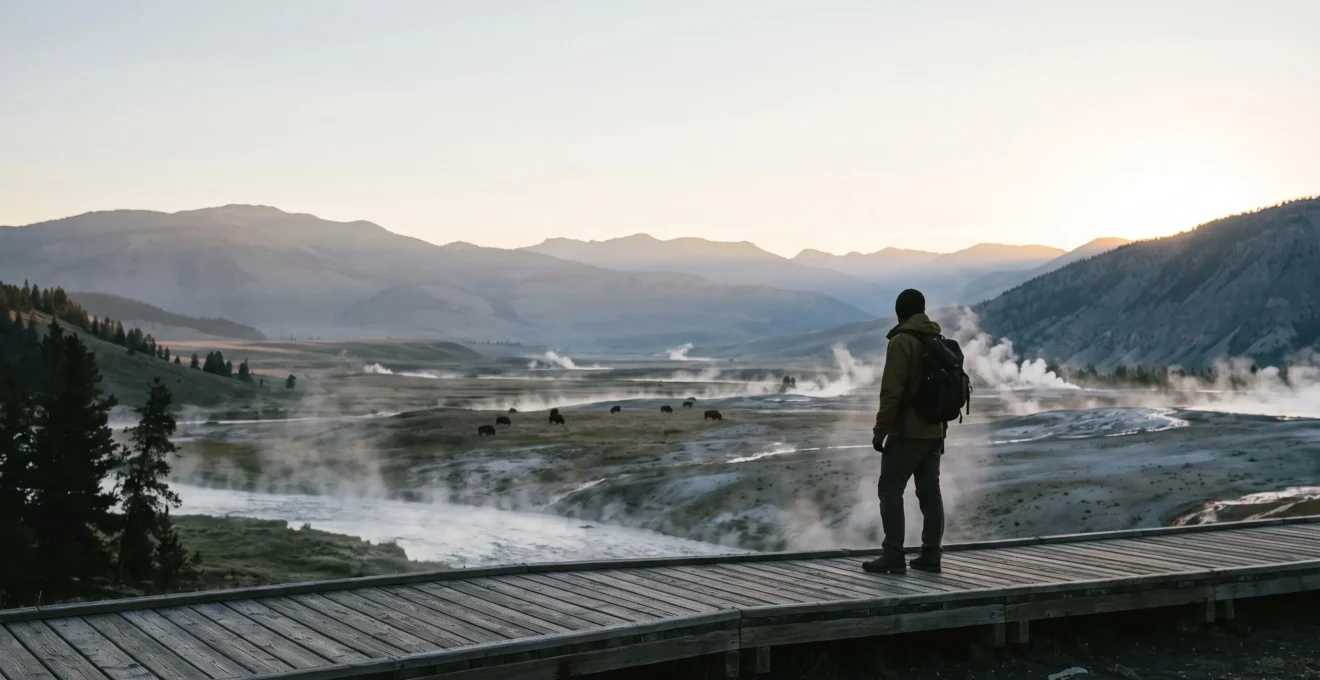
True solitude in Yellowstone isn’t found on a secret map; it’s achieved by shifting your mindset from avoiding people to synchronizing with the park’s own ancient rhythms.
- Instead of just seeking empty trails, learn to find stillness within the crowd by focusing on sound, silence, and the sky above.
- Reframe park programs and infrastructure not as tourist traps, but as tools for accessing deeper, more intentional experiences.
Recommendation: The next time you’re in a roadside pullout, turn off your car engine for a full five minutes and just listen. That is where the real park experience begins.
The image is iconic: a traffic jam caused not by cars, but by a colossal bison ambling across the road. Or perhaps it’s the human geyser erupting around Old Faithful, a sea of phones held aloft. Yellowstone, in its magnificent wildness, can often feel overwhelmingly crowded. The common advice is predictable: visit in the “shoulder seasons” of spring and fall, get up before the sun, or hike miles into the backcountry. These are valid strategies, but they only scratch the surface. They treat solitude as a matter of logistics, a problem of time and space to be solved.
But what if the true path to experiencing Yellowstone without the crowds isn’t about physically escaping them? What if it’s about a perceptual shift? As a naturalist guide, I’ve learned that the most profound moments of connection with this landscape happen not when you find a place devoid of people, but when you attune your senses so finely to the environment that the human noise simply fades into the background. It’s about learning to listen for the park’s own heartbeat, a rhythm that beats steadily beneath the hum of tourist activity.
This is not a guide to secret spots. It’s a guide to a different way of seeing, hearing, and being in this unparalleled wilderness. We will explore how to transform common advice into profound encounters, from the pre-dawn chill of the Lamar Valley to the vast, silent theater of the night sky. We will discover how to use the very structure of the park, from its winter vehicles to its family-friendly programs, as instruments for a more personal and contemplative journey. This is about finding the wild not just out there, but within you.
This guide offers a structured approach to cultivating that deeper connection. Each section provides a key to unlock a more solitary and meaningful experience, guiding you through the park’s rhythms and resources.
Summary: A Naturalist’s Guide to Finding Quiet in Yellowstone
- Lamar Valley at 5 AM: Why Is It the Best Time for Wolves?
- Why Is the Park an Exceptional Dark Sky Sanctuary?
- Snowcoach: How to Explore the Park When Roads Are Closed by Snow?
- Junior Ranger: Why This Program Isn’t Just for Kids?
- The Mistake of Never Turning Off the Car Engine to Listen to the Elk Bugling
- Dawn or Dusk: Which Time Is Best to Avoid Sunstroke?
- Where to Find Free Drinking Water to Avoid Buying 50 Plastic Bottles?
- How to Prepare for Yellowstone’s Wild and Unpredictable Conditions
Lamar Valley at 5 AM: Why Is It the Best Time for Wolves?
The advice to “get up early” is common, but in Yellowstone, it’s a specific prescription with a profound purpose. Arriving in the Lamar Valley at 5 AM is not about beating traffic; it’s about synchronizing your watch with the park’s apex predators. This is their time. The cool, pre-dawn air carries sound for miles, and the low light gives the wolves—crepuscular hunters by nature—a distinct advantage over their prey. This is the moment of rhythmic alignment, when you step out of the human schedule and into the ancient cycle of hunt and survival.
The valley’s unique geography makes this early-morning pilgrimage especially rewarding. As National Geographic photographer Ronan Donovan explains, the Lamar Valley is prime wolf-watching territory due to its open landscape and abundance of elk and bison. This allows for sightings from a great distance, respecting the animals’ space. The current population is robust, with the 2024 winter count identifying a healthy number of packs in the northern range. The valley is a living theater, and a 5 AM start gives you the best seat in the house, long before the curtain of midday heat descends and the actors retreat into the shadows.
Spotting a wolf is never guaranteed, but you can dramatically increase your chances by thinking like a naturalist. Scan the landscape not just for wolves, but for their messengers: a congregation of ravens or magpies often signals a recent kill. A high-powered spotting scope is essential; these animals are often just specks to the naked eye. This act of deep noticing—of patiently scanning, listening, and interpreting the subtle signs of the wild—is the true reward. The wolf is the prize, but the hunt for connection is the journey.
Even if no wolves appear, you will have witnessed the valley awaken: the first rays of sun painting the Absarokas, the steam of a bison’s breath in the cold air, the vast and profound silence. You came for wolves, but you’ll leave with a piece of the wild morning itself.
Why Is the Park an Exceptional Dark Sky Sanctuary?
When the sun sets and the last of the day-trippers have retreated to their lodges, Yellowstone undergoes a profound transformation. The wildlife spectacle gives way to a celestial one of breathtaking scale. The park’s remote location, high altitude, and clean air create a near-perfect environment for stargazing, a sanctuary from the light pollution that shrouds over 80% of the world’s population from the Milky Way. This isn’t just an absence of light; it’s the presence of an immense, humbling darkness that has become one of the rarest resources on Earth.
The experience can be deeply emotional. As NPS Interpretive Ranger Tammi Corchero once noted, “I’ve seen people come to tears when they see the Milky Way for the first time.” It’s a moment of sensory immersion that reconnects us to a universal heritage we have largely forgotten. To stand beneath this canopy of stars, with the silhouette of the geyser basins and the faint scent of sulfur in the air, is to feel the true scale of the universe and your own small, precious place within it.
This experience is not just for astronomers. For decades, programs like “Stars Over Yellowstone” have guided visitors through the cosmos, proving that this is a core part of the park experience. You don’t need a telescope, only a willingness to be still, to let your eyes adjust, and to look up. Choose a pullout far from any lodge lights, bring a blanket and a thermos of something warm, and simply lie back. You will see more stars than you thought possible, satellites tracing silent paths, and the ethereal, glowing river of our own galaxy arching overhead.
In a park defined by its geothermal wonders and charismatic megafauna, the greatest show might just be the one that happens every single cloudless night. It’s an experience that requires nothing more than patience and a sense of wonder, offering a form of solitude that is both cosmic and deeply personal.
Snowcoach: How to Explore the Park When Roads Are Closed by Snow?
Winter is Yellowstone’s quietest season, a time when the landscape is transformed by a thick blanket of snow and a profound silence. Most park roads close, rendering the vast interior inaccessible to regular vehicles. This is where the snowcoach comes in—not as a mere tour bus, but as a key to a secret kingdom. These specialized vehicles, whether large bus-style coaches or smaller vans on tracks, are your ticket to places like Old Faithful and the Grand Canyon of the Yellowstone when they are at their most serene and uncrowded.
To view the snowcoach as simply transportation is to miss the point. It is a vessel for structured solitude. Inside the warm cabin, as the frosted landscape glides by, the experience is one of shared contemplation. The rhythmic rumble of the tracks on the snow becomes a hypnotic soundtrack to a world of white. Bison, their coats frosted with ice, become living sculptures against the snow, and the steam from geysers appears even more dramatic in the frigid air. The guide’s voice over the intercom is not an interruption, but a thread connecting you to the stories of this harsh and beautiful season.
Choosing the right type of tour can significantly shape your experience. A small-group tour might offer more flexibility for photographers, while a larger coach provides a classic, shared journey. The following table, based on information from tour providers like Yellowstone Vacations, can help you decide which vessel best suits your quest for winter quiet.
| Feature | Large Bus-Style Snowcoach | Small Van-Based Tour |
|---|---|---|
| Comfort | Enclosed, heated cabin | Enclosed, heated cabin |
| Window Access for Photos | Windows often cracked to reduce fogging, limited opening | More flexible angles, easier repositioning within a smaller group |
| Guide Interaction | Interpretive commentary shared with a larger group | Closer, more personal interaction with the guide |
| Best Suited For | Larger groups, first-time winter visitors | Photographers and travelers seeking a quieter experience |
Regardless of your choice, the destination is almost secondary to the journey itself. The snowcoach delivers you to a Yellowstone that few get to see, a world that is quieter, slower, and arguably, even more wild than its summer counterpart.
Junior Ranger: Why This Program Isn’t Just for Kids?
At first glance, the Junior Ranger program seems explicitly for children. You purchase a workbook, attend a ranger-led talk, and complete a series of activities to earn a wooden badge. However, for the adult visitor seeking a deeper, more intentional connection with Yellowstone, this program offers a surprisingly powerful framework. It is a masterclass in deep noticing, disguised as a children’s game. It forces you to slow down, to look closer, and to engage with the park on a level that most tourists skim right over.
The program’s genius lies in its structure. It provides a mission. Instead of wandering aimlessly from one viewpoint to the next, you are now tasked with identifying three types of trees, sketching a geyser, or learning about the park’s history. These simple activities shift your focus from passive consumption to active engagement. You are no longer just a tourist; you are an investigator, a student of the ecosystem. You start to see the intricate web of life instead of just the big, obvious animals. This structured approach provides an antidote to the “checklist tourism” that can dominate a Yellowstone visit.
Embracing the program as an adult, perhaps alongside a child or even on your own, is a quiet act of rebellion against the pressure to “see it all.” It’s an investment of time and attention that pays dividends in understanding and appreciation. The best part? This key to a more mindful visit is incredibly accessible. You can pick up the workbook at any visitor center for just $3, a negligible cost for a tool that can fundamentally reshape your entire experience.
Your Action Plan to Become a ‘Senior’ Junior Ranger
- Acquire the tools: Pick up the official Junior Ranger booklet at any visitor center. Embrace the process, don’t just go through the motions.
- Engage with an expert: Attend a ranger-led program. Ask a question you’ve been pondering. Listen to the questions others ask.
- Walk the ground: Hike on a park trail or boardwalk with the specific goal of completing one of the booklet’s activities. Notice the difference in your attention.
- Document your findings: Complete the activities in the booklet not as a chore, but as a field journal. Your sketches don’t have to be art; they are tools for observation.
- Claim your reward: Recite the pledge with a ranger and receive your badge. Acknowledge this small token as a symbol of your renewed commitment to intentional presence in nature.
Ultimately, the wooden badge is just a souvenir. The real prize is the shift in perspective it fosters—a slower, richer, and more connected way of experiencing the wild heart of Yellowstone.
The Mistake of Never Turning Off the Car Engine to Listen to the Elk Bugling
The car is a necessity in Yellowstone’s 2.2 million acres, but it can also become a metal and glass cage, insulating us from the very wilderness we came to see. We drive from pullout to pullout, windows up, air conditioning humming, experiencing the park as a series of static images rather than a living, breathing entity. The single most transformative action you can take to find solitude is also the simplest: find a safe pullout, turn the key, and embrace the silence. This is the art of intentional presence.
The sudden absence of the engine’s hum is jarring at first. Then, slowly, the park’s true soundtrack emerges. You might hear the distant, haunting bugle of a bull elk, the chattering of a squirrel, the whisper of wind through lodgepole pines, or the gurgle of a nearby creek. These are the sounds that are constantly present but are drowned out by our mechanical bubble. In a park where the National Park Service notes that only about 3% of the land is ever seen by most visitors straying from the roads, learning to listen is like discovering a whole new dimension.
This practice is more than just listening for animals; it’s about allowing the landscape to speak. It’s about feeling the temperature shift as a cloud passes overhead. It’s about smelling the sagebrush after a brief rain shower. By turning off the engine, you are turning on your senses. You are stepping out of the role of a passive observer and becoming an active participant in the environment. It is in these quiet, five-minute interludes that the park often shares its most intimate secrets.
We stopped at this place and for my own part I almost wished I could spend the remainder of days in a place like this, where happiness and contentment seemed to reign in wild, romantic splendor, surrounded by majestic battlements which seemed to support the heavens and shut out all hostile intruders.
– Osborne Russell, Explorer in the Yellowstone region, 1834-1843
This feeling of wanting to stay, as described by an early explorer, is not found by driving faster to the next attraction, but by stopping completely and letting the place seep into you. It is the cheapest, easiest, and most effective way to find the real Yellowstone.
Dawn or Dusk: Which Time Is Best to Avoid Sunstroke?
In Yellowstone, timing is everything. This is true not only for avoiding heatstroke but, more critically for the solitude-seeker, for avoiding the peak-human-density that occurs between 10 AM and 4 PM. During the summer, especially in July when the park can see nearly 1 million visitors, the main roads and popular sites can feel more like a city square than a national park. The key is to adopt the rhythm of the wildlife: be most active at dawn and dusk, and lay low during the midday rush.
This strategy of rhythmic alignment is about more than comfort; it’s a strategic advantage. While the masses are fighting for parking at Artist Point or waiting in line for lunch, you can be exploring a quieter trail, taking a nap back at your campsite, or visiting one of the park’s gateway towns. This “midday break” isn’t wasted time; it’s a deliberate choice to trade a frustrating experience for a restful one, conserving your energy for the magical hours to come.
As the late afternoon light begins to soften, you re-emerge into a different park. The crowds have thinned, the light is golden and perfect for photography, and the animals begin to stir once more. A herd of elk might wander into a meadow to graze. A bear might appear on a distant hillside. You get the same iconic locations but with a fraction of the people and a much greater sense of peace. This split-day approach requires discipline, but it rewards you with two “golden hours” of prime viewing and relative solitude, effectively doubling the quality of your park experience.
Seasoned visitors have this strategy down to a science:
- Aim to be at your primary morning destination (like Grand Prismatic Overlook or Artist Point) before 9 a.m.
- Accept that midday (10 a.m. to 4 p.m.) will be busy, hot, and often frustrating. Use this time for logistics: a long lunch, a visit to a less-crowded visitor center, or simply a rest.
- Plan a second excursion for the late afternoon, starting around 4 p.m., to enjoy the evening light and increased wildlife activity.
- Recognize that dawn and dusk are not just beautiful; they are the seams in the day where the wild world is most accessible and the human world is least intrusive.
By consciously choosing to avoid the park at its busiest, you are not missing out. Instead, you are opting into a more intimate, quiet, and ultimately more rewarding encounter with Yellowstone’s wild heart.
Where to Find Free Drinking Water to Avoid Buying 50 Plastic Bottles?
A commitment to experiencing Yellowstone on a deeper level often leads to a desire to protect it. One of the most visible impacts of tourism is the mountain of single-use plastic it generates. A simple, powerful way to reduce your footprint and align yourself with the park’s conservation ethic is to entirely forgo buying disposable water bottles. This isn’t just an environmental act; it’s a practical one that frees you from the cycle of buying and discarding, and connects you to the park’s own infrastructure of sustainability.
The park itself has led the way. In a bold move, Yellowstone’s concessionaires completely stopped selling single-use plastic water bottles, opting instead for infinitely recyclable aluminum cans of water. This initiative is a clear signal: the park is serious about reducing waste, and it invites its visitors to be partners in that effort. By bringing your own reusable bottle, you are answering that call. It’s a small act of solidarity with the landscape you’ve come to admire.
Finding water is easy. The park has invested in numerous water bottle filling stations at major visitor centers, lodges, and even some campgrounds. These stations provide cold, clean, and free drinking water. Before your trip, make it a priority to equip every member of your group with a durable, reusable water bottle. This small piece of preparation eliminates a constant, nagging need and replaces it with a sense of self-sufficiency. It’s one less thing to worry about, one less purchase to make, and one less piece of trash to leave behind.
Embracing this ethos extends beyond just water bottles. It’s about a mindset of gentle presence. This means taking shorter showers to conserve a precious resource, diligently sorting your waste at recycling stations, and always packing out everything you pack in. These aren’t burdensome rules; they are the simple courtesies we extend to a place of such immense value. They are the quiet ways we say “thank you.”
In the end, leaving no trace is the ultimate form of respect. It ensures that the solitude and beauty you found will be there for the next person, and for generations to come, to discover as well.
Key Takeaways
- True solitude is a mindset, not a location. It’s found by synchronizing with the park’s rhythms, not by outrunning other people.
- Your senses are your best tools. Turning off the car engine to listen or staying out to watch the stars provides a deeper connection than any viewpoint.
- Embrace structure as a path to freedom. Use park programs like the Junior Ranger or a winter snowcoach tour to guide your attention and unlock quieter experiences.
How to Prepare for Yellowstone’s Wild and Unpredictable Conditions
The final element in cultivating a solitary Yellowstone experience is preparation. This goes beyond simply packing the right gear; it’s about mental and logistical readiness for a place that operates on its own terms. Yellowstone’s weather can swing wildly, with snow possible even in August. Roads can close unexpectedly for wildlife jams or accidents. Services are limited and accommodations fill up months, sometimes a year, in advance. Approaching the park with an expectation of seamless convenience is a recipe for frustration. Approaching it with respectful preparation is the key to freedom.
This means doing your homework long before you arrive. Accommodations, car rentals, and popular tours should be booked 3 to 6 months out, especially for the shoulder seasons. Understand that “spring” in Yellowstone means snow-covered ground and that many roads remain closed to cars until late April or May. Likewise, “fall” sees services beginning to shut down in mid-September, with most roads closing by early November. Being prepared for cold weather, even on a summer trip, is non-negotiable. A warm hat, gloves, and a waterproof layer are essential items, not optional extras.
This preparation frees you from anxiety. Knowing you have a place to sleep, a reliable vehicle, and clothes to keep you warm and dry allows you to relax and embrace the park’s unpredictability. When a bison herd blocks the road for an hour, it ceases to be an inconvenience and becomes the main event. When a sudden hailstorm rolls in, you can watch the spectacle from your car with a sense of awe rather than panic. You have prepared for the wildness, and now you are free to enjoy it.
This mindset is the culmination of all the other practices. It is the understanding that to truly connect with a wild place, you must cede a certain amount of control. You align with its rhythms, you listen to its sounds, you respect its power, and you come prepared for its caprice. This is the final layer of the naturalist’s approach: a quiet confidence that allows for a deep, unhurried, and truly solitary immersion in the wonder of Yellowstone.
Begin planning your journey not as a vacation, but as an expedition into a different way of being. Apply these principles of sensory immersion and rhythmic alignment from the very start, and you will find that the solitude you seek is waiting for you, not in a hidden corner of the map, but in a well-prepared and open state of mind.