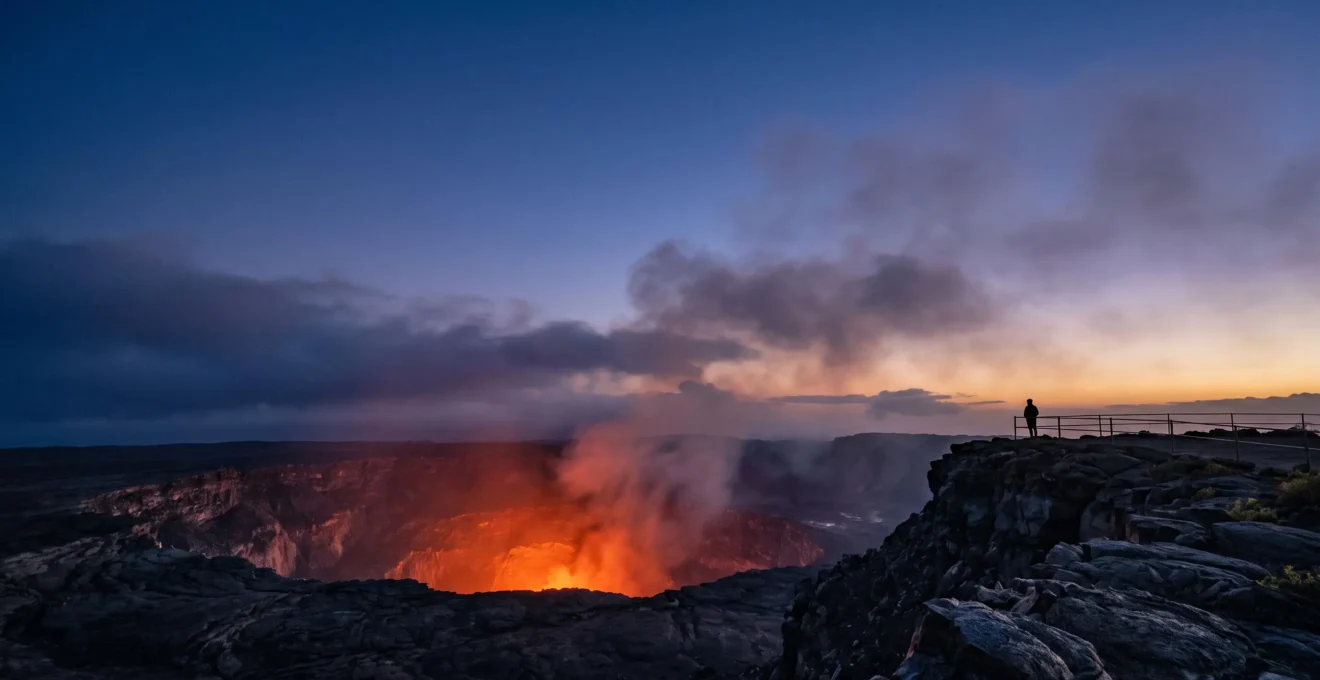
Witnessing an active volcanic eruption is a profound experience, but it presents real dangers that go beyond what is immediately visible. True safety in Hawaiʻi Volcanoes National Park isn’t about a simple checklist; it’s about developing a scientific and cultural understanding of the landscape. This guide provides the knowledge to assess risks like toxic gases and unstable terrain, allowing you to observe the power of Pélé with the informed prudence of a geologist.
The raw power of Kīlauea is a primal force of nature, a spectacle that draws adventurers from across the globe. Standing at the edge of the Halemaʻumaʻu caldera, you feel the earth’s heat and witness the creation of new land in real time. This profound connection to our planet’s inner workings is what makes a visit so compelling. Yet, this awe-inspiring display is governed by immense and unforgiving geological forces. The very processes that create such beauty also generate significant, often invisible, hazards.
Many guides will offer basic safety advice: stay on trails, bring water, wear good shoes. While essential, this advice barely scratches the surface. It treats the volcano like a static museum piece rather than the dynamic, living entity it is. The ground beneath your feet can be unstable, the air you breathe can carry corrosive gases, and the cultural landscape deserves as much respect as the physical one. The key to a safe and meaningful visit isn’t just following rules—it’s understanding the scientific reasons and cultural context behind them.
But if the real key wasn’t simply avoiding danger, but rather learning to read it? What if you could approach the volcano not just as a tourist, but as an informed observer, capable of making your own risk assessments? This guide is designed to give you that deeper perspective. We will move beyond the obvious to explore the science of night viewing, the chemistry of volcanic smog, the geology of the terrain, and the profound cultural importance of this sacred place. By the end, you will be equipped to witness the eruption with a newfound respect and a robust understanding of how to do so safely.
This article will guide you through the critical knowledge needed to transform your visit from a simple sightseeing trip into a safe, respectful, and deeply informed expedition. The following sections break down the essential elements, from visual phenomena to invisible risks.
Summary: A Scientist’s Framework for a Safe Volcano Visit
- Why Does a Night Visit to the Crater Offer a Superior Visual Experience?
- How to Know if the “Vog” Level Is Dangerous for Your Lungs?
- Hiking Boots or Sneakers: What to Wear on Sharp Volcanic Terrain?
- The Mistake of Crossing Safety Ropes for a Photo Near the Edge
- Who Is Pélé and Why You Should Never Take Volcanic Rock
- Beyond the Burger: What Fast-Food Chains Offer Real Salads?
- The Mistake of Not Bringing Potable Water if the Cabin Only Has a Well
- Essential Packing List for Staying in a Remote Rustic Cabin
Why Does a Night Visit to the Crater Offer a Superior Visual Experience?
While the Kīlauea caldera is impressive during the day, it truly transforms after sunset. The primary reason for the superior nighttime experience is simple physics: contrast. During the day, the bright Hawaiian sun illuminates the entire landscape, and its light often overpowers the relatively faint glow of the lava lake, which can appear as a mere shimmer of heat or a patch of reddish rock. Your pupils are constricted, limiting the amount of light entering your eyes and reducing your ability to perceive subtle differences in luminescence.
At night, the situation is inverted. The surrounding landscape falls into darkness, creating a perfect black canvas. The only significant light source becomes the incandescent lava itself. Your pupils dilate, allowing them to capture every photon emanating from the crater. This immense contrast makes the molten rock’s glow appear exponentially brighter and more vibrant. The soft red pulsating from the heart of the volcano becomes the dominant feature, painting the plume of gas and steam above it in ethereal shades of orange and pink. The experience shifts from observing a geological feature to being immersed in an atmospheric light show.
This dynamic activity is a constant reminder of the volcano’s power. Recent eruptive phases have been incredibly active; some of the 35+ eruptive episodes have produced fountains up to 1,500 feet high. While such dramatic fountaining isn’t always present, the steady glow is a sign of the immense energy churning just below the surface, a spectacle best appreciated in the deep quiet of the night.
As you can see, the darkness eliminates all visual distractions, focusing the eye and the mind entirely on the volcanic activity. This allows for a more contemplative and powerful connection to the event. The silhouettes of other visitors along the railing only serve to emphasize the scale of the caldera and the shared human experience of witnessing such a natural wonder.
How to Know if the “Vog” Level Is Dangerous for Your Lungs?
One of the most significant invisible dangers in the park is “vog,” or volcanic smog. It forms when sulfur dioxide (SO2) and other volcanic gases mix with oxygen, moisture, and sunlight. For visitors, especially those with pre-existing respiratory conditions like asthma, children, or the elderly, high concentrations of vog can be more than just unpleasant—they can be hazardous, causing headaches, breathing difficulties, and irritation to the eyes and lungs. Therefore, knowing how to assess air quality is not optional; it’s a critical safety skill.
Do not rely on your senses alone. While you may smell the characteristic “rotten egg” odor of sulfur compounds, the most dangerous components can be odorless and invisible. Your primary tool for risk assessment is data from official monitoring agencies. Before and during your visit, you must consult real-time air quality reports. These resources provide scientific data on SO2 levels and particulate matter, allowing you to make an informed decision about whether it is safe to be in the summit area.
This proactive approach is endorsed by health and geological authorities alike. As the U.S. Geological Survey notes, a wealth of information is available to the public. In a recent announcement, the USGS highlighted a key resource:
The International Volcanic Health Hazard Network has a new resource for the current eruptive activity and associated hazards at Kīlauea’s lower East Rift Zone and summit.
– U.S. Geological Survey (USGS), USGS News
Relying on these expert sources is paramount. A clear day can become hazy within hours due to shifting winds, turning a pleasant visit into a health risk. Checking the data is as fundamental as checking the weather forecast before a hike.
Your Action Plan: Air Quality Assessment
- Consult the Vog Dashboard: Before leaving your accommodation, check the Hawaii Interagency Vog Information Dashboard. It is your most comprehensive source for all vog and SO2 information.
- Review the SO2 Advisory: Specifically look at the Hawaii Short Term SO2 Advisory for the Island of Hawaiʻi. This provides the current Air Quality Index (AQI) for the park area.
- Check State Health Data: For broader context, consult the Hawaii Ambient Air Quality Data published by the state’s Department of Health.
- Use Forecast Maps: Look at the VMAP (Vog Measurement and Prediction Project) to see forecast maps of where the plume is expected to travel in the coming hours.
- Make an Informed Go/No-Go Decision: If advisories indicate “unhealthy” or “hazardous” levels and you are in a sensitive group, postpone your visit to the summit area. If you are already there and conditions worsen, leave immediately.
Hiking Boots or Sneakers: What to Wear on Sharp Volcanic Terrain?
The question of footwear may seem trivial, but on the unforgiving terrain of Hawaiʻi Volcanoes National Park, it’s a critical safety decision. The ground you walk on is not dirt or gravel; it’s cooled lava, which often takes the form of aʻā (ah-ah). This type of lava cools into a chaotic jumble of sharp, jagged, and glassy fragments. Walking on aʻā has been compared to walking on broken glass. A standard pair of sneakers with thin, flexible soles offers virtually no protection.
The sharp edges of the volcanic rock can easily puncture or shred the sole of a running shoe, and even a minor slip can result in a severe cut. This is why sturdy, closed-toed hiking boots with thick, rigid soles are non-negotiable. The thick rubber and deep lugs of a hiking boot are designed to withstand this kind of punishment, protecting your feet from punctures and providing the ankle support needed to navigate the uneven surfaces. Choosing sneakers over boots is a rookie mistake that can quickly end your trip with an injury.
This image perfectly illustrates the confrontation between proper gear and the environment. The deep tread of the boot sole is essential for gripping the abrasive, uneven surface, while its thickness is the only thing preventing the razor-sharp volcanic rock from causing injury. Beyond footwear, remember that the summit of Kīlauea is at an elevation of 4,000 feet. It can be surprisingly cold, windy, and wet, especially after dark. Dressing in layers, bringing a rain jacket, and packing a flashlight or headlamp for the return journey on the unlit trails are all part of a proper gear strategy.
The Mistake of Crossing Safety Ropes for a Photo Near the Edge
The temptation can be strong: a perfect, unobstructed photo of the caldera, just a few feet beyond the safety rope. It seems like a minor transgression for an epic shot. This is, without a doubt, one of the most dangerous mistakes a visitor can make. The barriers are not arbitrary suggestions; they are placed at the absolute limit of what geologists and park rangers consider a survivable distance from multiple, often invisible, lethal hazards.
The first hazard is geological instability. The rim of the Halemaʻumaʻu crater is not solid bedrock. It is a constantly changing structure composed of layers of ash and crumbly lava, weakened by steam vents and seismic activity. Areas that appear solid can be undercut, forming a thin shelf with nothing but a 1,500-foot drop below. A collapse can happen without warning. The second, more insidious danger is volcanic gas. As Chief Ranger Jack Corrao has starkly warned, a sudden shift in wind can be fatal for someone in a closed area. He states that even “a slight change in wind direction could cause someone who has crossed a closure to inhale a fatal dose of volcanic gas.”
Disregarding these warnings is not taken lightly by the National Park Service, and the consequences are real, not just for safety but also legally and financially.
Case Study: The Price of a Picture
In a notable incident, park rangers had to take action against a group who ignored the clear warnings. According to a report from the National Park Service, eleven visitors were cited after they illegally entered a closed area and were spotted at the sheer, unstable edge of the Halemaʻumaʻu crater. They were not only risking a catastrophic fall but also exposure to toxic gases. For their decision, each person was fined $100 for the closure violation plus an additional $250 for disorderly conduct, a tangible price for a reckless photo opportunity.
The safety ropes represent the collective knowledge of scientists and rangers who understand this dynamic environment intimately. Trusting their expertise is the single most important decision you will make at the crater’s edge. No photograph is worth your life.
Who Is Pélé and Why You Should Never Take Volcanic Rock
In Hawaiian culture, the volcano is not just a geological feature; it is the home of Pélé, the goddess of fire and volcanoes. She is a revered and respected creator deity, and the lava rock (pohaku) is considered part of her body. To remove a rock from the park is seen as an act of profound disrespect to both Pélé and the Native Hawaiian culture. This belief has given rise to the famous “curse of Pélé,” which holds that those who take lava rocks or sand from Hawaii will be plagued by misfortune until the stolen items are returned.
While some may dismiss this as folklore, the cultural significance is deeply real. Moreover, the “curse” serves as a powerful metaphor for a modern conservation principle: leave no trace. The sheer scale of this problem is staggering. Park officials are inundated with packages from around the world sent by guilt-ridden visitors hoping to reverse their bad luck. According to one report, more than 2,000 pounds of lava rocks are mailed back to the park every year. This is not a trivial amount; it represents a significant, cumulative impact on the natural landscape.
This constant stream of returned pohaku is a daily reality for park staff. As Hawaiʻi Volcanoes National Park Public Affairs Officer Jessica Ferracane described in an interview, the volume is relentless: “Every single day, we get boxes of them and envelopes filled with rock sand, even items that aren’t natural.” Each package, often accompanied by a letter of apology, is a testament to a lesson learned too late. Whether you believe in the curse or simply in the ethics of conservation, the message is the same. The park is a sacred and protected place, not a souvenir shop. Take only pictures and memories, and leave the rocks for Pélé.
Beyond the Burger: What Fast-Food Chains Offer Real Salads?
In the context of a national park visit, this question becomes a powerful metaphor. The “fast-food burger” represents the easy, obvious, and often superficial experience: driving up to the main Kīlauea overlook, snapping a photo, and leaving. It’s quick and satisfies an immediate craving, but it lacks nutritional depth. The “real salad” symbolizes the richer, more rewarding experiences that lie beyond the main attraction, requiring a bit more effort to find but offering far greater substance.
Your visit to Hawaiʻi Volcanoes National Park can be more than just the caldera rim. The park is vast and diverse, offering experiences that provide a deeper understanding of its unique ecology and geology. Instead of just seeing the eruption, you can explore the “salad bar” of the park’s other offerings. This means venturing onto trails that showcase different aspects of the volcanic landscape.
Consider hiking a portion of the Kīlauea Iki trail, which takes you across the floor of a solidified lava lake from a 1959 eruption. Or explore the Thurston Lava Tube (Nāhuku), a cavernous tunnel formed by a river of molten rock. These experiences are the “fresh greens and vegetables” of your visit. They add texture, variety, and a deeper nutritional value to your understanding of volcanism. They require more walking and a bit of planning, but they provide a far more complete and memorable “meal” than simply staying at the main viewpoint.
The Mistake of Not Bringing Potable Water if the Cabin Only Has a Well
This scenario, while specific, highlights a universal principle for visiting a remote and wild place like Hawaiʻi Volcanoes National Park: absolute self-reliance. The park is your “remote cabin,” and its resources are finite and spread out. The “well with non-potable water” is a metaphor for the park’s limited services. While there are visitor centers and some facilities, you cannot assume that water, food, or first aid will be available wherever and whenever you need it.
The gravest error is to venture away from the main developed areas without being fully self-sufficient. Every visitor is responsible for carrying an adequate supply of their own potable water. Dehydration is a serious risk, especially on exposed lava fields under the hot sun. The park’s water is primarily from rainwater catchment systems, which can be unreliable and may not be treated for drinking. Assuming you can find a water fountain on a remote trail is like assuming the well at a rustic cabin provides clean drinking water—a potentially dangerous gamble.
This principle extends beyond water. You must carry your own food, a comprehensive first-aid kit, sun protection, and appropriate clothing for rapidly changing weather. The park rangers are a vital safety net, but they are not a concierge service. By preparing as if no help is available, you not only ensure your own safety but also show respect for the park’s resources and staff, allowing them to focus on true emergencies. Treat every hike as an expedition into a place where you are the sole provider of your own needs.
Key Takeaways
- True safety comes from understanding the ‘why’ behind park rules, not just following a checklist.
- Always use official, real-time data to assess invisible risks like volcanic gas (vog) before and during your visit.
- Cultural respect is as important as physical safety; the landscape is a sacred space, not a source for souvenirs.
Essential Packing List for Staying in a Remote Rustic Cabin
Finally, we arrive at the most important packing list. This isn’t about the physical items in your backpack, but the mental and ethical framework you carry with you into the park. This is the “essential packing list” for the responsible visitor, the one who seeks to understand and respect the “remote rustic cabin” that is this powerful, wild landscape.
First on the list is curiosity paired with caution. Bring an intense desire to learn about the geology, ecology, and culture of the place. But temper this with the profound understanding that this is a dynamic environment where conditions can change in an instant. Your curiosity should drive you to learn, while your caution should guide you to obey every sign and barrier without question.
Second, pack a deep sense of humility and respect (kuleana). You are a guest in a place that is sacred to the Native Hawaiian people and is the domain of forces far beyond human control. This means treading lightly, leaving no trace, and never taking anything, from the smallest pebble to the most beautiful feather. This respect extends to other visitors, giving them space to experience the wonder in peace.
Lastly, pack unwavering self-sufficiency. As we’ve discussed, you must be prepared to be your own provider of water, food, comfort, and first aid. This mindset is the ultimate expression of respect for the wildness of the park and its limited resources. It ensures that your adventure does not become a burden on the rangers and the delicate infrastructure that supports this incredible place.
With this framework of informed caution, cultural respect, and self-reliance, you are prepared not just to see the volcano, but to truly experience it. Your next step is to put this knowledge into practice by meticulously planning your visit using the official park resources and air quality dashboards.