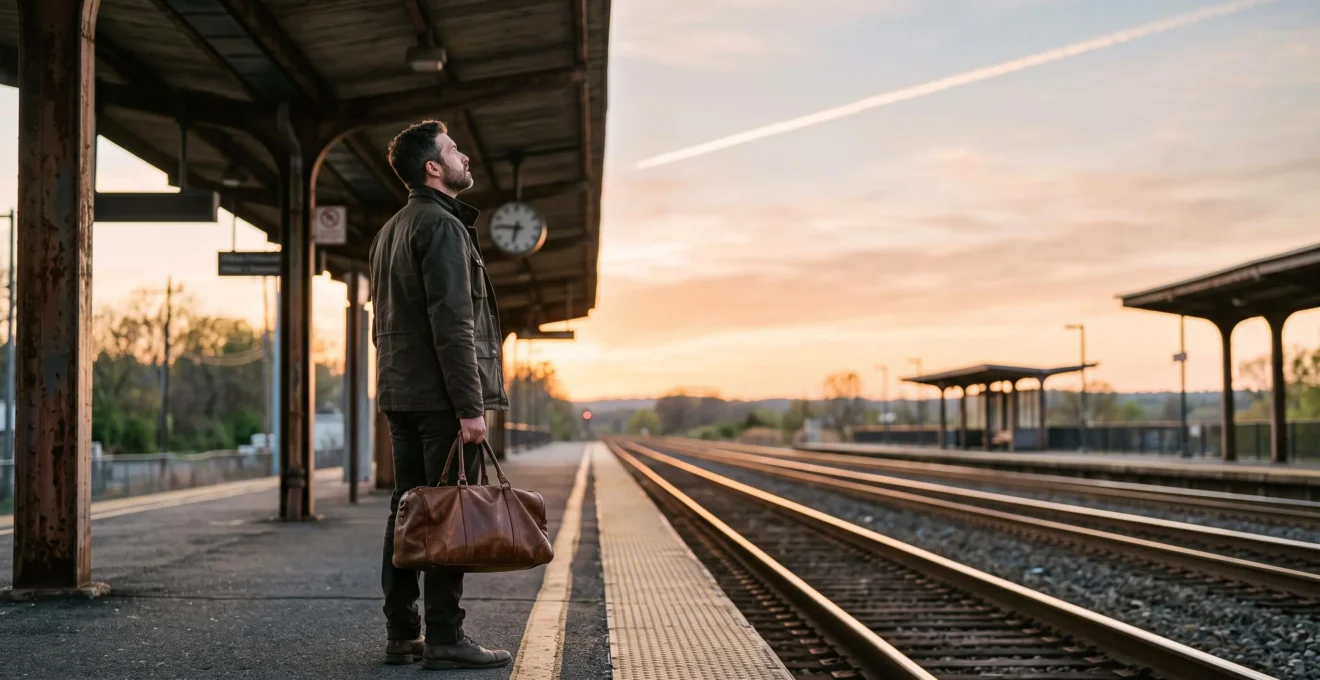
For a European train lover, judging Amtrak against flying is the wrong comparison; the key is understanding it as an entirely different travel philosophy.
- American passenger trains are guests on a network built for and owned by freight companies, which dictates schedules and reliability.
- True comfort and the “classic” experience often require a calculated splurge on a sleeper car, which includes meals and privacy.
Recommendation: Instead of seeking speed and efficiency, embrace the journey as the destination and plan for a slower, more deliberate, and potentially more rewarding way to see the vastness of the United States.
If you’ve fallen in love with the seamless, punctual, and passenger-focused rail networks of Europe, the idea of crossing the vast American landscape by train is undeniably romantic. You picture yourself gazing out at changing scenery, novel in hand, leaving the chaos of airports far behind. This vision, heavily promoted in movies and travelogues, is a powerful one. It promises a more civilized, reflective way to travel, turning the journey itself into a key part of the vacation.
But the American rail system operates on a fundamentally different principle than its European counterparts. The question isn’t simply whether the train is “better” than the plane. The real question is: are you prepared for what American train travel actually is? It’s a system with its own logic, its own frustrations, and its own unique, incomparable rewards. Forget everything you know about a TGV or an ICE; to appreciate Amtrak, you must first understand the world it inhabits—a world built for cargo, where passengers are often just along for the ride.
This guide will not try to sell you a fantasy. Instead, it will give you an honest, nuanced perspective from a rail enthusiast who knows both the profound joys and the deep frustrations of traveling the American rails. We will explore the critical differences that define the experience, from why freight trains call the shots to where the system actually shines, so you can decide if this iconic way of travel is truly for you.
The following sections break down the essential truths of the Amtrak experience, providing the context and practical advice you need to navigate its unique ecosystem. From the economics of your ticket to the strategy for your meals, this is the realistic briefing you need before booking your great American train adventure.
Summary: A Realist’s Guide to Amtrak vs. Flying
- Why do freight trains have priority over passengers (and what about the delays)?
- Roomette or Coach Seat: is the bed worth the $400 extra?
- California Zephyr: why does this train offer views a car can’t provide?
- The mistake of relying solely on the café car for proper meals
- Northeast Corridor vs. the rest of the country: where is the train actually fast?
- Why is a 50-minute connection in Chicago in winter a logistical nightmare?
- Memphis, Nashville, or New Orleans: what’s the logical order for a historic trip?
- How to Navigate huge US Airport Hubs Like ATL or ORD Without Missing Your Flight?
Why do freight trains have priority over passengers (and what about the delays)?
The single most important fact to understand about Amtrak is this: with a few exceptions, Amtrak does not own the tracks it runs on. The vast majority of the American rail network belongs to private freight companies like Union Pacific and BNSF. Amtrak is essentially a tenant, paying to run its passenger trains on tracks built for and optimized to move goods. This creates a fundamental power imbalance that a European traveler, accustomed to passenger-first networks, will find jarring.
When a heavy, two-mile-long freight train and a sleek Amtrak passenger train need the same piece of track, federal law gives Amtrak priority. However, the reality on the ground is often different. Dispatchers employed by the freight railroads may prioritize their own cargo, citing logistical complexities. The result is the most common complaint about Amtrak: delays. Your train might be parked on a siding in the middle of nowhere, waiting for a seemingly endless procession of container cars to pass. This isn’t a bug; it’s a feature of operating in freight’s domain.
This reality directly impacts on-time performance, which can vary wildly. While improvements are being made, the cooperation of the “host railroad” is paramount. For example, on one route in Texas, a recent focus on cooperation meant that the Texas Eagle’s on-time performance jumped to 74% in the second quarter of 2024, up from 63% the previous year. This shows that delays aren’t random, but a direct consequence of the relationship between passenger and freight operations. For the traveler, this means you must build buffer time into your schedule and accept that the timetable is often more of a suggestion than a guarantee.
Roomette or Coach Seat: is the bed worth the $400 extra?
On any overnight Amtrak journey, you’ll face this crucial decision. A coach seat is familiar: a spacious, reclining chair with ample legroom, far superior to an economy airline seat. But a Roomette is a different world. It’s a private cabin with two seats that convert into a bed, a second bunk that folds down from the ceiling, and a door that closes you off from the rest of the train. The price difference is significant, with prices for a Roomette often starting around $400 per person over the coach fare.
So, is it worth it? The answer lies in reframing the question. You are not just paying for a bed; you are paying for an entirely different travel experience. This is what we call calculated comfort—an investment that transforms the journey from simple transit into a core part of the vacation. The extra cost includes all your meals in the dining car, which are of surprisingly high quality, as well as complimentary coffee, water, and juice. You also get access to a dedicated car attendant and, crucially, private shower facilities.
The tactile difference between the crisp, clean linens of a sleeper bed and the functional fabric of a coach seat illustrates the choice perfectly. A coach seat is for getting there; a Roomette is for experiencing the journey. Sleeping horizontally in a private, quiet space as the American landscape rolls by is an experience a reclining chair can never replicate. Waking up to sunrise over the desert or mountains, then heading to the dining car for a full breakfast you didn’t have to pay for, fundamentally changes the nature of your trip.
This table breaks down the tangible benefits you get for the extra cost, showing it’s more than just a place to sleep.
| Feature | Coach Seat | Roomette |
|---|---|---|
| Starting price (example route) | $148 per person | $448 for one person / $633 for two |
| Meals included | No | Yes, all dining car meals plus water, coffee, juice |
| Shower access | No | Yes |
| Flat bed for sleeping | No (reclining seat only) | Yes |
California Zephyr: why does this train offer views a car can’t provide?
If there is one route that single-handedly makes the case for American train travel, it’s the California Zephyr. Winding its way from Chicago to the San Francisco Bay Area, this legendary train is the epitome of making the journey the destination. While you could drive a similar route, the train offers perspectives that are physically inaccessible by car. This is because the rails were often laid down first, long before the interstate highway system, taking paths of least resistance through canyons and over mountains that road engineers couldn’t follow.
The most spectacular example of this is in the Rocky Mountains. As one analysis notes, in Colorado, passengers traverse the historic Moffat Tunnel and witness the engineering marvel of Glenwood Canyon—a 12-mile stretch where the tracks are carved directly into red rock walls just feet from the Colorado River. From the floor-to-ceiling windows of the Sightseer Lounge car, you are not just looking at the landscape; you are *in* it. No highway runs through this part of the canyon. The view from your window is exclusive, a panorama of rock, river, and sky that motorists on the distant I-70 can only dream of.
To truly maximize this unique experience, a little inside knowledge goes a long way. The views are not the same on both sides of the train, and the best side can change depending on the leg of the journey. Here are some tips for positioning yourself on the Zephyr:
- From Denver to the Moffat Tunnel, the right side of the train generally offers more scenic views of the mountain climbs.
- Through the winding river valleys from Granby to Dotsero, the left side is often preferable for wide mountain vistas.
- The best strategy is to claim a spot in the Sightseer Lounge, which has swivel chairs, allowing you to easily alternate your view as the landscape unfolds on either side.
The mistake of relying solely on the café car for proper meals
For coach passengers on a long-distance journey, the café car can seem like a lifeline. It’s the only place, aside from the formal dining car reserved for sleeper passengers, to buy food and drinks. However, making it your sole source of sustenance for a multi-day trip is a rookie mistake. The menu is limited, primarily consisting of snacks, microwaveable burgers, and pizza. While perfectly fine for a quick bite, it’s not a sustainable or healthy way to eat for 48 hours.
This is where the concept of a logistical cushion becomes essential. Experienced Amtrak travelers know that planning your food strategy is as important as planning your route. Unlike on a plane, you are actively encouraged to bring your own food and drinks on board. This freedom is one of the great perks of train travel, allowing you to eat better and save a significant amount of money.
Sure, we could have taken a four-hour direct flight, but riding cross-country in an Amtrak sleeper car sounded like an experience I didn’t want to miss, and once onboard, roomette tickets included all meals… removing any need to rely on the café car alone.
– The Points Guy
Even if you’re not in a sleeper car with included meals, you can still craft a superior dining experience. A smart, tiered approach to onboard eating is the best strategy:
- Base Layer: Pack non-perishable items like sandwiches for the first day, trail mix, fruit, and energy bars. Many travelers even bring a small cooler for refrigerated items, which is perfectly permissible.
- Middle Layer: Use the café car to supplement your supplies. This is the place to grab a hot coffee in the morning, a cold beer in the afternoon, or an ice cream for a treat.
- Top Layer: Even as a coach passenger, you can often make a reservation for the dining car if space is available. Planning for one “special” meal here per journey can elevate the experience without the full cost of a sleeper ticket.
Northeast Corridor vs. the rest of the country: where is the train actually fast?
For a traveler accustomed to Europe’s high-speed rail, the term “fast train” in America can be misleading. There is one region, and only one, where passenger rail operates in a way you would recognize: the Northeast Corridor (NEC). This stretch of track from Washington D.C. to Boston, running through Philadelphia and New York, is the crown jewel of Amtrak’s network. It is also, crucially, one of the few significant stretches of track that Amtrak actually owns.
This ownership creates a stark infrastructural divide between the NEC and the rest of the national network. On the NEC, passenger trains have priority. Tracks are maintained for high speeds, and investments are made to improve service. The Acela, Amtrak’s flagship high-speed service, can reach speeds of 150 mph on certain segments. While its overall average is lower, Acela’s best average speed is 103 mph between Baltimore and Wilmington, a velocity unheard of on the long-distance routes out west. In this corridor, taking the train is often genuinely faster than flying, once you factor in travel to and from airports and security screening.
This stark difference in service quality and speed is reflected in ridership. The NEC is a bustling commuter and intercity network, while the long-distance trains serve a different purpose, more focused on tourism and a leisurely travel experience.
| Service Type | 2024 Ridership Growth vs 2023 |
|---|---|
| Acela (Northeast Corridor) | +9.4% |
| Northeast Regional (Northeast Corridor) | +18% |
| Long-Distance Routes (national network) | +8.3% |
This tale of two Amtraks—the swift, efficient commuter line and the meandering, scenic wanderer—is a source of endless debate among rail advocates. As rail expert Joseph Vranich famously described it, the system can feel like both a point of national pride and a missed opportunity.
Amtrak’s crown jewel and a remarkable fiasco
– Joseph Vranich, The Conversation
Why is a 50-minute connection in Chicago in winter a logistical nightmare?
Chicago’s Union Station is the historic and operational heart of Amtrak. It’s the central hub where the great long-distance trains from the east and west coasts converge. For many cross-country travelers, a connection in Chicago is unavoidable. And this is where the theory of Amtrak’s timetable collides with the harsh reality of its operations, especially in winter. Booking a connection with a 50-minute layover might look efficient on the website, but it’s a high-stakes gamble.
Remember the core principle: your inbound train has likely spent hundreds of miles traveling on tracks owned by freight companies. As official data confirms, freight train interference accounted for the largest number of delay minutes for Amtrak trains. A single delay for weather, a freight train ahead, or mechanical issues hundreds of miles away can have a cascading effect. A 30-minute delay leaving Denver can easily become a 90-minute delay by the time you reach Illinois. Your 50-minute buffer has vanished.
In winter, this risk is amplified. Snow and ice can slow train speeds and cause switch failures, adding further unpredictability. A missed connection in Chicago can mean a 24-hour wait for the next day’s train. This is why experienced travelers build a massive logistical cushion into their itineraries, often opting for an overnight stay in Chicago rather than risking a tight connection. It transforms a point of stress into an opportunity to explore a great city.
Your 5-Point Contingency Plan for Amtrak Connections
- Route Analysis: Check the historical on-time performance for your specific inbound train route on sites like Amtrak’s own performance trackers.
- Buffer Calculation: Book connections with at least 3-4 hours of buffer time, especially in winter or through major hubs like Chicago.
- Host Railroad ID: Identify the freight railroad that owns the majority of your route (e.g., BNSF, Union Pacific); their performance is a key indicator of your delay risk.
- Contingency Fund: Have a backup plan and budget for a potential hotel stay or alternative transport just in case a connection is missed.
- Communication Check: Use the Amtrak app and website to track your train in real-time. This allows you to make informed decisions and communicate with staff before you arrive.
Memphis, Nashville, or New Orleans: what’s the logical order for a historic trip?
Planning a multi-city trip by train, especially one themed around a rich cultural history like American music, requires a different mindset than in Europe. You can’t assume that every major city is connected by a convenient rail line. A classic music pilgrimage through the American South—from the blues of Memphis to the country music of Nashville and the jazz of New Orleans—is a perfect case study in the limitations and opportunities of the Amtrak network.
The first reality check for a European traveler is that Nashville, the “Music City,” is not served by Amtrak. The network is not comprehensive; it’s a collection of specific lines. This immediately changes your planning. You cannot simply hop from one city to the next. Instead, you must build your itinerary around the existing main line: the “City of New Orleans” route, which runs directly between Chicago and New Orleans, with a key stop in Memphis.
Therefore, the most logical order for a trip using the train as its backbone is to start north and head south, following the path of the Great Migration of African Americans who brought the blues from the Mississippi Delta to the cities of the north. You could fly into Chicago, take the “City of New Orleans” to Memphis to soak in the history of Beale Street and Sun Studio, then continue on the same line down to New Orleans to experience the birthplace of jazz. From there, you could rent a car or take a bus for a side trip to Nashville before flying home, or simply fly out of New Orleans.
This approach uses the train for what it does best: a long, historic corridor journey. It acknowledges the network’s gaps (Nashville) and leverages its strengths (the direct Memphis-New Orleans link). It’s a prime example of how you must adapt your itinerary to the American rail system, rather than expecting the system to adapt to your ideal itinerary.
Key Takeaways
- Embrace the System: Acknowledge that Amtrak is a guest on freight’s network. Delays are a possibility, so plan a generous time buffer.
- Travel is the Destination: Choose the train for the experience of the journey itself—the views, the pace, the social interactions—not as a way to save time.
- Plan for Comfort: Invest in your own comfort, whether by splurging on a sleeper car or by packing a well-stocked cooler and your favorite snacks for a trip in coach.
How to Navigate huge US Airport Hubs Like ATL or ORD Without Missing Your Flight?
Perhaps the most compelling argument for taking the train has nothing to do with the train itself, but with its alternative. Consider the modern airport experience: the stressful drive to a remote location, the search for expensive parking, the long lines for baggage check, and the dehumanizing shuffle through security. You arrive hours early only to wait in a crowded terminal, bombarded by announcements, before squeezing into a cramped metal tube.
Navigating massive hubs like Atlanta’s Hartsfield-Jackson (ATL) or Chicago’s O’Hare (ORD) is a masterclass in stress management. You’re sprinting between distant gates, praying your connection isn’t on the other side of a terminal that requires its own train to navigate. It is an experience designed for logistical efficiency, not human comfort. It is purely about getting from Point A to Point B as quickly as possible, and the journey itself is something to be endured, not enjoyed.
Now, contrast this with the train. You arrive at a station often located in the heart of a city’s downtown. You walk onto the platform with your luggage and find your seat. There is no lengthy security screening, no two-hour waiting period. The experience is, by its very nature, calmer, more human-scale. The “hassle” of a train journey comes from its potential slowness and unpredictability, as we’ve discussed. But the “hassle” of air travel is a guaranteed, front-loaded dose of stress and anxiety.
Choosing Amtrak is not about avoiding travel challenges; it’s about choosing your preferred *type* of challenge. Do you prefer the frantic, time-compressed stress of the airport, or the slow, unpredictable, but ultimately more relaxed pace of the railroad? For many, especially on routes where the scenery is a key attraction, the trade-off becomes a clear and easy choice. You are trading the controlled chaos of the airport for the peaceful uncertainty of the open rails.
So, is Amtrak a viable alternative to flying? If your only metric is speed, the answer is no, except in the Northeast. But if you are willing to adopt a different mindset—one that values the experience over efficiency, the journey over the destination, and calm over chaos—then the answer is a resounding yes. Armed with a realistic perspective, you are now ready to plan an American train journey not as a substitute for a flight, but as a superior way to truly see the country.