In summary:
- Turning right on a red light is generally permitted after a full stop, unless a sign explicitly prohibits it.
- High-Occupancy Vehicle (HOV) lanes are restricted during peak hours; solo driving in them results in steep fines.
- You must always stop for a school bus with its red lights flashing, regardless of your direction of travel, unless on a divided highway.
- During a police traffic stop, the protocol is to pull over, turn off the engine, and keep your hands visible on the steering wheel.
- A standard European car license is typically sufficient to rent and drive most RVs for a road trip.
If you’re a seasoned European driver, you feel at home on the road. You can navigate a three-lane roundabout in your sleep and handle the unrestricted sections of the Autobahn with confidence. But the thought of driving in the United States? That can be a source of genuine anxiety. The cars are bigger, the distances are vaster, and the rules seem… different. You’ve probably heard vague advice about “turning right on red” or the chaos of multi-lane freeways, but these tips rarely address the core of the issue: the American driving culture itself.
This isn’t just about memorizing a new set of traffic laws. It’s about understanding the unspoken etiquette, the situational awareness required, and the high-stakes scenarios that have no direct parallel in Europe. Many guides will give you a list of rules, but they won’t prepare you for the feeling of a police car’s lights flashing in your rearview mirror or the communal, almost choreographed, dance of a four-way stop intersection.
As a driving instructor, my goal isn’t to just teach you to pass a test; it’s to build your confidence by demystifying the road. This guide is your personal instruction manual. We won’t just cover the ‘what’; we will dive deep into the ‘why’ behind the most confusing and critical US driving rules. We’ll replace your anxiety with a clear mental model for how to handle everything from carpool lanes to a cross-country RV trip. By the end, you’ll have the tools not just to survive, but to navigate American roads safely and with the confidence of a local.
This article breaks down the essential, and often misunderstood, rules and scenarios you will encounter. Each section is designed to give you a clear, practical understanding to make your US driving experience a safe and enjoyable one.
Summary: The Essential Guide to American Driving Rules for Foreigners
- Quand est-il interdit de tourner à droite au feu rouge (No Turn on Red) ?
- HOV Lanes : pourquoi rouler seul dans la voie de gauche peut vous coûter $400 ?
- L’erreur de dépasser un bus scolaire à l’arrêt avec ses clignotants rouges
- Undertaking : pourquoi est-il légal et fréquent de doubler par la droite sur l’Interstate ?
- Mains sur le volant : comment se comporter lors d’un contrôle routier (Traffic Stop) ?
- Permis voiture ou permis lourd : que faut-il pour conduire un gros RV aux USA ?
- Sieste ou caféine : quelle stratégie pour conduire 800 km en sécurité ?
- RV or Rental Car: Which is Best for a 3-Week US Road Trip?
Quand est-il interdit de tourner à droite au feu rouge (No Turn on Red) ?
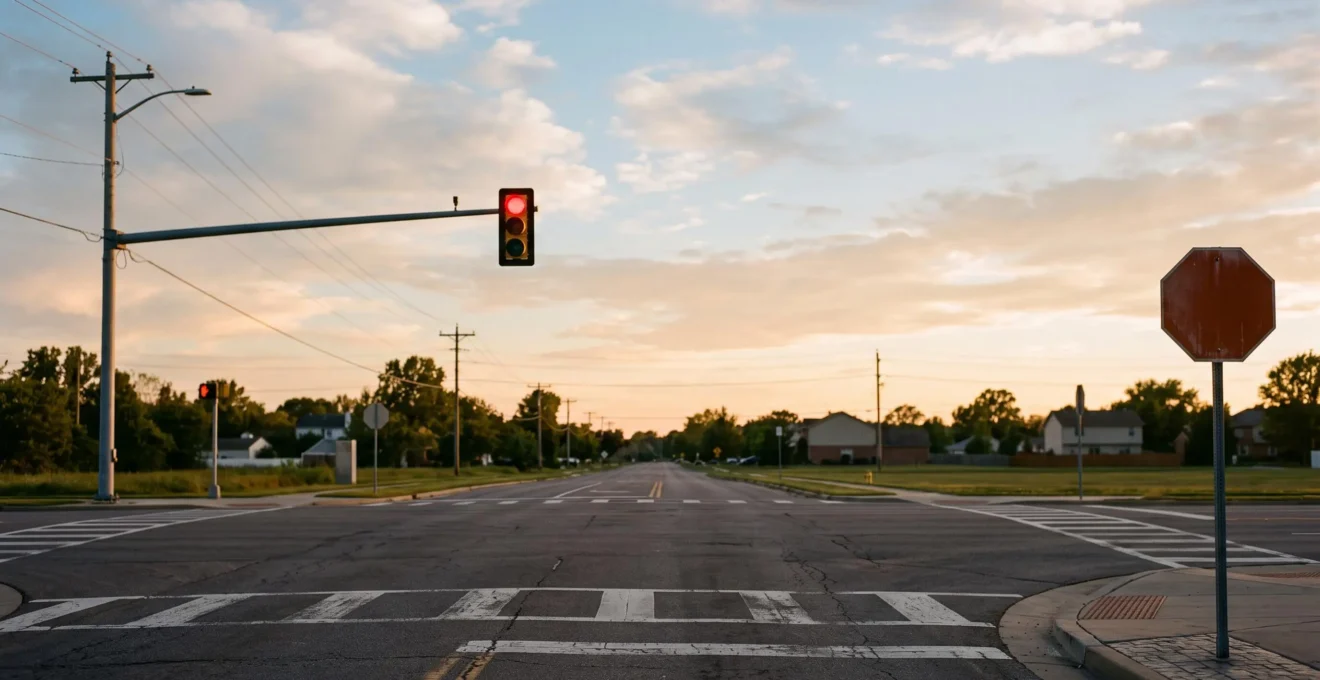
This is perhaps the most famous—and misunderstood—rule of American driving. In most of the United States, the default rule is that you are allowed to turn right at a red light. However, this is not a free-for-all. It’s a two-step process: you must first come to a complete stop, just as you would for a stop sign. Then, after stopping and ensuring there is no oncoming traffic or pedestrians crossing, you may proceed with the turn. The purpose is to improve traffic flow and reduce idling.
The confusion arises from the exceptions. The permission to turn right on red is immediately revoked if you see a sign that says “NO TURN ON RED”. These are most common in dense urban areas, at complex intersections, or where visibility is poor. Some signs may specify times, such as “NO TURN ON RED 7 AM – 7 PM.” Additionally, if the traffic light is a red arrow pointing right, you must wait for a green light. The key is to train your eyes to scan for that prohibitive sign every time you approach a red light intending to turn right.
The most significant exception to the rule is a geographical one. While turning right on red is the default everywhere else, the opposite is true in New York City. Understanding this distinction is critical, as a wrong turn can be a costly mistake. For example, in New York, a violation can result in a significant penalty; an illegal right turn can cost between $50 and $300 plus license points.
This table clarifies the default rule and how to identify the exceptions, which is crucial for navigating different parts of the country.
| Location | Default rule | How to know when it’s allowed/forbidden |
|---|---|---|
| New York City | Right turn on red is prohibited by default | Only allowed where a specific sign permits it |
| Rest of the United States (most states) | Right turn on red is allowed by default | Forbidden only where a sign, red arrow, or pedestrian signal says otherwise |
HOV Lanes : pourquoi rouler seul dans la voie de gauche peut vous coûter $400 ?
On many large American freeways, you will notice lanes marked with a diamond symbol (◊) and the letters “HOV”. This stands for High-Occupancy Vehicle, and these lanes are a tool cities use to combat traffic congestion and encourage carpooling. They are often the far-left lane and are sometimes referred to as “carpool lanes.” The core rule is simple: to use this lane during its operational hours, your vehicle must contain a minimum number of people, usually two or more (2+), but sometimes three or more (3+). The specific requirement is always posted on signs along the freeway.
These restrictions are typically only enforced during peak rush hour periods, for example, 6-9 AM and 3-6 PM on weekdays. Outside of these posted hours, the lane usually reverts to a general-purpose lane open to all traffic. However, violating the rule during operational hours is a serious and expensive mistake. It’s not treated as a minor infraction. States post clear warnings, and as an example, signs along Arizona freeways warn of a $400 minimum fine for improper use.
While the “no solo drivers” rule is strict, there are a few standard exceptions that allow a single person to use the HOV lane legally. It’s important to know these, as they can be very useful:
- Motorcycles are almost universally allowed in the HOV lane, regardless of the number of riders.
- Certain low-emission or electric vehicles may be permitted, but this often requires a special decal or permit that would be unavailable on a rental car.
- Public transit vehicles, like city buses, are permitted even with only the driver aboard.
For a tourist in a rental car, the takeaway is straightforward: unless you have at least one passenger, stay out of the diamond lane during posted hours. It is not a “fast lane” for everyone.
L’erreur de dépasser un bus scolaire à l’arrêt avec ses clignotants rouges
Of all the rules on American roads, this is the most sacred and enforced with zero tolerance. When a yellow school bus stops, extends its small stop sign on the side (the “stop-arm”), and flashes its red lights, all traffic around it must come to a complete stop. This is not a suggestion; it is an absolute command. The reason is simple and profound: the safety of children. Children may be crossing the street from any direction, and their behavior can be unpredictable. The law creates a protective bubble around the bus.
The scale of non-compliance is staggering and puts children at risk daily. According to the National Highway Traffic Safety Administration (NHTSA), there are an estimated 43.5 million illegal passings of school buses every school year in the United States. Because of this danger, penalties are severe, including hefty fines, license suspension, and in some cases, even jail time.
The rule applies to traffic moving in both directions. Here’s how it works:
- If you are on a two-lane road (one lane in each direction): All traffic, from both the front and the rear, must stop.
- If you are on a multi-lane, undivided road: All traffic, in all lanes and in both directions, must stop.
- The ONE key exception: If you are on a divided highway with a physical median (like a strip of grass or a concrete barrier) between the opposing lanes of traffic, only the vehicles traveling in the same direction as the bus are required to stop. Traffic moving in the opposite direction on the other side of the median may proceed with caution.
Your responsibility as a driver is clear: see flashing red lights on a school bus, you stop. Do not try to “time it” or “squeeze by.” You remain stopped until the lights stop flashing, the stop-arm is retracted, and the bus begins to move again.
Undertaking : pourquoi est-il légal et fréquent de doubler par la droite sur l’Interstate ?
For many European drivers accustomed to strict lane discipline, the sight of cars passing on the right (“undertaking”) on a multi-lane American freeway can seem like pure chaos. It feels dangerous, undisciplined, and wrong. However, in most of the US, passing on the right on a multi-lane highway is not illegal. This practice is a symptom of a different underlying rule and driving culture compared to Europe.
The core difference is the “keep right” rule. In many European countries, the left lane is strictly for passing, and you are legally required to move back to the right after overtaking. In the US, the laws are more varied and often less strictly enforced. While the general principle is “slower traffic keep right,” many drivers use the left lane for cruising, a practice often called “left-lane camping” or “left-lane hogging.” When a faster-moving vehicle approaches a left-lane camper, instead of waiting for them to move over (which may not happen), they will simply pass them on the right.
This reality is codified in state laws, which fall into two main categories. Understanding this helps explain the on-road behavior you will witness.
In recent years, many states have been cracking down not on the undertakers, but on the left-lane campers who cause the bottleneck. For instance, some states, like South Carolina, now fine left-lane loitering directly to improve traffic flow. As a visitor, the safest strategy is to adopt the “slower traffic keep right” model. Use the left-most lanes for passing, and then move back to a center or right lane to continue cruising.
| Rule type | Number of states | What it means for drivers |
|---|---|---|
| Slower traffic must keep right | 29 states | Any car traveling slower than surrounding traffic must move to the right lane |
| Left lane reserved for passing/turning only | 11 states | The left lane cannot be used for cruising even at the speed limit |
Mains sur le volant : comment se comporter lors d’un contrôle routier (Traffic Stop) ?
Seeing flashing red and blue lights in your rearview mirror is a stressful experience for any driver, but for a foreigner in the United States, it is a critically important moment that requires a specific, learned protocol. The interaction is fundamentally different from what you may be used to in Europe. In the US, traffic stops are considered high-risk situations for law enforcement officers, and your behavior as the driver is key to ensuring the encounter is safe, brief, and professional for everyone involved.
The officer’s primary concern is their own safety. They do not know who you are or what is inside your vehicle. Sudden movements or reaching for things can be misinterpreted as a threat. As one anonymous officer wrote for a police publication, the core of the danger is simple and chilling. In his words:
It’s the hands that kill us, friends.
– Anonymous police officer, Police1.com
This single idea should guide your every action. Your goal is to be predictable and non-threatening. Do not get out of your car unless explicitly told to do so. Do not rummage through your glove box or bags for your license and registration before the officer asks for them. The single most important thing you can do is keep your hands visible at all times. The American Association of Motor Vehicle Administrators (AAMVA) provides a clear protocol which you should memorize and follow precisely.
Your action plan for a US traffic stop:
- Activate your turn signal and pull off to the side of the roadway as soon as it is safe to do so.
- Turn off the engine and any audio devices.
- Stay in your vehicle unless directed by the officer to exit, and turn on your interior lights if pulled over at night.
- Keep your hands on the steering wheel or in another visible location where they are easily observable. Wait for the officer to instruct you.
- When asked for your documents, calmly state where they are and that you are going to retrieve them before you move your hands. For example: “Okay, my license is in my wallet. I’m going to get it now.”
Permis voiture ou permis lourd : que faut-il pour conduire un gros RV aux USA ?
The idea of a great American road trip often involves a Recreational Vehicle (RV), but for European drivers, the size of these vehicles can raise a daunting question: is my standard car license (like a Class B) even legal for driving a vehicle that looks more like a bus?
Here is the good news: for the vast majority of rental RVs, your standard car license is all you need. In the United States, license requirements are generally based on the vehicle’s weight and intended use (commercial vs. private). Most RVs available for rent, even the large “Class A” models that resemble buses, are intentionally built to fall under the weight threshold that would require a special Commercial Driver’s License (CDL). This threshold is typically 26,000 pounds (around 11,790 kg).
Rental companies are in the business of renting to the general public, so they ensure their fleets are operable by drivers with a regular license. When you rent an RV, the company will confirm your license is valid, but they won’t expect you to have a heavy vehicle or truck license. An International Driving Permit (IDP) is also highly recommended, not as a license itself, but as an official translation of your home country’s license, which can simplify things during a traffic stop or at the rental counter.
The key takeaway is to not be intimidated by the size. While you won’t likely need a special license, you will need a special kind of attention and care when driving. RVs have significant blind spots, require much more room for turns, and are heavily affected by crosswinds. The challenge isn’t legal; it’s practical. Always ask the rental agency for a full orientation on the vehicle’s systems and take some time to practice driving it in a large, empty parking lot before heading out onto the highway.
Sieste ou caféine : quelle stratégie pour conduire 800 km en sécurité ?
The sheer scale of the United States means long driving days are a common part of any road trip. Covering 500 miles (about 800 km) in a day is not unusual, but it presents a significant challenge to driver alertness. When fatigue inevitably sets in, drivers often face a choice: push through with the help of caffeine, or pull over and rest?
As a driving instructor, my advice is unequivocal: the nap is always the better strategy. Caffeine, whether from coffee or energy drinks, is a temporary fix that merely masks the symptoms of fatigue. It can give you a short-term boost in alertness, but it doesn’t solve the underlying problem—your brain and body need rest. Worse, when the caffeine wears off, the “crash” can be sudden and severe, leaving you more drowsy than before. Driving in this state is known as “drowsy driving,” and it is just as dangerous as drunk driving.
A strategic nap, on the other hand, actually restores brain function. Research has consistently shown that even a short “power nap” of 20-30 minutes can significantly improve alertness, performance, and reaction time. It is the only real countermeasure to fatigue.
This image perfectly captures the smarter choice for a long-distance driver battling fatigue.
The key is to do it safely. Don’t just pull over on the shoulder of the highway. Plan to stop at a designated public rest area, a well-lit truck stop, or a service station parking lot. Lock your doors, set an alarm for 20-30 minutes, and allow yourself to rest. After your nap, take a short walk to get your blood flowing before getting back on the road. This short delay is an investment in your safety and the safety of everyone else on the road. It’s the choice a professional, defensive driver makes.
Key takeaways
- Right on red is the default rule, except where a sign (or being in New York City) explicitly forbids it.
- “Undertaking” is a legal consequence of a different lane culture; the primary rule is that slower traffic should keep right, freeing the left lane for passing.
- A police traffic stop is a high-stakes protocol where safety is paramount: pull over, turn off the engine, and keep your hands visible on the wheel until instructed otherwise.
RV or Rental Car: Which is Best for a 3-Week US Road Trip?
Planning a three-week American road trip presents a fantastic choice at the very heart of your journey: will you embrace the freedom of a rental car, staying in hotels and eating in diners, or will you opt for the home-on-wheels convenience of an RV? There is no single right answer, as the best choice depends entirely on your travel style, budget, and priorities.
This image of two paths on a vast desert highway visualizes the fundamental decision you’re making about your travel experience.
A rental car offers unparalleled flexibility and spontaneity. It’s easy to drive, simple to park, and allows you to navigate crowded city streets and tight parking lots in National Parks without a second thought. You can change your itinerary on a whim, opting for a roadside motel one night and a city hotel the next. This is the classic road trip experience, focused on the journey and the discoveries along the way. However, it means you are constantly packing and unpacking, and the costs of hotels and restaurant meals can add up quickly over three weeks.
An RV, on the other hand, offers comfort and consistency. Your bed, your kitchen, and your bathroom are with you at all times. This can be a huge benefit for families or those who prefer to cook their own meals. Waking up inside a National Park is a magical experience that an RV facilitates. The trade-off is a significant loss of flexibility. Driving and parking a large RV is stressful, especially for those not used to it. Many scenic backroads may be off-limits, and navigating urban areas is a nightmare. While you save on hotels and food, the initial rental cost and the abysmal fuel economy mean an RV is not automatically the cheaper option. It’s a choice for a slower, more domestic style of travel.
For a three-week trip, the choice often comes down to this: do you prioritize the freedom to explore anywhere (car) or the comfort of having your own space everywhere you go (RV)?
Ultimately, driving in the US is an achievable and incredibly rewarding experience. By replacing anxiety with knowledge and understanding the mindset behind the rules, you can navigate the country’s vast and varied roads with confidence. Safe travels!