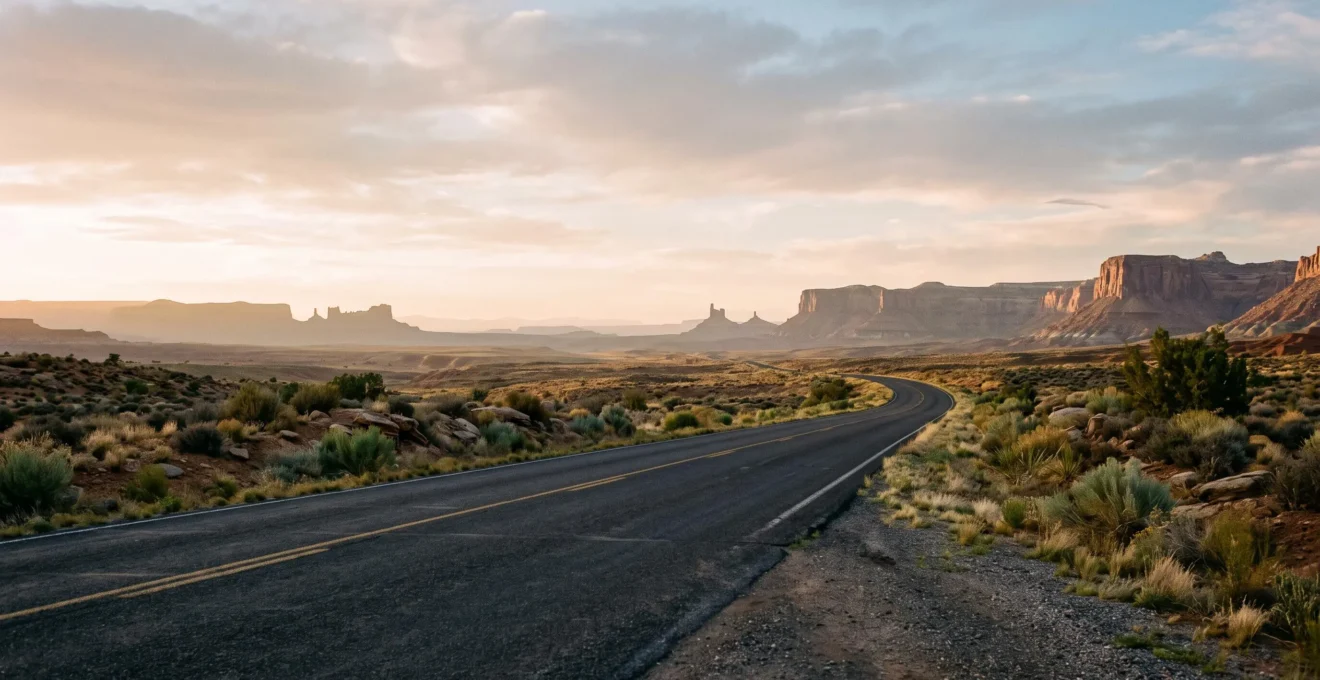
True authentic travel in the United States has nothing to do with finding secret spots; it is an act of intellectual and philosophical curation.
- The primary obstacle to an authentic journey is the pre-conceived “cinematic narrative” of what America is supposed to look like.
- Meaningful experiences are earned through deliberate slowness and a “confrontational curiosity” that engages with the country’s real, complex character.
Recommendation: Stop trying to build a better itinerary. Start by cultivating a more discerning travel philosophy.
For the discerning traveler, the United States presents a unique paradox. It is a nation exhaustively documented, filmed, and photographed, yet its genuine character remains elusive, buried under layers of cinematic cliché and the relentless efficiency of the tourism industry. The typical advice—rent a car, drive a famous route, tick off the major national parks—is a formula for a satisfactory trip, but a surefire path to a forgettable one. It delivers the expected postcard views but withholds the very thing a seasoned traveler seeks: a sense of discovery, of genuine immersion, of a story that feels uniquely their own.
The conventional wisdom assumes that authenticity is a destination—a hidden diner, an undiscovered vista. This assumption is the first mistake. Most guides will offer lists of “alternatives,” suggesting you swap one crowded landmark for another, slightly less crowded one. But this only trades one set of clichés for another. It fails to address the root problem: a passive, consumerist approach to travel that prioritizes seeing over understanding. We are conditioned to seek the America of the movies, a simplified and sanitized highlight reel that flattens the country’s vast and contradictory soul.
But what if the key to a transformative American journey wasn’t about *where* you go, but *how* you approach it? What if the most memorable experiences aren’t found on a map but are cultivated through a specific mindset? This guide proposes a different path. It’s a philosophy built on rejecting the cinematic illusion, embracing deliberate slowness, and developing a confrontational curiosity that is unafraid of the nation’s complex, and often uncomfortable, psychological topography. This is not a list of places to see, but a new lens through which to see them.
Throughout this guide, we will deconstruct the common pitfalls of US travel and provide a strategic framework for designing a journey that delivers profound, lasting memories. We will explore how to choose destinations based on the quality of experience they offer, find the pulse of a place beyond the tourist-facing facade, and engage with the country’s story in a way that is both challenging and deeply rewarding.
Summary: A New Manifesto for Authentic US Travel
- Why does Utah offer des souvenirs plus marquants que la Floride pour les aventuriers ?
- Comment trouver des événements locaux sans passer par une agence de tourisme ?
- Slow Travel vs Circuit Rapide : lequel choisir pour une immersion réelle ?
- L’erreur de croire que tout ressemble aux films hollywoodiens
- Photographier les USA : les 5 réglages pour sublimer les paysages grandioses
- Pourquoi le National Memorial for Peace and Justice est une visite incontournable ?
- Lamar Valley à 5h du matin : pourquoi est-ce le meilleur moment pour les loups ?
- How to Navigate the Deep South’s Complex History on a Cultural Tour?
Why does Utah offer des souvenirs plus marquants que la Floride pour les aventuriers ?
The choice between a destination like Florida and one like Utah is not merely a choice of landscape, but of travel philosophy. Florida’s appeal often lies in curated, passive attractions—theme parks and beach resorts where the experience is delivered to you. Utah, by contrast, demands participation. Its value is predicated on the concept of the earned experience, a reward that is directly proportional to the effort invested.
The state’s tourism surge is not an accident; it is a direct response to a growing desire among travelers for self-directed adventure over pre-packaged entertainment. Recent tourism data reveals a significant trend: Zion has now become America’s second-most visited national park, surpassing even the Grand Canyon. This isn’t because it’s the easiest park to visit; it’s because its most iconic experiences, like hiking The Narrows or Angels Landing, require physical commitment and personal resolve. The memory is not of the thing you saw, but of what you did to see it.
This landscape forces an encounter with scale, solitude, and deep time that is impossible to replicate in a more managed environment. Standing alone in a vast red rock canyon, dwarfed by geological formations millions of years in the making, you are not a customer being served an attraction. You are a participant in a raw, elemental narrative. This is the crucial difference: Florida offers distraction, while Utah offers confrontation with the sublime. The souvenirs you bring back from Utah are not objects, but the indelible imprints of silence, effort, and awe.
Comment trouver des événements locaux sans passer par une agence de tourisme ?
To truly connect with a place, one must bypass the sanitized layer of its official tourism apparatus. Tourism agencies are designed to direct you to predictable, monetizable experiences. True local culture, however, resides in the spaces where residents live their lives, often invisible to the average visitor. Finding these events requires a shift from being a passive recipient of information to an active cultural archaeologist.
Your primary tools are not guidebooks but analog and digital listening posts. Forget the glossy brochures at the hotel lobby. Instead, start with these strategies:
- The Small-Town Newspaper Website: Nearly every small town has a local paper with a digital presence. Scan the “Community Calendar” or “Local Events” section. This is where you’ll find listings for high school football games, farmers’ markets, town hall meetings, or local band performances—the very fabric of daily life.
- The Local Library & Coffee Shop Bulletin Board: These are the last bastions of analog community connection. Here, you’ll find flyers for poetry readings, volunteer opportunities, book club meetings, or neighborhood clean-ups. Participating, or even just observing, offers a genuine slice of the local social ecosystem.
- University and College Schedules: A town with a college is a goldmine. Check the university’s website for free public lectures, student art gallery openings, or obscure film screenings. These events are intellectually stimulating and populated by locals, not tourists.
- Specialty Shop Staff: Do not ask the hotel concierge for a recommendation. Instead, go to a local fly-fishing shop, an independent bookstore, or a craft brewery. Ask the person behind the counter what *they* are doing this weekend. Their answer will be a door into the town’s real rhythm.
This method requires more effort than a Google search for “top attractions,” but the payoff is immense. It transforms you from a consumer of a place into a temporary, respectful inhabitant. The goal is not just to see a town, but to briefly feel what it’s like to live there.
Slow Travel vs Circuit Rapide : lequel choisir pour une immersion réelle ?
The modern American road trip is often a frantic exercise in accumulation—a checklist of states, cities, and landmarks to be conquered and cataloged. This “fast circuit” model treats the country as a series of disconnected points of interest, with the space in between relegated to a featureless blur seen through a windshield. For genuine immersion, a more radical approach is needed: deliberate slowness. This isn’t just about spending more time in one place; it’s a fundamental reordering of priorities from quantity of sights to quality of experience.
Slow travel recognizes that the most meaningful moments often happen in the unplanned pauses, the detours, the moments of quiet observation. It is an intentional rejection of the “fear of missing out.” A growing number of discerning travelers are embracing this philosophy, a trend reflected in the surprising resurgence of long-distance train travel. In fiscal year 2024, Amtrak recorded a record 33 million riders, with scenic routes seeing double-digit growth. This is not because the train is the fastest way to get from A to B, but because it is the slowest. It re-engages the traveler with the journey itself, turning the landscape from a backdrop into the main event.
Choosing slow travel over a fast circuit means making conscious trade-offs. You will see fewer places. But the places you do see, you will understand more deeply. Real immersion looks like this:
- Making space mentally and physically for things to happen spontaneously instead of following a packed itinerary.
- Taking time to walk in nature or cycle through a small town rather than rushing between landmarks.
- Engaging directly with locals by lingering in one place, becoming a familiar face at the local coffee shop.
- Allowing the pace of the journey itself, whether by rail or on a less-traveled secondary road, to become part of the experience.
The fast circuit leaves you with a collection of photos. The slow journey leaves you with a collection of stories and a genuine, felt sense of a place.
L’erreur de croire que tout ressemble aux films hollywoodiens
The single greatest obstacle to experiencing the authentic United States is the cinematic illusion. Decades of Hollywood films and television have created a powerful, pervasive, and deeply misleading narrative of what the country is, looks, and feels like. From the sun-drenched, carefree highways of California to the gritty, romanticized streets of New York, we arrive with a pre-loaded soundtrack and a set of visual expectations. This mental framework acts as a filter, preventing us from seeing the place that actually exists in favor of the one we were conditioned to expect.
This mistake manifests in a constant, low-grade disappointment. The real Route 66 is not an endless parade of vintage cars and quirky Americana; it’s largely a collection of decaying motels and stretches of interstate. The Midwest is not a monolith of wholesome farmland but a complex tapestry of post-industrial cities, vibrant immigrant communities, and vast, empty spaces. To travel with cinematic expectations is to seek confirmation of a myth, and in doing so, to become blind to the more nuanced, and often more interesting, reality.
An authentic journey requires a conscious act of de-programming. It means actively challenging your own assumptions. When a place doesn’t match the movie version, the discerning traveler doesn’t feel let down; they feel a flicker of excitement. This dissonance is the entry point to authenticity. It’s a signal that you have broken through the facade and are beginning to touch the real psychological topography of a place. The goal is to replace the question, “Where can I find the America I’ve seen in the movies?” with a more powerful one: “What is this place, now that I am actually here?”
Embracing the mundane, the awkward, the un-photogenic, and the contradictory is the only way to dismantle the cinematic illusion. The real America is found not in the grand, sweeping vistas, but in the quiet, unscripted moments that defy easy categorization.
Photographier les USA : les 5 réglages pour sublimer les paysages grandioses
Photographing the vast American landscape is a common travel ritual, but most images produced are interchangeable and soulless. They capture the view but miss the feeling. Elevating your photography from mere documentation to evocative storytelling isn’t about having the best camera; it’s about adjusting your philosophical settings. Forget the technical jargon for a moment and focus on these five conceptual “settings” to capture the grandeur of the American landscape.
1. The Shutter Speed of Patience: The most iconic landscapes are often overrun at midday. The real “shot” is almost always at the fringes of the day. Setting your internal shutter to “slow” means arriving before dawn or staying long after sunset, when the light is transformative and the crowds have vanished. The image becomes a reward for your patience.
2. The Aperture of Human Scale: A mountain range is just a postcard until you give it scale. Instead of a wide, empty shot, use a narrow “aperture” to focus on a single, telling detail that implies the vastness around it. A lone hiker, a tiny cabin, or your own worn-out boots in the foreground tells a more compelling story about the scale of the place than the grand view alone.
3. The ISO of Imperfection: The temptation is to create a slick, perfect, high-resolution image. Resist it. Embrace the “noise.” Capture the haze in the valley, the lens flare from the sun, the motion blur of the wind in the trees. These imperfections are what convey the atmosphere and the reality of the moment, distinguishing your photo from a stock image.
4. The White Balance of Place: Don’t “correct” the light to a neutral standard. Let the cold, blue light of pre-dawn in the Rockies be blue. Let the fiery, warm glow of a desert sunset in Arizona saturate the frame. The color of the light is a primary character of the landscape; preserving its true nature is essential for conveying a sense of place.
5. The Focus on the In-Between: The most clichéd shots are taken from the designated viewpoints. The most interesting photos are often found in the spaces *between* them. Focus on the texture of a weathered fence post, the pattern of cracks in a dry lakebed, the light filtering through the window of a roadside diner. These small narratives ground the epic landscape in a personal, tangible reality.
Pourquoi le National Memorial for Peace and Justice est une visite incontournable ?
In the landscape of American monuments, most are designed for passive admiration and patriotic reflection. The National Memorial for Peace and Justice in Montgomery, Alabama, is engineered for a different purpose: active, uncomfortable, and necessary confrontation. It is not a place you simply visit; it is an experience you endure. For any traveler committed to understanding the United States beyond its sanitized myths, it is an essential pilgrimage. Its power lies in its brilliant and devastating use of architectural storytelling.
As designed by MASS Design Group, the memorial masterfully manipulates the visitor’s physical perspective to force an emotional and intellectual reckoning. You begin by walking among 800 six-foot steel monuments, one for each US county where a racial terror lynching took place. At first, they stand on the ground with you, like pillars. But as the pathway gradually descends, you realize the pillars are, in fact, hanging from the ceiling. Soon, they are suspended above you, evoking the horrific history they represent. You are forced to look up, craning your neck, in a physical posture that mirrors that of the historical onlookers. This is not history presented behind glass; it is a weight—physical, visual, and emotional—that the space compels you to feel.
This journey is framed by a profound understanding of justice, articulated in the words of Dr. Martin Luther King Jr. that greet visitors:
True peace is not merely the absence of tension: it is the presence of justice.
– Martin Luther King Jr., Inscription at the National Memorial for Peace and Justice
The memorial is a must-visit because it embodies this principle. It understands that true engagement with American history cannot be a comfortable or passive act. It must be a form of confrontational curiosity, a willingness to face the tension of the past to comprehend the present. It is, perhaps, the most honest and necessary single acre in the entire country.
Lamar Valley à 5h du matin : pourquoi est-ce le meilleur moment pour les loups ?
Seeing a wolf in the wild is the holy grail for many visitors to Yellowstone, yet most leave disappointed. The reason is simple: they operate on a human schedule, not a wolf’s. The Lamar Valley, often called America’s Serengeti, is the best place on the continent for wolf-watching, but only for those who understand that the experience must be earned. Arriving at 5 a.m. is not an arbitrary suggestion; it is a strategic necessity rooted in animal behavior and the culture of dedicated wildlife observation.
Wolves are crepuscular, meaning they are most active during the twilight hours of dawn and dusk. The cool air and low light provide them with a predatory advantage. By midday, they are often resting in high, timbered country, invisible to the casual observer. The pre-dawn hours are your primary window of opportunity. This is when packs are on the move, communicating with haunting howls that carry for miles in the still morning air. To be there as the first light hits the valley is to witness the landscape coming to life on its own terms. As of late 2025, park biologists confirmed Yellowstone is home to about 84 wolves in 8 packs, and your best chance to see them is by respecting their schedule.
Furthermore, showing up early is about joining a community. The roadside pullouts in Lamar Valley are filled with serious “wolf-watchers” before the sun rises. They are a network of eyes and ears, equipped with powerful spotting scopes and radios, sharing information in real-time. By being there, you become part of this collective effort, dramatically increasing your chances. It is an experience built on shared passion, patience, and reverence for the wild.
Your Action Plan for a Dawn Wolf Watch:
- Be parked and scanning the valley before first light; serious watchers arrive while the sky is still gray.
- Treat evening as the second-best window if a dawn outing isn’t possible.
- Skip midday entirely, as wolf activity is at its lowest.
- In winter, use the Northeast Entrance Road through Lamar, the only road that stays open to regular vehicles.
- Bring warm layers, a hot drink, and settle in for patient, quiet observation alongside the dedicated community.
The 5 a.m. start is a filter. It weeds out the casual tourists and leaves only those willing to put in the effort. The potential reward—a glimpse of a wolf moving freely across the vast, wild stage of the Lamar Valley—is one of the most profound and earned experiences North America has to offer.
Key takeaways
- Authentic travel is not about the destination but the mindset; the most memorable moments are “earned experiences” that require effort and participation.
- Embrace “deliberate slowness” by rejecting packed itineraries, allowing for spontaneity and deeper connection to a single place.
- Confronting the complex and often uncomfortable aspects of American history is not an optional detour but an essential part of an honest and immersive journey.
How to Navigate the Deep South’s Complex History on a Cultural Tour?
A cultural tour of the American South that focuses only on its celebrated hospitality, music, and cuisine is not a cultural tour at all; it is a curated fiction. To truly engage with the region is to engage with its ghosts and its unresolved legacy of racial injustice. This is not about seeking guilt or judgment, but about practicing a form of confrontational curiosity—an honest, unflinching look at the complete story of a place. Navigating this complex history requires a framework of respect, context, and a willingness to listen.
First, prioritize sites of conscience over sites of comfort. This means dedicating as much time to a place like the National Memorial for Peace and Justice as you would to a celebrated restaurant. It means seeking out the local Black history museum, visiting the grounds of a former plantation with a tour that centers the enslaved, or walking a bridge that was a flashpoint in the Civil Rights Movement. As Rep. Terri A. Sewell stated at the unveiling of the Montgomery memorial, ” No matter how painful, these are memories which our nation must confront.” As a traveler, you have a unique opportunity to bear witness to that confrontation.
Second, understand that this history is not abstract. It is quantified by staggering loss. The steel monuments in Montgomery are not symbolic; they represent the real names of the 300+ documented lynching victims in Alabama alone. Approaching this history means seeing it not as a political issue but as a landscape of human stories. This requires humility and a quiet, observant posture. This is not the time to debate, but to listen—to the tour guides, to the exhibits, and to the silence of the spaces themselves.
No matter how painful, these are memories which our nation must confront.
– Rep. Terri A. Sewell, Statement on the Unveiling of the National Memorial for Peace and Justice
Ultimately, navigating the South’s history is the ultimate test of a discerning traveler. It asks you to abandon the comfort of the cinematic narrative and embrace the messy, painful, and profoundly human reality. It transforms you from a tourist, a consumer of pleasantries, into a witness. And being a witness, even a temporary one, is the most authentic and impactful role a traveler can assume.
The journey is complete not when you have seen everything, but when you have learned a new way to see. Applying this philosophy of deliberate slowness and confrontational curiosity is the first step in designing your own truly transcendent American holiday.