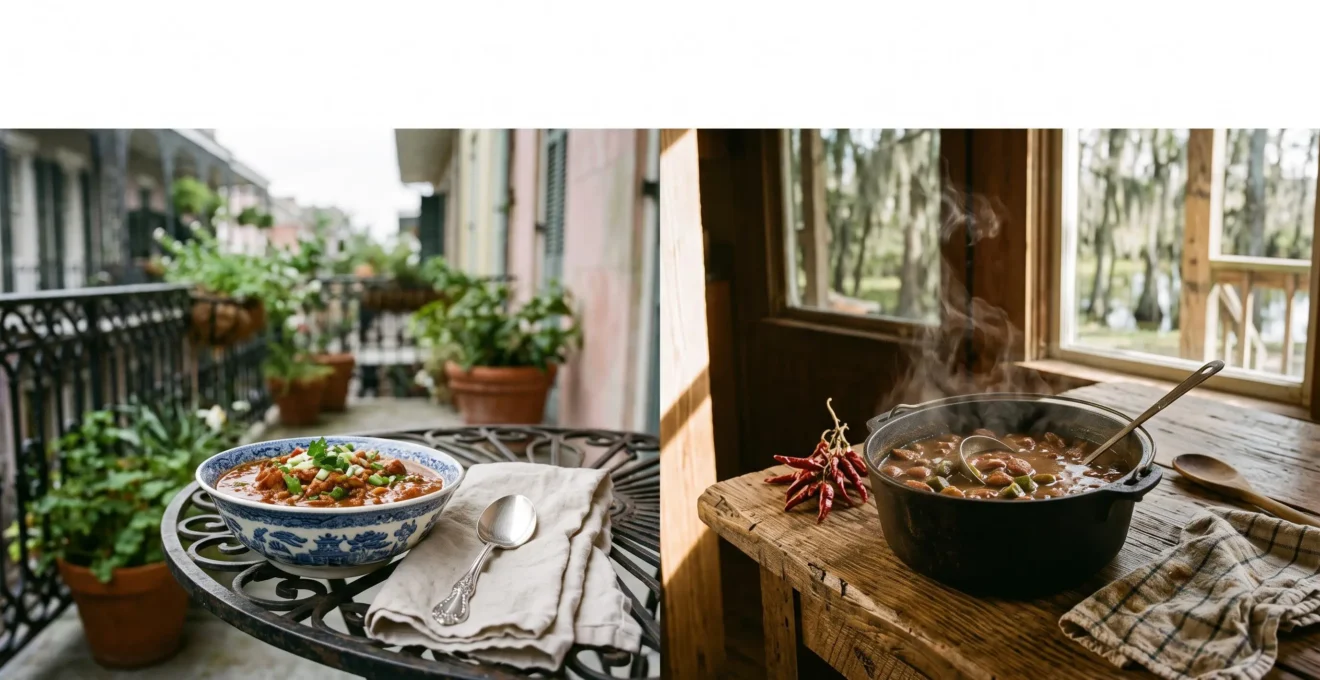
The real difference between Creole and Cajun isn’t just city versus country—it’s a tale of two entirely different culinary philosophies.
- Creole is the cuisine of composition, a refined, layered style born from aristocratic urban kitchens with global influences.
- Cajun is the cuisine of resourcefulness, a rustic, deep-flavored style created by country settlers using what the land provided.
Recommendation: Pay close attention to the color of the roux in a gumbo. A lighter, butter-based roux signals a Creole dish, while a dark, oil-based roux reveals its soulful Cajun roots.
The scent hangs in the humid New Orleans air—a rich, savory perfume of simmering stock, toasted flour, and a trinity of aromatics. You sit down, menu in hand, and face the delicious dilemma that confronts every food-loving visitor to Louisiana: Cajun or Creole? You’ve likely heard the common refrains. “Creole is city food, Cajun is country food.” Or perhaps the classic “Creole uses tomatoes, Cajun never does.” While these adages hold a kernel of truth, they are merely tasting notes in a much richer, more complex symphony of flavor and history.
To truly understand Louisiana on a plate, you must look past the ingredient lists. The real distinction is not found in a tomato, but in the very soul of the cook and the history that guides their hand. It’s a fundamental difference in culinary philosophy. Creole cuisine is an act of composition, a refined and layered art form born from the multicultural melting pot of an aristocratic port city. Cajun cuisine, in contrast, is an expression of resourcefulness, a rustic and soulful tradition forged from the necessity and bounty of the bayou and prairies. One is built in layers; the other is simmered into one profound, harmonious pot.
Forget the simple binaries. To truly appreciate what you’re about to eat, you need to understand the why behind the dish. In this guide, we will move beyond the clichés to explore the heart of these two great American cuisines. We’ll decode their foundational dishes, learn the secrets of their techniques, and equip you with the knowledge to navigate any Louisiana menu with the confidence of a seasoned local.
This article will guide you through the essential distinctions a true foodie needs to know. From the philosophy behind a perfect gumbo to the unwritten rules of dining in the South’s most celebrated restaurants, we will explore the nuances that make Louisiana’s culinary landscape so endlessly fascinating.
Summary: The Foodie’s Guide to Cajun and Creole Cuisine
- Why Is Gumbo Different in the City (Creole) vs. the Countryside (Cajun)?
- How to Get a Table at Commander’s Palace Without Booking 3 Months in Advance?
- Cooking Class: Which One to Choose to Master the Perfect Roux?
- The Mistake of Underestimating the Spice in Authentic Dishes
- How Much to Tip in Southern Fine Dining Restaurants?
- Glenwood Springs or Pagosa Springs: Which Thermal Station to Choose?
- Where to Eat to Support Businesses from the Historic Black Community?
- Denver to Aspen: How to Structure a 10-Day Colorado Itinerary in Summer?
Why Is Gumbo Different in the City (Creole) vs. the Countryside (Cajun)?
Gumbo is the quintessential Louisiana dish, but not all gumbos are created equal. The difference is the perfect illustration of the Creole versus Cajun mindset. As legendary New Orleans chef Frank Brigtsen famously said, “It’s the difference, I always say, between city and country tables.” A Creole gumbo, born in the refined kitchens of New Orleans, often starts with a lighter roux—the color of a paper bag or peanut butter—made with butter and flour. It’s more likely to include tomatoes and will almost certainly feature a bounty of seafood like shrimp, crab, and oysters, reflecting the city’s status as a global port.
A Cajun gumbo, however, tells a different story. It’s a tale of making do with what you have. The roux is the soul of the dish, cooked low and slow with oil or lard until it reaches a deep, smoky dark chocolate color. This process takes patience and skill, as a burnt roux is a ruined roux. This dark base adds an incredible depth of flavor that is the hallmark of Cajun country cooking. Tomatoes are almost never seen. Instead, the proteins are heartier, often focused on chicken and andouille sausage, or whatever game was hunted that day. It is a one-pot meal born of necessity, but one that has been elevated to an art form.
This table breaks down the core philosophical differences that manifest on your spoon. It’s not just a recipe; it’s a worldview, as detailed in this exploration of gumbo’s rich history.
| Aspect | Creole Gumbo (City) | Cajun Gumbo (Country) |
|---|---|---|
| Roux base | Lighter, often butter-based, cooked less intensely | Dark, oil or lard-based, cooked long and slow |
| Tomatoes | Often included, tomato-based sauces common | Traditionally excluded |
| Primary protein | Seafood-forward (shrimp, crab, oysters) | Meat-forward (chicken, andouille sausage, game) |
| Cultural roots | French and Spanish aristocratic households, refined techniques | Rural Acadian settlers, resourceful one-pot cooking |
| Culinary philosophy | A composed, layered dish reflecting urban sophistication | A rustic, improvised dish born of necessity and available ingredients |
How to Get a Table at Commander’s Palace Without Booking 3 Months in Advance?
Commander’s Palace, the turquoise-and-white icon in the Garden District, is the epitome of Creole grand dining. Securing a dinner reservation can feel like a competitive sport. But as a chef, I can tell you there’s more than one way to get in the door. The secret isn’t a hidden website; it’s about understanding the rhythm of the restaurant. The most overlooked opportunity is the legendary weekday lunch. This is where the city’s power brokers and discerning locals gather, and it’s a far more accessible experience than the perennially booked-out weekend dinner service.
The key is to aim for the famous 25-cent martini lunch, a tradition that offers a vibrant taste of the restaurant’s culture. While reservations are still recommended, the turnover is faster, and the staff is accustomed to accommodating walk-ins who are patient and, importantly, properly dressed. As co-proprietor Ti Martin once noted, there’s a certain Southern hospitality at play. In a conversation with Southern Kitchen about the history of the martini lunch, she shared a key insight: “if guests show up hungry and dressed nicely, they’ll find a table for them.” Don’t be afraid to show up, have a drink in the beautiful courtyard, and wait for a spot to open. It’s part of the experience.
Your Action Plan: The 25-Cent Martini Lunch Gambit
- Target lunch instead of dinner: Focus on the legendary 25-cent martini service on Wednesday, Thursday, and Friday lunches, which have a separate, more accessible booking window.
- Arrive prepared to wait: If it’s fully booked online, show up dressed for the occasion. Well-dressed guests are often accommodated after a pleasant wait in the courtyard, martini in hand.
- Call the day-of for cancellations: Lunch service has more turnover, and last-minute changes create same-day openings more frequently than dinner. A polite call around 11 a.m. can work wonders.
- Consider a weekday visit: While popular, the martini lunches are still more accessible on a Wednesday or Thursday than a prime-time weekend dinner reservation.
Cooking Class: Which One to Choose to Master the Perfect Roux?
After a few meals in Louisiana, you’ll realize that the roux is everything. It’s the foundational flavor that dictates the character of a gumbo, an étouffée, or a stew. For a foodie who wants to take a piece of Louisiana home, a cooking class is a fantastic idea. But be warned: many classes are large-scale demonstrations where you simply watch a chef cook. To truly learn, you need to find a class that lets you get your own hands dirty.
The goal is to feel the roux change under your own spoon. You want to see it transform from a pale, pasty mixture to a fragrant, nutty, and dangerously dark liquid. This requires a hands-on workshop format, typically with smaller class sizes. Look for schools that explicitly state “hands-on” or “participation” in their descriptions, rather than “demonstration.” These are the places where you’ll be standing at your own station, whisk in hand, learning the patience and constant stirring required to achieve a perfect dark Cajun roux without burning it.
Case Study: Hands-On Roux Mastery at the Mardi Gras School of Cooking
To truly understand the value of a hands-on approach, consider the experience of a food writer who sought to demystify Louisiana’s core techniques. By booking an intimate, hands-on class at the Mardi Gras School of Cooking, they were able to move beyond theory. As documented in their culinary journey, the small workshop format allowed them to personally practice preparing both a light Creole-style roux and a dark Cajun one. Instead of just watching, they felt the texture change and smelled the aromas evolve, an experience that a larger demonstration class simply cannot replicate. This illustrates how choosing a dedicated, practical workshop is the key for any visitor wanting to actually master the technique, not just observe it.
The Mistake of Underestimating the Spice in Authentic Dishes
There’s a common misconception among visitors that all Louisiana food, especially Cajun, is fiery hot. This leads many to be timid when ordering, fearing an onslaught of chili heat. This is, to put it simply, a misunderstanding of how we approach flavor. The goal is not to burn your palate; it is to build a deep, complex, and layered warmth. As the official Louisiana Office of Tourism rightly points out, “Cajun food is well-seasoned, but not necessarily spicy.”
Think of it as the difference between a spotlight and a warm glow. True Louisiana cooking uses cayenne pepper, paprika, and other spices not for scorching heat, but for a well-rounded flavor profile. We build layers of seasoning. You have the savory depth from the roux, the aromatic foundation of the “holy trinity” (onions, celery, and bell peppers), and then a carefully controlled warmth from the spices. A great chef wants you to taste every element—the sweetness of the crab, the smokiness of the sausage, the earthiness of the stock. Overpowering heat would simply flatten that complexity.
So, do not be afraid. Order the dish as the chef intends it. Most restaurants will have bottles of hot sauce on the table for you to adjust the heat to your personal preference. The dish that arrives at your table, however, will be balanced and deeply flavorful, designed to warm your soul, not set your mouth on fire.
How Much to Tip in Southern Fine Dining Restaurants?
While the food is the star, the service in Louisiana’s great restaurants is a critical part of the performance. Tipping culture here follows the general American standard but with an added appreciation for true Southern hospitality. For good service in any restaurant, a tip of 18% to 20% of the pre-tax bill is the expected baseline. However, in the “Grand Dame” restaurants of New Orleans and other fine dining establishments across the South, service is often elevated to an art form.
When you receive exceptional service—a waiter who expertly guides you through the menu, anticipates your needs, and shares stories about the restaurant’s history—it’s customary to show your appreciation by tipping more, often in the 22% to 25% range. This acknowledges the skill and professionalism that contribute so much to the memorable experience. Furthermore, if a sommelier has provided dedicated assistance in selecting a bottle of wine, it’s a gesture of class to tip them separately, typically 15-20% of the wine’s cost, often handed directly to them in cash. Think of tipping not just as a transaction, but as your applause for a beautifully executed performance.
Glenwood Springs or Pagosa Springs: Which Thermal Station to Choose?
Now, a true culinary journey can sometimes take unexpected turns. While my heart and my knives belong to Louisiana, I hear from traveling foodies that their adventures sometimes lead them west to the mountains of Colorado. If your palate leads you from our bayous to their hot springs, you might face a choice between Glenwood Springs and Pagosa Springs. While both offer a relaxing soak, they cater to different tastes.
From what I gather, Glenwood Springs is the more developed and accessible option. It boasts the world’s largest hot springs pool, making it a great destination for families and those who appreciate a resort-like atmosphere with plenty of amenities and nearby activities. It’s a classic, well-established destination. Pagosa Springs, on the other hand, offers a more rustic and, some would say, more therapeutic experience. It’s home to the world’s deepest geothermal hot spring, and its various pools offer a wider range of temperatures. It tends to appeal to those seeking a quieter, more nature-focused retreat. The choice, much like with gumbo, depends on whether you prefer a composed resort experience or a more rustic, elemental one.
Key Takeaways
- The core difference between Creole and Cajun is philosophy: Creole is refined ‘composition’, while Cajun is rustic ‘resourcefulness’.
- Decode a gumbo by its roux: a light, butter-based roux suggests a Creole origin, while a dark, oil-based one is distinctly Cajun.
- Don’t fear the spice. Authentic Louisiana food is about deep, ‘layered warmth’ and complex seasoning, not just fiery heat.
Where to Eat to Support Businesses from the Historic Black Community?
To eat in Louisiana is to taste history, and no part of that history is more vital than the contribution of its Black chefs and restaurateurs. From the enslaved cooks who developed the foundational techniques of Creole cuisine in aristocratic kitchens to the civil rights-era pioneers who created community hubs, Black culinary heritage is the soul of New Orleans. To support these businesses is not just an ethical choice; it’s a direct path to the most authentic and historically significant food in the city.
Rather than just seeking out a single dish, seek out the historic neighborhoods where this culinary tradition thrives. Explore the restaurants of Tremé, one of the oldest African-American neighborhoods in the United States, or the soulful spots in the Faubourg Marigny. This is where you’ll find institutions that have been passed down through generations. Think of places like the legendary Dooky Chase’s Restaurant, where Chef Leah Chase not only served presidents but also hosted secret meetings for civil rights leaders. Eating at these restaurants is a way of participating in a living history, ensuring that the stories and flavors that truly define Louisiana continue to be told for generations to come.
Supporting these establishments is a delicious way to honor the true architects of this cuisine. Look for the family-run spots, the neighborhood kitchens, and the chefs who are both preserving tradition and innovating upon it.
Denver to Aspen: How to Structure a 10-Day Colorado Itinerary in Summer?
My expertise is firmly planted in the alluvial soil of the Mississippi Delta, but a good palate travels well. If your summer journey extends from our culinary capital to the peaks of Colorado for a 10-day adventure from Denver to Aspen, a structured approach will help you savor the experience. A well-paced itinerary allows you to acclimate to the altitude while enjoying both urban culture and natural splendor.
A logical structure would be:
- Days 1-3: Denver. Start in the Mile High City to acclimate. Explore its thriving food scene, craft breweries, and cultural districts like RiNo.
- Days 4-6: The Rockies & Vail/Breckenridge. Drive into the mountains. Choose a base like Vail or Breckenridge to explore the high country. Focus on hiking, scenic drives, and enjoying the crisp mountain air.
- Days 7-9: Aspen. Continue to the iconic town of Aspen. Explore the Maroon Bells, indulge in its world-class dining, and soak in the unique blend of rustic charm and luxury.
- Day 10: Return Journey. Enjoy a final mountain breakfast before making the scenic drive back towards Denver for your departure.
This structure balances driving time with immersive stays, preventing you from rushing and allowing you to truly appreciate the dramatic shift in landscape from the plains to the peaks.
Now that you understand the soul behind the food, the next step is to taste it for yourself. Go out, explore with confidence, ask questions, and let your palate be your guide. Welcome to Louisiana.