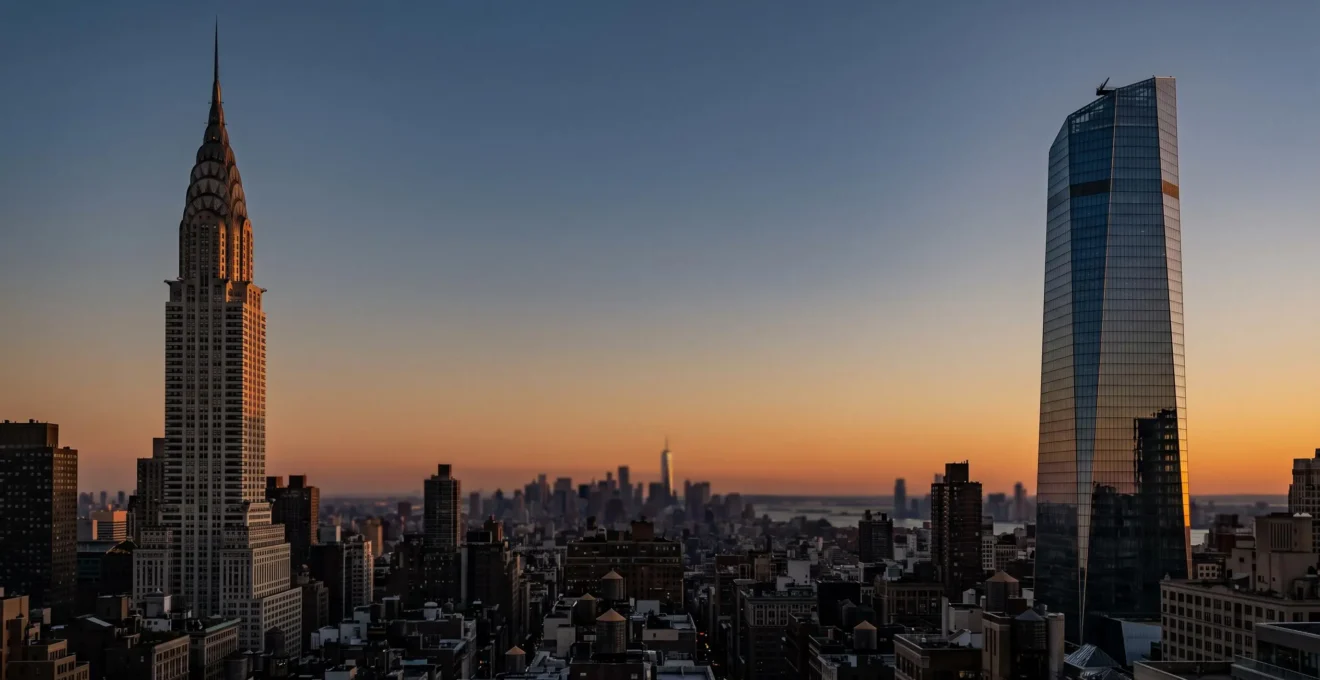
For a first-time visitor with one choice, the Empire State Building delivers better value and a more authentically iconic New York moment than SUMMIT One Vanderbilt.
- The Empire State Building offers a timeless, cinematic experience with the significant advantage of an open-air deck for reflection-free photos.
- SUMMIT provides a modern, immersive art installation, but the ‘spectacle’ can be hindered by crowds and the practical challenge of taking good photos through layers of glass and mirrors.
Recommendation: Go to the Empire State Building for the classic, historical pilgrimage. Choose SUMMIT only if you prioritize a futuristic, sensory art experience over a pure, unobstructed city view.
You have one shot. One ticket, roughly £40, and a single slot in your packed New York itinerary. Before you stand two giants: the legendary Empire State Building, a titan of history and cinema, and SUMMIT One Vanderbilt, the dazzling newcomer that has flooded social media with its mirrored halls. Every travel blog will tell you to go at sunset, but few will give you a straight answer to the real question: which one is the right *investment* for your money and your memories?
This isn’t just about which building is taller or newer. It’s about the DNA of the experience itself. Are you paying for a historical pilgrimage or a futuristic spectacle? Are you buying a clear, unobstructed view or an interactive art installation that happens to be 1,000 feet in the air? The truth is, the best choice depends on what you value most, and most guides are too afraid to make a definitive call.
We’re not. This guide is designed for the decisive tourist. We’ll dissect the core debate between the Empire State and SUMMIT, but we won’t stop there. Because making smart choices with your time and money is the key to conquering New York. We’ll apply the same critical lens to other classic tourist dilemmas, from getting the best photo of the skyline to snagging those impossible-to-get Broadway tickets. It’s time to move beyond generic advice and start making choices that deliver maximum value.
This article provides a clear framework for making the big decisions on your NYC trip. We’ll start with an in-depth comparison of the city’s viewing platforms before expanding to other key experiences that can make or break your vacation budget and schedule.
Summary: A Strategic Guide to Maximizing Your NYC Experience
- Why does the Empire State Building remain an icon despite taller towers?
- How to get the perfect sunset picture from the Top of the Rock?
- Which skyscraper offers the best experience for people with reduced mobility?
- The mistake of not booking your time slot 2 weeks in advance
- Rooftop bar or observation deck: which option for a romantic evening?
- Orchestre or Mezzanine: quelle place offre la meilleure vue pour une comédie musicale?
- Pourquoi le concierge peut obtenir des réservations de restaurant impossibles en ligne?
- TKTS Booth or Online Booking: How to Get Cheap Broadway Tickets?
Why does the Empire State Building remain an icon despite taller towers?
The Empire State Building’s power isn’t in its height; it’s in its history. While newer, taller structures compete for the skyline, the ESB offers something they cannot: a genuine sense of historical pilgrimage. This isn’t just a building; it’s a cultural landmark woven into the fabric of American identity. As former governor Al Smith remarked at its opening, it was simply “a great piece of work,” a statement of ambition and artistry that still resonates. Its status as an icon was cemented during the decades it stood as the world’s tallest building. In fact, the tower held the title of “world’s tallest skyscraper” for nearly 40 years, an unparalleled reign that embedded it in the global consciousness.
This legacy creates an experience DNA rooted in resilience and timelessness. Unlike modern attractions built purely for visual spectacle, the ESB’s story is one of endurance. Opening during the Great Depression, it became a symbol of hope and persistence. This narrative of survival, of a monument that has weathered economic collapse and world wars, adds a layer of depth to your visit that a simple photo-op cannot replicate. When you stand on its 86th-floor open-air deck, you’re not just seeing a view; you’re participating in a 90-year-old tradition, standing in the same spot as millions before you, from movie stars to world leaders.
Ultimately, choosing the Empire State Building is choosing to connect with the soul of New York. It’s an investment in a classic, cinematic moment. The unobstructed, open-air experience feels more authentic, more visceral than being sealed behind glass. You feel the wind, hear the city below, and connect with the skyline in a way that modern, enclosed observatories simply can’t match. It remains an icon because it offers more than a view; it offers a story.
How to get the perfect sunset picture from the Top of the Rock?
Here’s a crucial piece of insider advice: if your absolute priority is the “perfect” sunset photo, with the Empire State Building *in the frame*, then neither Summit nor the ESB is your best bet. The undisputed champion for this specific shot is Top of the Rock. The reason is simple and structural: its upper deck is open-air, with low safety barriers instead of floor-to-ceiling glass or metal mesh. This design offers a completely unobstructed view, eliminating the frustrating reflections and glare that plague photographers at fully enclosed decks like SUMMIT.
The core of the problem at many modern decks is their own design. SUMMIT, for instance, is a visual spectacle of mirrors and glass. While stunning in person, it’s a nightmare for photography. The golden hour light, amplified and scattered by these surfaces, creates a beautiful ambiance but makes a clean, reflection-free shot of the city nearly impossible. The Empire State Building’s 86th-floor deck is open-air, which is a huge plus, but you are *inside* the icon you likely want to photograph. Top of the Rock solves both issues, placing you at the perfect vantage point to capture the ESB against a setting sun, with no glass in your way.
Your Action Plan for the Perfect Skyline Photo:
- Book for Golden Hour: Plan your visit for one hour before the official sunset time. This gives you time to get through security and find a spot while the sky is bathed in a warm, golden glow.
- Stay for Blue Hour: Don’t leave immediately after the sun disappears. The 20-30 minutes *after* sunset, known as “blue hour,” offer the best contrast between the deep blue sky and the city’s emerging lights.
- Choose the Right Deck: Prioritize Top of the Rock’s top tier for completely unobstructed, reflection-free shots of the Empire State Building.
- Manage Reflections Elsewhere: If you are at SUMMIT, press a rubber lens hood directly against the glass to cut out interior reflections. At the ESB, use the 86th-floor open-air deck to avoid glass.
- Compose Your Shot: Look for leading lines in the city grid and place the horizon on the upper or lower third of your frame, not directly in the middle.
Therefore, the strategic choice for a photographer is clear. While SUMMIT offers an ‘experience,’ Top of the Rock provides the superior photographic *opportunity* for that classic NYC sunset composition. It’s a trade-off between an immersive event and a pristine, controllable photographic environment.
Which skyscraper offers the best experience for people with reduced mobility?
When it comes to accessibility, both the Empire State Building and SUMMIT One Vanderbilt have made significant strides, but they offer fundamentally different experiences that cater to different needs. Both are fully wheelchair accessible, but the nature of their design creates distinct advantages and disadvantages. The Empire State Building proudly states it is fully ADA-compliant, with ramps integrated throughout to ensure smooth passage for wheelchair users. Its accessible restrooms are conveniently located on the main 86th Floor Observatory, making it a straightforward and reliable choice.
SUMMIT One Vanderbilt is also fully wheelchair accessible across all its levels and even offers a limited number of wheelchairs on a first-come, first-served basis. However, its primary challenge lies not in physical barriers but in its very nature as a multi-sensory experience. The official accessibility team warns that “the multisensory nature of the experience, we have audiovisual components on all floors that can be stimulating for some guests.”
This is a critical distinction. For visitors with sensory sensitivities, such as autism or sensitivity to flashing lights and loud sounds, SUMMIT could be overwhelming. While they thoughtfully provide earplugs and sunglasses upon request, the core experience is one of intense stimulation. The Empire State Building, by contrast, offers a more traditional and less overwhelming sensory environment. The main ‘sound’ is the city itself, and the main ‘light’ is the sun. This makes it a safer bet for visitors who may be prone to sensory overload.
As you can see, the experience for a guest with mobility needs can be joyful and expansive. The decision, therefore, comes down to the individual’s needs. For straightforward, best-in-class physical accessibility without sensory overload, the Empire State Building is the more dependable choice. For those who are comfortable with a high-stimulation environment and want the modern, immersive experience, SUMMIT is fully equipped to provide it, as long as they are prepared for its intense sensory nature.
The mistake of not booking your time slot 2 weeks in advance
In the new era of post-pandemic travel, the “wing it” approach to visiting New York’s top attractions is a recipe for disappointment. The single biggest mistake a tourist can make is assuming they can walk up and buy a ticket for a desirable time. For popular observation decks, especially SUMMIT, this is practically impossible. Reservation systems are now mandatory, and the most coveted slots—namely, sunset—are often sold out weeks, not days, in advance. As one booking platform bluntly states, “Popular times, like sunset and in the evening, sell out quickly.”
How far in advance is enough? Data from visitor reviews suggests that for SUMMIT, tickets are frequently booked 20 days in advance on average. This means a “two weeks ahead” rule is already cutting it fine. For a £40 ticket, leaving this to chance is a poor investment strategy. You risk being forced into a less desirable mid-day slot or missing out entirely.
This mandatory pre-booking also changes the calculus of your purchase. You are not just buying a ticket; you are committing to a specific date and time, often with limited flexibility. It’s crucial to understand the cancellation policies before you click “buy.” While some combo tickets offer cancellations up to 48 hours before the experience, a critical policy to note for the Empire State Building is that refunds are not offered for weather conditions. This means if you book your “perfect sunset” slot and it’s cloudy or raining, you’ve paid for a view of the clouds. This financial risk underscores the importance of planning not as a loose guideline, but as a rigid, scheduled commitment. The age of spontaneity for A-list attractions is over; strategic, advance planning is now mandatory.
Rooftop bar or observation deck: which option for a romantic evening?
While an observation deck offers an epic, sweeping panorama, it can often lack intimacy. You’re sharing the moment with hundreds of other people, jostling for a spot by the glass, with the sounds of crowds and cameras all around. For a truly romantic evening, the scale and shared nature of a major tourist attraction can sometimes work against the mood. This is where the classic New York rooftop bar presents a compelling alternative. It’s a different kind of “view” investment—one that trades panoramic scope for curated atmosphere.
The experience is fundamentally different. Instead of a ticket, you’re buying a cocktail. Instead of a vast, open platform, you’re in a designed space with music, comfortable seating, and service. As the team at Starchild Rooftop notes, “There is something magical and romantic about sipping a cocktail hundreds of feet above the New York City streets.” This magic comes from the combination of the view, the ambiance, and the intimacy of sharing a table for two. It transforms the experience from passive observation to active participation in the city’s glamorous nightlife.
The choice hinges on your definition of a perfect evening. If romance for you is the awe-inspiring, jaw-dropping scale of the entire city laid out before you, then an observation deck like the Empire State Building at night is unbeatable. It’s a grand, cinematic gesture. However, if romance is found in the quieter moments—a shared conversation, the clinking of glasses, a more intimate and stylish setting with the city lights as a glittering backdrop—then a rooftop bar is unequivocally the superior choice. It offers a more personal and sophisticated experience.
The decision boils down to this: an observation deck is a place you *go to see* the city. A rooftop bar is a place you *go to be in* the city. For a romantic evening, being part of the vibrant, sparkling tapestry, rather than just observing it from a distance, often makes all the difference.
Orchestre or Mezzanine: quelle place offre la meilleure vue pour une comédie musicale?
The same “investment value” mindset we applied to observation decks is just as critical when choosing your seat for a Broadway show. A £150 ticket can lead to the night of your life or a frustrating experience with a blocked view. The eternal debate is “Orchestra or Mezzanine?” The answer, as with our skyline views, isn’t about which is “better,” but which is better *for a specific type of show*.
The Orchestra section, the level closest to the stage, offers unparalleled intimacy. For dialogue-heavy plays or dramas where seeing the actors’ facial expressions is paramount, being close is a huge advantage. You feel the energy directly from the performers. However, there’s a catch: sitting too close (the first few rows) can mean looking up at a steep angle, and sitting further back under the mezzanine overhang can result in the top of the stage being cut off—a disaster for shows with multi-level sets.
The Front Mezzanine is often considered the sweet spot by theatre aficionados, especially for large-scale musicals. From here, you get a full, elevated view of the entire stage. This is crucial for shows with complex choreography and grand visual spectacles (think *The Lion King* or *Wicked*). You can appreciate the director’s full vision and the patterns of the ensemble dancers in a way that’s impossible from the orchestra. The trade-off is distance; you lose the intimate facial expressions but gain a breathtaking perspective. The Rear Mezzanine offers a similar wide view but at a greater distance and a lower price point, making it a good budget option if you don’t mind the performers looking smaller.
So, the rule of thumb is: for intimate dramas, choose the center orchestra (rows 5-15). For epic musicals with lots of choreography, choose the front mezzanine. It’s about matching your seat to the “DNA” of the show you’re seeing.
Pourquoi le concierge peut obtenir des réservations de restaurant impossibles en ligne?
After securing the perfect view and the perfect theatre seat, the final piece of the puzzle for many tourists is the perfect meal. But what happens when every online booking platform—OpenTable, Resy, SevenRooms—shows that the trendy restaurant you’re dying to try is fully booked for months? This is where one of New York’s most underutilized “secret weapons” comes into play: the hotel concierge. While it might seem old-fashioned in the digital age, a good concierge possesses a power that no algorithm can replicate: the power of human relationships.
Concierges at top hotels spend years, even decades, building relationships with the maîtres d’hôtel and general managers of the city’s best restaurants. They are not just anonymous users on a booking app; they are trusted partners who consistently send high-quality clientele to these establishments. In return for this steady stream of reliable business, restaurants often hold back a few tables from online inventory specifically for requests from these valued concierges. These are known as “concierge tables” or are part of a “house account” system.
When you ask a concierge for a reservation, they aren’t just checking the same public website you are. They are making a personal call or sending a direct email to a specific person they know by name. This personal request from a trusted source carries far more weight than an anonymous online click. The restaurant knows the concierge is vetting the guest, making no-shows less likely and ensuring the patron is a good fit for the establishment. This system is built on mutual trust and respect, a currency that is far more valuable in the hospitality industry than the fleeting availability shown on a website. Essentially, the concierge is leveraging their social capital on your behalf, opening doors that are digitally sealed shut.
Key Takeaways
- For Views: Choose the Empire State Building for classic, open-air photos; Top of the Rock for perfectly framed shots of the ESB at sunset.
- For Experience: Opt for SUMMIT for a modern, sensory art installation; choose a rooftop bar for a romantic and intimate atmosphere.
- For Planning: Book all major attractions at least 3 weeks in advance, especially for sunset slots, and understand the non-refundable weather policies.
- For Broadway: Select Front Mezzanine seats for large musicals and Center Orchestra for intimate plays to maximize your viewing experience.
TKTS Booth or Online Booking: How to Get Cheap Broadway Tickets?
For the budget-conscious traveler, the allure of Broadway doesn’t have to be diminished by its notoriously high prices. The quest for a deal typically leads to two main paths: the digital convenience of online booking apps or the old-school thrill of the TKTS Discount Booth in Times Square. Choosing the right path is the final strategic decision for the savvy tourist, and it’s a classic trade-off between cost, convenience, and choice.
Online booking platforms and apps (like TodayTix) offer unbeatable convenience. You can browse available shows, compare prices, and secure your tickets from your hotel room weeks in advance or even hours before the show. This is ideal for planners who want to lock in a specific show and time without hassle. While they offer discounts, they may not always be the absolute rock-bottom prices, and service fees can add up. Their biggest advantage is certainty and the ability to plan your day around a guaranteed show.
The TKTS Booth, on the other hand, is an institution built on spontaneity and deep discounts. By offering same-day tickets at 20-50% off, it provides the best potential savings. However, this comes at a cost: time and uncertainty. You must be physically present and prepared to queue, sometimes for a significant amount of time. Furthermore, the inventory is unpredictable; the blockbuster hit you’re hoping for might not be available, forcing you to choose from what’s on offer that day. TKTS is perfect for the adventurous, flexible traveler who is open to discovering a new show and considers the queue part of the authentic NYC experience.
The verdict? If you have your heart set on a specific, popular show, book it online in advance to avoid disappointment. If you are flexible, adventurous, and want the biggest possible discount on whatever is available, head to the TKTS booth. It’s the ultimate test of your tourist strategy: planning versus spontaneity.
Ultimately, navigating New York is a series of strategic decisions. By approaching each choice—from the view at the top of a skyscraper to the seat in a darkened theatre—not just as a purchase but as an investment in a specific type of experience, you empower yourself to craft a trip that is not only memorable but also perfectly aligned with your personal travel style and budget. Plan ahead, know your priorities, and you’ll conquer the city like a seasoned New Yorker.