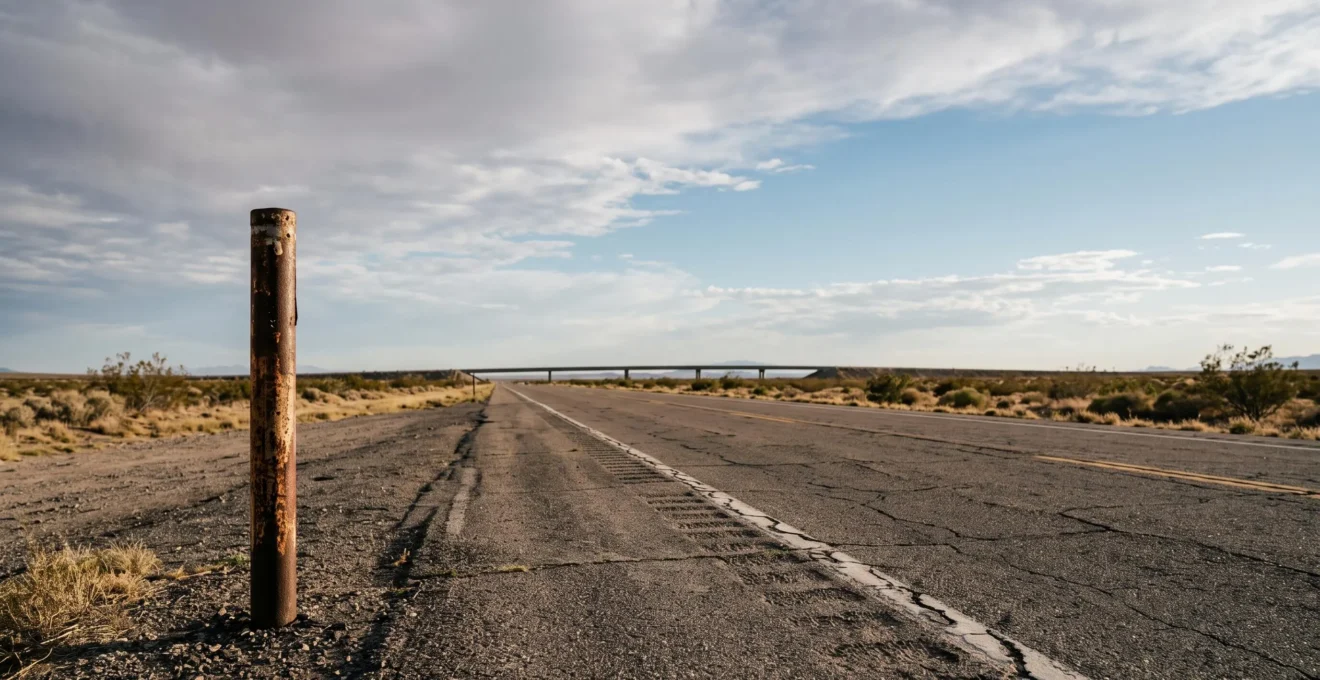
Contrary to the fear that Route 66 is gone, its soul hasn’t vanished—it has simply migrated from the forgotten pavement to the people and places that keep its story alive.
- The journey’s success now depends on embracing a slower pace and deliberately seeking out the historic, often “kitsch,” landmarks.
- Navigating the original route requires specific tools and a detective’s mindset, as modern GPS will lead you astray onto sterile interstates.
Recommendation: Approach it not as a simple drive from A to B, but as a curated historical treasure hunt where the detours are the destination.
The image is etched into the collective consciousness: a chrome-laden convertible, top down, cruising a sun-drenched ribbon of asphalt that cuts through the vast American landscape. This is the promise of Route 66, the Mother Road, a symbol of freedom and discovery. For any nostalgist who grew up with tales of its glory days, the question inevitably arises with a hint of melancholy: In an age of efficient interstates and satellite navigation, is any of that real anymore? Has the legendary highway been completely paved over by progress, reduced to a fragmented memory best viewed in old photographs?
Many assume the worst—that the route is a disjointed collection of tourist traps and impassable roads. They believe the authentic experience is lost forever. The common advice is often practical but uninspired, focusing on simply getting from Chicago to Los Angeles. But what if the true essence of the Mother Road isn’t just in the physical pavement? What if the journey has evolved from a straightforward drive into an act of historical curation? The soul of Route 66 hasn’t disappeared; it has simply become a treasure that asks to be found, hiding in plain sight within the neon-lit motels, the quirky roadside attractions, and the stories of the people who are its modern-day custodians.
This guide offers a realistic but romantic perspective. It accepts the modern challenges not as obstacles, but as part of a new, more engaging adventure. We will explore the mindset required for this journey, from dedicating the proper time to learning the unwritten rules of the road. This is not about merely driving a road; it’s about learning how to read its history, appreciate its character, and ultimately, discover if its legendary spirit still speaks to the 21st-century traveler.
To truly understand if this journey is right for you, we need to delve into the practical realities and cultural nuances that define the Route 66 experience today. This article is structured to guide you through the essential considerations, from trip planning and navigation to appreciating the unique fabric of the road.
Summary: Rediscovering the Mother Road in the 21st Century
- Pourquoi 2 semaines est le minimum pour faire Chicago-LA sans courir ?
- Comment suivre la route historique quand le GPS veut vous mettre sur l’autoroute ?
- Quelles sont les étapes abandonnées les plus photogéniques du trajet ?
- L’erreur de snober les attractions touristiques “kitsch” qui font l’âme de la route
- Où louer sa voiture à Chicago pour éviter les taxes d’aéroport excessives ?
- Quand est-il interdit de tourner à droite au feu rouge (No Turn on Red) ?
- Sieste ou caféine : quelle stratégie pour conduire 800 km en sécurité ?
- Right on Red and 4-Way Stops: US Driving Rules Foreigners Must Know
Pourquoi 2 semaines est le minimum pour faire Chicago-LA sans courir ?
The first mistake a modern traveler can make is to look at Route 66 as a simple line on a map. A “speed run” on the interstate from Chicago to Los Angeles can be done in about 30 hours of pure driving time, a trip one could rush through in under a week. This, however, is the antithesis of the Route 66 experience. The entire point of the Mother Road is to abandon the interstate’s efficiency in favor of the main streets, winding curves, and slow pace of a bygone era. To do it justice, you are not planning a drive; you are planning an immersion.
This is why seasoned travelers and historians agree that two weeks is the absolute bare minimum. In fact, many argue for three or even four weeks to allow for a richer, more leisurely trip. This timeframe isn’t about covering the 2,400 miles; it’s about having the freedom to stop at a quirky museum on a whim, to spend an hour talking to a motel owner whose family has been on the route for generations, or to wait for the perfect “golden hour” light at a photogenic vista. Planning for anything less forces you back into the interstate mindset of “making good time,” which means you’ll miss the very soul you came to find. As travel planners often note, the ideal trip length is between 14 to 21 days for a more complete experience.
Think of it as the difference between sprinting through a museum and taking a guided tour. Rushing means you’ll see the layout, but you won’t understand the story behind any of the exhibits. A two-week timeline builds in the necessary buffer for spontaneous discoveries, unplanned detours, and the simple act of slowing down to the rhythm of small-town America. It transforms the journey from a logistical challenge into a genuine adventure.
Comment suivre la route historique quand le GPS veut vous mettre sur l’autoroute ?
Herein lies the central challenge and, for the dedicated traveler, the greatest joy of a modern Route 66 trip: your GPS is actively working against you. Standard navigation tools like Google Maps or Waze are programmed for one thing: efficiency. They see the meandering, sometimes fragmented, path of old Route 66 as an obstacle to be bypassed. Following their instructions will inevitably place you on the parallel, soulless interstate. To stay on the historic path, you must become a navigational detective, using a combination of modern tech and old-fashioned observation.
Your primary weapon will be a dedicated Route 66 navigation app. These are not your standard GPS; they are painstakingly mapped by enthusiasts to follow the original alignments, even when they devolve into gravel roads or seemingly dead-end streets. They are essential for turn-by-turn directions that respect the history, not the highway. However, even these have their own quirks and are best used in conjunction with a good paper map or guidebook for a broader perspective.
This table compares some of the tools you might use to navigate the Mother Road.
| Tool | Best for | Key feature | Main drawback |
|---|---|---|---|
| Route 66 Navigation app | Historical purists wanting turn-by-turn fidelity | Offline turn-by-turn navigation for the historic alignment, both directions | Paywall for full navigation (subscription required) |
| Route 66 Ultimate Guide app | Families and first-time travelers | Points-of-interest database, virtual passport, audio tours | Less precise on granular historic road alignment |
| Standard GPS (Google Maps) | International visitors needing macro-navigation | Reliable for reaching the next major town | Defaults to the modern interstate, bypassing the historic route |
Beyond technology, you must also learn to read the road itself. Look for the physical clues: the texture of old, cracked concrete giving way to newer asphalt, the “Historic Route 66” signs, or the faint remnants of a painted line on a road shoulder. This is the pavement palimpsest—layers of history written on the ground itself.
As you can see, the journey becomes a game of connecting the dots. It requires patience and a willingness to occasionally get lost and backtrack. Some users of dedicated apps note the “last second” nature of turn instructions, reinforcing the need to be an alert and engaged driver, not a passive passenger following a screen. Embracing this challenge is fundamental to the authentic experience.
Quelles sont les étapes abandonnées les plus photogéniques du trajet ?
The story of Route 66 is one of both life and decay. For every restored neon sign, there is a crumbling motel or a ghost town slowly being reclaimed by the desert. These abandoned places are not signs of failure; they are poignant, photogenic monuments to the road’s history and the profound impact of the interstate highway system. It is estimated that more than 3,000 motels lay crumbling near the historic route, each a silent testament to a once-thriving artery of commerce.
Perhaps no place illustrates this better than Glenrio, straddling the Texas-New Mexico border. Once a bustling stop for travelers, its fate was sealed when Interstate 40 bypassed it. Businesses closed, residents left, and the town became a perfectly preserved time capsule of abandonment. Walking its silent streets is a powerful, melancholic experience, offering a direct look at what happened when the lifeblood of traffic was rerouted. These ghost towns are not just ruins; they are open-air museums of economic change.
The photographic appeal of these locations is undeniable. The image of a single, rusted gas pump against a vast desert sunset, or the peeling paint on a mid-century motel sign, captures a sense of beautiful decay and nostalgia. Places like the “painted desert” section in Arizona, with its long-abandoned cars, or the forgotten towns of the Mojave Desert, offer a quiet, contemplative contrast to the more lively parts of the route. They remind you that the road is a living entity that has changed, evolved, and, in some places, gone to sleep.
L’erreur de snober les attractions touristiques “kitsch” qui font l’âme de la route
For a certain type of sophisticated traveler, the word “kitsch” is a pejorative. They might see the giant concrete dinosaurs, the world’s largest ketchup bottle, or the garishly painted gift shops as things to be endured or, better yet, avoided. On Route 66, this is a profound mistake. Snober the kitsch is to miss the very heart and soul of the road. These attractions aren’t just silly diversions; they are the products of a unique, pre-interstate form of roadside capitalism and are now a crucial part of the route’s preservation.
This is a form of economic archaeology. When you buy a souvenir at the Hackberry General Store or pay to see the Blue Whale of Catoosa, you are not just a tourist. You are an active participant in historical preservation. You are casting a vote with your wallet, helping a small, family-run business keep the lights on and maintain a piece of Americana that would otherwise vanish. The story of the couple who, instead of retiring to an RV, decided to buy and run the historic Blue Swallow Motel is a perfect illustration. Their passion is funded directly by the travelers who choose to stay there.
As the travel blog HoneyTrek so eloquently puts it after their own journey down the Mother Road:
The story of Route 66 is not in its impressive landscapes or even its neon art, but in the people who blazed this trail and those who are preserving it.
– HoneyTrek travel blog, Route 66 Road Trip Guide
That is the secret. The “kitsch” is the context for the people. It’s the stage upon which the modern story of Route 66 is played out. Embracing these quirky, colorful, and deeply human stops is non-negotiable for anyone wanting to understand what the road means today.
Où louer sa voiture à Chicago pour éviter les taxes d’aéroport excessives ?
Before the romantic journey begins, there is the practical matter of securing your vehicle. For many travelers, especially those from overseas, this means renting a car. The most obvious place to do this is at Chicago’s O’Hare International Airport (ORD). However, this is often a costly mistake. Car rentals from major airports in the U.S. are subject to a slew of additional taxes and concession fees that can significantly inflate the final price.
A far more cost-effective strategy is to take a taxi, rideshare, or the ‘L’ train from the airport into downtown Chicago and rent from a city-based location. While this requires an extra step, the savings can be substantial—often hundreds of dollars over a multi-week rental. This is especially true for one-way rentals, which are standard for a Route 66 trip and already carry a hefty “one-way drop-off fee.” Minimizing your initial cost is a savvy first move.
Considering the overall expense, every saving counts. A full trip requires a significant financial commitment, with some estimates putting a two-week Route 66 budget at roughly $1,800 to $4,500 per person, excluding flights. The car rental is a major component of this budget. By avoiding the airport premium, you free up funds that are better spent on authentic experiences along the route—a nicer motel, a memorable meal at a classic diner, or admission to another wonderfully “kitsch” attraction.
Quand est-il interdit de tourner à droite au feu rouge (No Turn on Red) ?
One of the most common driving rules that can confuse foreign visitors in the United States is the ability to turn right at a red light. While this is generally permitted, there is a crucial exception that you must be able to recognize instantly for safety. The permission to turn right on red is immediately revoked when a specific sign is present at the intersection.
You must look for a sign that explicitly says “NO TURN ON RED”. This sign is typically a white rectangle with black or red lettering and is posted next to the traffic light it governs. When you see this sign, the red light functions exactly as it would in many other countries: you must wait for the light to turn green before proceeding with your turn. There is no ambiguity here; the sign overrides the general rule.
In some cases, the restriction may be conditional. You might see a sign that specifies certain times or days, for example, “NO TURN ON RED 7 AM TO 7 PM.” Outside of those posted hours, the general rule applies, and you may turn right on red after a full stop. Always read these signs carefully. Ignoring them is not only illegal and can result in a traffic ticket, but it is also extremely dangerous, as cross-traffic will have a green light and will not be expecting you to enter the intersection.
Sieste ou caféine : quelle stratégie pour conduire 800 km en sécurité ?
A Route 66 trip involves long stretches of driving, and driver fatigue is a serious and often underestimated risk. Pushing through a long day, especially on the monotonous highways that sometimes connect the more interesting historic segments, can lead to dangerously impaired judgment. The classic debate among drivers is whether to rely on caffeine or pull over for a quick nap. According to safety experts, the most effective strategy is not one or the other, but a clever combination of both.
The U.S. National Highway Traffic Safety Administration (NHTSA) endorses a technique sometimes called a “caffeine nap.” The science is simple: caffeine takes about 20-30 minutes to be fully absorbed and take effect. This creates a perfect window of opportunity. The recommendation is to drink a caffeinated beverage (equivalent to about two cups of coffee), and then immediately take a short 15-20 minute nap. When you wake up, you benefit from both the restorative effects of the nap and the full alerting power of the caffeine kicking in. The NHTSA notes that these two remedial actions can make a short-term difference in driving alertness.
This is a short-term fix, not a substitute for proper rest. Nothing can replace a good night’s sleep. However, for that mid-afternoon slump on a long drive across the plains of Oklahoma or the desert of Arizona, it’s a powerful tool to have in your safety arsenal. Fighting drowsiness is a battle you are destined to lose; the only winning move is to stop driving.
Action Plan: Staying Alert on Long Drives
- Get plenty of sleep (at least six hours) the night before a long driving day.
- Travel at times when you are normally awake rather than pushing through the night.
- Schedule a break every two hours or every 100 miles.
- Stop driving immediately if you start to feel sleepy, since fatigue impairs reaction time and judgment similarly to alcohol.
- Avoid planning to work all day and then drive all night.
- Drink a caffeinated beverage and, since caffeine takes about 30 minutes to act, use that window for a short nap.
Key Takeaways
- The authentic Route 66 experience is a curated treasure hunt, not a simple drive; its soul lies with its people and places, not just the pavement.
- Embracing the “kitsch” roadside attractions is essential, as they represent living history funded by travelers’ support.
- A minimum of two to three weeks is non-negotiable to escape the interstate mindset and allow for the spontaneous discovery that defines the journey.
Right on Red and 4-Way Stops: US Driving Rules Foreigners Must Know
Beyond the specific “No Turn on Red” signs, understanding the default rules of the American road is crucial for a safe and stress-free trip. Two of the most common situations you’ll encounter are the general right-on-red rule and the unique etiquette of the four-way stop. Mastering these will make you feel less like a tourist and more like a local.
The “Right on Red” rule is the standard across the United States. Unless a sign explicitly forbids it, you may turn right at a red light. However, this is not a right-of-way. You must first come to a complete stop, just as you would for a stop sign. Then, you must yield to all oncoming traffic and pedestrians. Only when the way is completely clear can you proceed with your turn. It is a rule of convenience, not a requirement.
The four-way stop, marked by stop signs on all four corners of an intersection, operates on a simple but firm system of etiquette. The rule is “first to arrive, first to go.” The first vehicle to come to a complete stop at the intersection has the right-of-way. If two vehicles arrive at the exact same time, the vehicle on the right goes first. This is where you’ll often see the culture of the road in action. In many parts of the Midwest and West, a friendly wave of the hand is used to signal to another driver to go ahead.
As this image suggests, these intersections are less about rigid law and more about a shared, courteous understanding. It’s a small dance of patience and communication. Rushing a four-way stop is a major breach of driving etiquette. Taking a deep breath, making eye contact, and even giving a small “Midwestern wave” will show you understand the unwritten rules of the road.
So, is driving the full Route 66 still worth it? If you are looking for a pristine, unbroken highway from a bygone era, then no. That road no longer exists. But if you are looking for an adventure, a treasure hunt through the heart of American history, and a chance to connect with the passionate people keeping its spirit alive, then the answer is an emphatic yes. Now that you understand the spirit and the rules, the Mother Road awaits. It’s time to start planning your own journey into the heart of America.