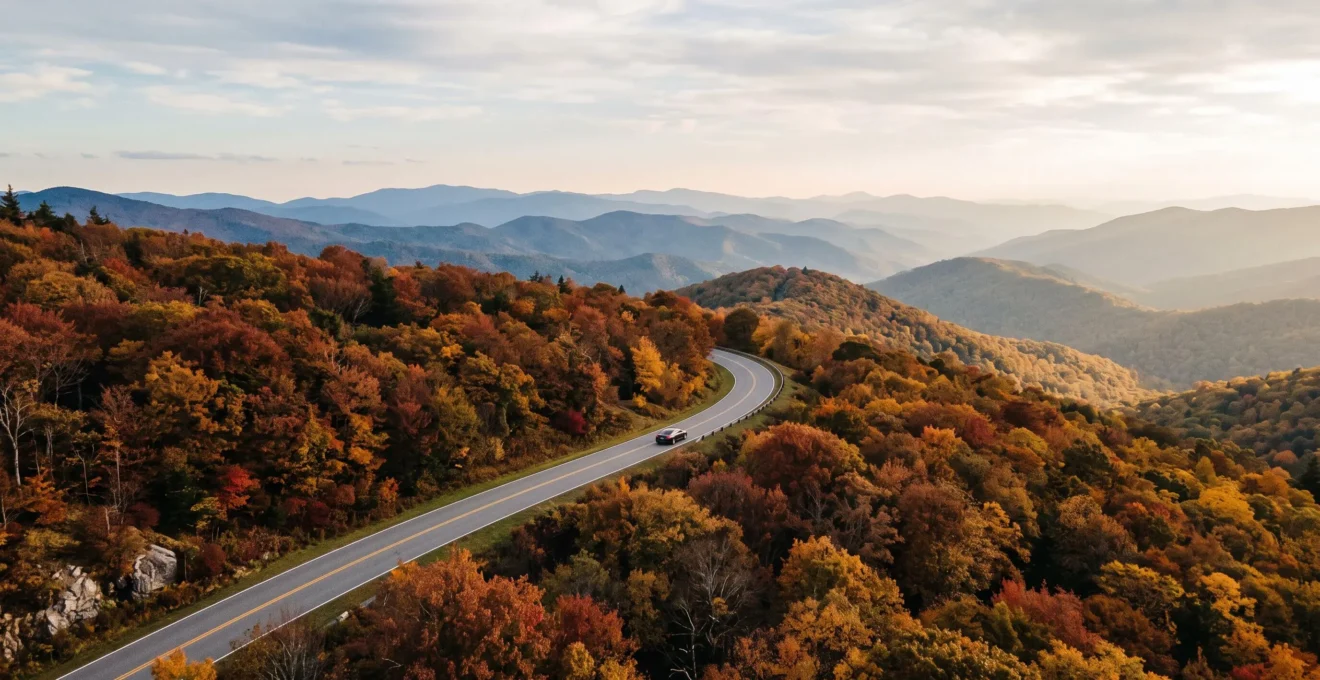
The secret to catching peak fall foliage isn’t picking the right date; it’s chasing the color as it cascades down the mountains.
- Peak color is a moving target, starting at high elevations in late September and rolling down to the foothills through October.
- Success depends on a flexible strategy of moving with the color, not aiming for a single, static location.
Recommendation: Plan your trip around a central “base camp” like Asheville and take day trips to different elevations, moving up or down the Parkway as the color dictates.
Every autumn, a familiar anxiety settles over nature lovers and photographers. The question echoes in forums and social media groups: “When is the absolute peak?” We consult fall foliage maps, study historical data, and book trips months in advance, all in pursuit of that magical, fleeting window when the Appalachian ridges are set ablaze in shades of crimson, gold, and orange. This is the great foliage hunt, and its grand prize is found along the scenic bends of the Blue Ridge Parkway.
For many, the strategy is simple: pick a weekend in mid-October, book a room in Asheville, and hope for the best. But this often leads to disappointment—arriving a week too early to green hills, or a week too late to bare branches, all while stuck in bumper-to-bumper traffic. The Parkway, which stretches 469 miles from Virginia’s Shenandoah National Park to the Great Smoky Mountains in North Carolina, is not a single destination with a single peak date. It’s a vertical landscape, a temporal tapestry.
But what if the hunt itself is the art? The key to unlocking a perfect fall trip isn’t about guessing a date, but about embracing a different mindset: that of a foliage hunter who learns to read the landscape. The secret is to stop trying to *find* the peak and start learning how to *follow* it. This guide is built on that principle. We’ll explore a strategy that treats the Parkway as a vertical timeline, giving you the tools to chase the color cascade from the highest peaks down to the rolling foothills, ensuring you’re in the right place at the right time.
This article provides a complete strategy for your foliage hunt, from understanding the park’s rules to planning your accommodations and finding the most rewarding views. The following sections will guide you through each critical aspect of your journey.
Summary: A Strategic Guide to the Blue Ridge Parkway’s Autumn Display
- Pourquoi la limite de 45 mph est strictement appliquée par les rangers ?
- L’erreur d’arriver en octobre sans réservation d’hôtel à Asheville
- Que faire à Asheville pour une pause urbaine au milieu de la nature ?
- Quels sentiers offrent les meilleures vues avec moins de 1 heure de marche ?
- Comment gérer la conduite quand le brouillard de montagne tombe soudainement ?
- Au-delà du burger : quelles chaînes de fast-food offrent de vraies salades ?
- How to Eat Healthy and Stay Fit During a Month-Long US Road Trip?
- L’erreur de ne pas apporter d’eau potable si la cabane n’a qu’un puits
Pourquoi la limite de 45 mph est strictement appliquée par les rangers ?
The first rule of foliage hunting is to slow down—a principle the National Park Service enforces with purpose. The 45 mph speed limit on the Blue Ridge Parkway isn’t just a suggestion; it’s the foundational rhythm of the road. For a hunter of light and color, this isn’t a restriction but a gift. The Parkway was designed for leisurely travel, with every curve engineered to reveal a new vista. To speed is to miss the subtle shifts in light, the sudden flash of a crimson maple, or the deer grazing quietly in a meadow. It’s an invitation to adopt a more contemplative pace, which is essential for both safety and the aesthetic experience.
Rangers strictly enforce this limit because the road’s design, with its limited shoulders, sharp curves, and frequent wildlife crossings, leaves no room for error. Each year, there are roughly 200 ranger-investigated accidents on the Parkway, with a significant number attributed to speed and driver inattention. The goal is to prevent you from becoming a statistic, ensuring the road remains a place of serenity, not stress.
A prime example of this data-driven approach is the Asheville Corridor. After a review of crash data showed a high number of collisions, the Park Service lowered the speed limit to 35 mph on that busy stretch. This decision underscores that speed enforcement is about documented safety risks, not arbitrary rules. For the foliage hunter, adhering to the limit is an act of respect for the environment, for other travelers, and for the very nature of the journey itself. It forces you to see, not just to look.
L’erreur d’arriver en octobre sans réservation d’hôtel à Asheville
The “color cascade” is a magnificent, slow-motion event that draws visitors from all over. This wave of color, which starts at the highest elevations around 6,000 feet in late September and works its way down the slopes over several weeks, creates a prolonged season of peak demand. The biggest mistake a traveler can make is underestimating this demand, especially around a central hub like Asheville. Arriving in October without a reservation is not a spontaneous adventure; it’s a recipe for disappointment, high prices, or being forced to stay miles away from your target locations.
The competition is fierce. For the most desirable window in mid-October, travel platforms recommend booking 30 to 90 days in advance. Local lodging analysts confirm that the second and third weeks of October are the most contested period of the entire year, with downtown and Biltmore-area properties often selling out completely. This isn’t a single-weekend event; the rolling peak keeps demand high for nearly a full month.
If you find Asheville’s market too saturated or expensive, a strategic foliage hunter looks to nearby towns as alternative base camps. These locations often offer better availability, easier parking, and their own unique charm, while still providing excellent access to the Parkway. This approach allows you to “hub-and-spoke” your daily excursions to chase the color at different elevations.
This comparative table shows some excellent alternatives to Asheville, each offering a strategic advantage for accessing different parts of the Parkway’s fall display. Using one of these towns can be a savvy move for a successful foliage hunt.
| Town | Approx. Distance from Asheville | Typical Foliage Peak Window | Best For |
|---|---|---|---|
| Hendersonville, NC | ~25 min south | Mid-to-late October | Small-town charm, easier parking |
| Black Mountain, NC | ~20 min east | Mid-to-late October | Quick access back onto the Parkway |
| Brevard, NC | ~40 min southwest | Mid-to-late October | Base for Pisgah/Graveyard Fields hikes |
| Weaverville, NC | ~20 min north | Early-to-mid October (higher elevation nearby) | Quieter alternative close to Craggy Gardens |
Que faire à Asheville pour une pause urbaine au milieu de la nature ?
Even the most dedicated foliage hunter needs a day off the road. The constant focus, the slow-moving traffic, and the sensory overload of endless beauty can be draining. Asheville serves as the perfect urban oasis, a place to decompress, refuel, and plan your next foray into the mountains without ever truly leaving nature behind. The city is nestled in a valley, and the surrounding peaks are a constant, colorful reminder of your mission.
A day in Asheville is about recalibrating. You can start the day with a gourmet coffee and a locally sourced breakfast, then spend the afternoon wandering through the River Arts District or exploring the independent shops downtown. Crucially, book restaurant tables in advance, as the best spots fill up just as quickly as the hotels. If Parkway visibility is poor due to fog or rain, Asheville offers a wealth of indoor alternatives, from breweries to art galleries and fall festivals. It’s a walkable decompression zone that provides a much-needed change of pace from scenic driving.
For a truly unique blend of urban and natural escape, look no further than the Biltmore Estate. This is more than a historic house; it’s a massive private park within the city limits. With 8,000 acres of meticulously landscaped grounds, gardens, and trails designed by Frederick Law Olmsted, it offers a curated, crowd-managed foliage experience. You can spend an entire day here, exploring the autumn colors of the gardens, biking the trails along the French Broad River, or enjoying a wine tasting with a mountain view.
This is what an urban break for a foliage hunter looks like: a moment of quiet reflection, with a warm drink, overlooking the very mountains you’ve been exploring. It’s a pause that recharges the spirit for the next day’s chase.
Using Asheville as your base camp allows for this vital rhythm of adventure and rest. You can attack the Parkway early on a weekday morning to avoid congestion and retreat to the city’s vibrant culture in the afternoon. This balance is key to a sustainable and enjoyable hunt.
Quels sentiers offrent les meilleures vues avec moins de 1 heure de marche ?
Driving the Parkway is only half the experience. To truly immerse yourself in the autumn landscape, you must leave the car behind and step onto a trail. The best foliage hunters know that the most profound moments often come from a high vantage point, earned with just a little effort. You don’t need to be a seasoned backpacker to find breathtaking views. The Parkway is dotted with short, high-reward trails that offer maximum panoramic impact for minimal time investment—perfect for capturing that golden-hour shot or simply feeling the crisp mountain air.
These trails are the foliage hunter’s secret weapon, allowing you to quickly access 360-degree vistas that put the vastness of the color cascade into perspective. A hike of less than a mile can transport you from the enclosed world of the road to an open, grassy bald where the ridgelines unfold in every direction. The key is knowing which trailheads to look for by their milepost marker.
Here are some of the most rewarding short hikes, many of which can be completed in under an hour, providing access to classic Blue Ridge scenery:
- Craggy Pinnacle Trail (near MP 364): A 1.4-mile round trip through a tunnel of rhododendron to a stunning 360-degree view. A must-do.
- Devil’s Courthouse Trail (MP 422.4): A short but steep 0.4-mile climb to a dramatic rock outcrop with sweeping views towards the southern peaks.
- Waterrock Knob Trail (MP 451.2): A 1.2-mile round trip to a high-elevation summit, making it a perfect spot for sunrise or sunset. The colors here are among the first to appear on the Parkway.
- Black Balsam Knob (MP 420.2): Not a single trail but a vast area of open, grassy balds. You can walk for 15 minutes or two hours and have panoramic views the entire time.
Finding a trail like this, a simple path leading to an immense vista, is the essence of the foliage hunt. It’s where the scale of the landscape and the fleeting beauty of the season truly connect.
Choosing the right short hike depends on your location on the Parkway and the current elevation of the peak color. Having a list of these quick-access points allows you to be nimble and opportunistic, capturing the best of the day’s light and color without committing to a full day of hiking.
Comment gérer la conduite quand le brouillard de montagne tombe soudainement ?
The same atmospheric conditions that create the vibrant fall colors can also conjure one of the Parkway’s most significant hazards: fog. The mountains make their own weather, and a sunny afternoon can vanish into a thick, disorienting cloud in a matter of minutes. For the foliage hunter, encountering fog is not a question of if, but when. Knowing how to react when visibility drops to near zero is a non-negotiable safety skill. This is where patience and procedure replace speed and spontaneity.
When the fog rolls in, your priorities shift instantly from sightseeing to survival. The winding, shoulder-less road becomes a treacherous path, and every curve holds a potential unseen danger. As an experienced Parkway motorcyclist noted, anyone in a hurry is already approaching the road wrong. He stresses a core principle of mountain driving:
If traffic builds up behind you, the safe move is to pull into the next turn-out and let others pass rather than pushing on through deteriorating conditions.
– Experienced Parkway Rider, BMW MOA Forums
This advice is golden. Fighting the conditions is a losing battle. The wisest move is to find a safe pull-off, wait for a break in the weather, or turn back if necessary. The photograph you miss is better than the accident you have. The Parkway’s official guidance reinforces this cautious approach with a clear set of actions to take immediately.
Action Plan: Driving in Sudden Mountain Fog
- Slow down immediately: Drop your speed well below the posted 45 mph limit as soon as visibility decreases.
- Turn on your headlights: Ensure you are visible to other drivers, even during the day.
- Use extra vigilance on curves: Be prepared for stopped vehicles or wildlife you can’t see until the last moment.
- Pull off only at designated overlooks: Never stop on the road’s shoulder or in a travel lane. Pull your vehicle completely off the pavement.
- Be patient or turn around: If conditions are severe, it is always safer to wait it out at a safe location or find an exit to a lower-elevation state road.
Au-delà du burger : quelles chaînes de fast-food offrent de vraies salades ?
A successful foliage hunt is a marathon, not a sprint. The long hours spent driving, hiking, and patiently waiting for the right light require sustained energy. Subsisting on a diet of gas station snacks and greasy fast food is the quickest way to burn out. While the Blue Ridge Parkway itself is a food desert, with only a few lodges offering meals, the gateway towns at its access points provide opportunities to refuel with healthier options. Knowing where to find a proper meal—something beyond the standard burger and fries—is a crucial piece of logistical planning.
In towns like Roanoke, Boone, Blowing Rock, and Asheville, your options expand significantly. While local, farm-to-table restaurants are ideal for a relaxing dinner, sometimes you need a quick, reliable, and healthy lunch to get back on the road. Many national and regional fast-casual chains have recognized the demand for better food and now offer surprisingly good salads. Look for chains like Panera Bread, which offers a variety of complex salads and soups, or Chipotle, where you can build a salad bowl with grilled proteins and fresh vegetables.
Even some traditional fast-food players have upped their game. Wendy’s has long been recognized for offering a decent selection of seasonal salads, and Chick-fil-A provides several grilled chicken options, including salads and wraps. The key is to plan ahead. When you descend from the Parkway for gas, identify which of these chains is available and make a deliberate choice. Packing a cooler with your own drinks, fruits, and snacks is also a powerful strategy to avoid impulse buys of sugary sodas and candy bars. A well-fed hunter is a focused and resilient hunter.
How to Eat Healthy and Stay Fit During a Month-Long US Road Trip?
While a foliage hunt on the Blue Ridge Parkway may not last a full month, the principles of staying healthy on the road are directly applicable and, in some ways, even more critical. The intensity of a week-long trip, with its long driving hours and physical demands of hiking, requires a focused approach to wellness. The goal is to return home invigorated by the beauty you’ve witnessed, not depleted by the journey itself. Staying fit on the Parkway is a two-part strategy: intentional movement and mindful eating.
The fitness component is built directly into the hunt. The very trails that offer the best views are your outdoor gym. Make it a rule to get out of the car for a short hike at least twice a day. Even a 20-minute walk at an overlook like Waterrock Knob or Craggy Gardens will get your blood flowing, stretch your legs, and clear your head after hours of sitting. This active approach turns the time between photo opportunities into a wellness benefit, keeping your body and mind sharp.
The healthy eating aspect requires more forethought. The Parkway is a pristine natural environment, which means commercial services are sparse. Don’t rely on finding food on the road. The most effective strategy is to start your day with a stop at a grocery store in a gateway town like Waynesboro or Cherokee. Stock a small cooler with essentials:
- Bottled water or a large refillable jug.
- Fresh fruits like apples and bananas.
- Protein-rich snacks like nuts, cheese sticks, or jerky.
- Ingredients for simple sandwiches or wraps.
This tactic gives you complete control over your meals, saving you time, money, and the empty calories of convenience store fare. It allows you to have a picnic at a scenic overlook, fully immersed in the environment you came to see, rather than in a fluorescent-lit fast-food joint.
Key Takeaways
- Peak foliage is not a date, but a “color cascade” that flows down the mountains by elevation; chase it, don’t just guess a date.
- Strategic planning is everything: book lodging in or near hubs like Asheville months in advance, as October demand is immense.
- Embrace the journey: The 45 mph speed limit and unpredictable weather are part of the experience, forcing a slower, more mindful approach.
L’erreur de ne pas apporter d’eau potable si la cabane n’a qu’un puits
The final element of a master foliage hunter’s plan is total preparedness. Your journey may take you to remote cabins or rustic rentals tucked away in the hollows and on the ridgelines that surround the Parkway. These locations offer solitude and an authentic mountain experience, but they can also come with logistical quirks. One of the most common—and potentially disruptive—is the water source. Many rural properties rely on well water, which, while often perfectly safe, can have a taste or mineral content you’re not used to. In some cases, it may not be certified as potable (safe for drinking).
Making the assumption that clean, palatable drinking water will be readily available everywhere is a rookie mistake. Arriving late at night to a secluded cabin, tired from a long day’s drive, only to find you have nothing to drink or make coffee with the next morning, can quickly sour the experience. Hydration is critical, especially if you’re planning to hike. Dehydration can lead to fatigue, headaches, and poor decision-making—all things that can ruin a trip.
The solution is simple and speaks to the core mindset of a prepared traveler: always carry your own initial supply of drinking water. A gallon jug or a case of bottled water in your trunk is a small investment that pays huge dividends in peace of mind. It acts as a buffer, giving you time to assess the water situation at your lodging without being desperate. For longer stays or for those who are environmentally conscious, a portable water filter like a Brita pitcher or a more advanced backpacking filter is an excellent addition to your travel kit. This simple act of self-sufficiency is the final layer of a well-executed plan. It ensures that no matter how remote your chosen outpost is, your basic needs are covered, allowing you to focus completely on the beauty of the hunt.
Now that you are equipped with the strategies for timing, lodging, safety, and self-sufficiency, you have the blueprint for a truly successful foliage hunt. The final step is to put this knowledge into practice and begin planning your own temporal, aesthetic journey along the Blue Ridge Parkway.