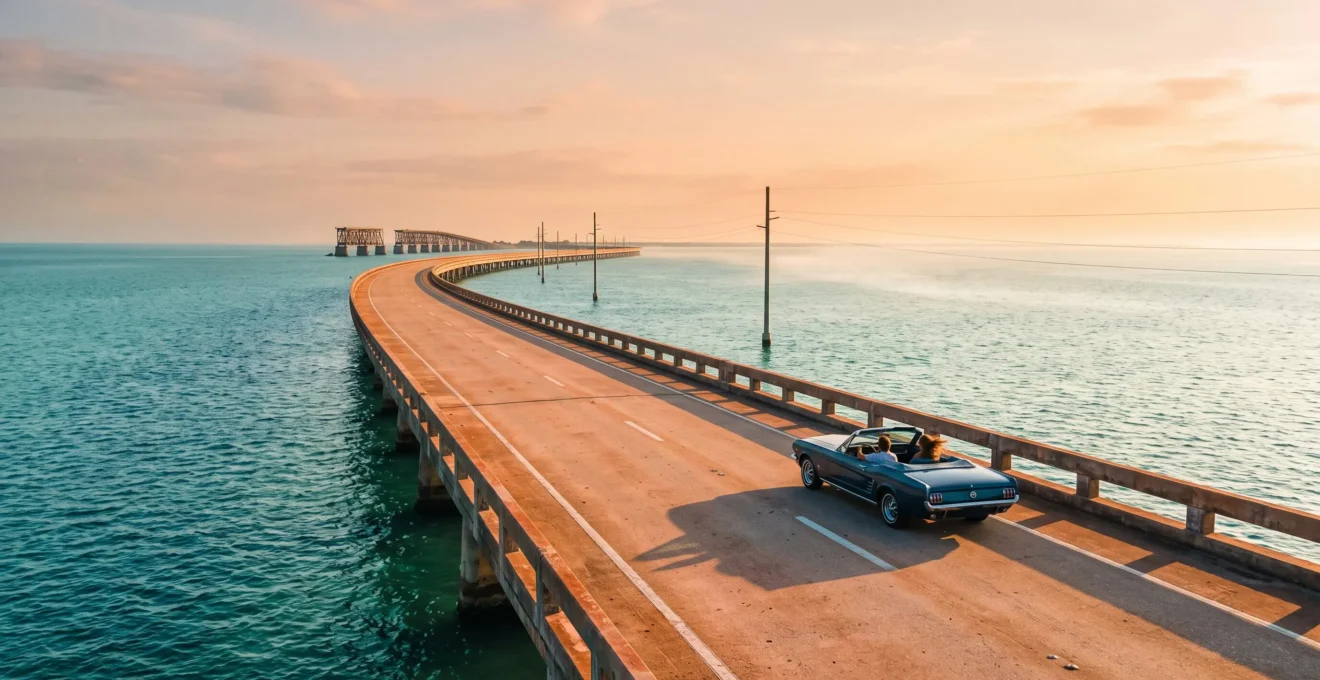
The secret to a great Key West road trip isn’t just seeing the sights—it’s outsmarting the common frustrations that plague most tourists.
- Your departure time is the single most critical factor in avoiding hours of gridlock.
- Hidden administrative fees on rental car tolls can easily double your driving costs if you’re not prepared.
- Knowing a few key local driving rules and photo spots separates a stressful journey from a spectacular one.
Recommendation: Treat the drive as part of the vacation, not a race. A little strategic planning transforms it from a logistical headache into the scenic adventure it’s meant to be.
The drive to Key West is the stuff of legend. That iconic ribbon of concrete, US-1, hopping from key to key over turquoise water is more than a road; it’s a rite of passage for any Florida vacationer. The dream is a windows-down, music-up cruise into an island paradise. The reality, for too many, is a sweltering, bumper-to-bumper crawl that tests the patience of even the most serene traveler. The typical advice you’ll hear is to “leave early” or “just be patient,” but that’s not a strategy—it’s a surrender.
The truth is, conquering the Overseas Highway without misery isn’t about luck; it’s about logistics. It’s about understanding the rhythm of the Keys and thinking like a local, not a tourist. This isn’t just about avoiding traffic. It’s about dodging the hidden “tourist taxes”—the exorbitant rental car toll fees, the wasted hours searching for non-existent parking, and the missed opportunities for that perfect, uncrowded photo. This drive is a beautiful puzzle, and most people don’t even know they’re supposed to be solving it.
But if the key isn’t just leaving at dawn, what is it? It’s a combination of tactical timing, insider knowledge, and a healthy respect for the unique environment you’re driving through. This guide is your playbook. We’re going to dismantle the common pain points of the journey, from the gridlock leaving the mainland to the confounding 4-way stops in town. We’ll show you how to manage costs, where to safely capture those iconic bridge shots, and when to know if Mother Nature has other plans for your trip. Forget misery; let’s plan for magic.
To help you navigate this iconic journey, we’ve broken down the essential strategies into key topics. This structure will guide you through every critical decision point, ensuring your drive south is as breathtaking as the destination itself.
Summary: Your Strategic Guide to the Overseas Highway
- Why leaving on a Friday afternoon is a terrible idea?
- Where to stop to safely photograph the Seven Mile Bridge?
- Key Lime Pie: which stop on the road offers the best authentic pie?
- The mistake of looking for free parking in downtown Key West
- When to cancel your trip in case of a hurricane alert?
- Transponder or online payment: how to avoid the $15 per day admin fee?
- HOV Lanes: why driving alone in the left lane can cost you $400?
- Right on Red and 4-Way Stops: US Driving Rules Foreigners Must Know
Why leaving on a Friday afternoon is a terrible idea?
Let’s be blunt: leaving for the Keys on a Friday afternoon is an act of self-sabotage. You, along with every other person in South Florida with a three-day weekend, will be converging on a single two-lane road. It’s not a question of *if* you’ll hit traffic, but for how many hours you’ll be sitting in it. The dream of a breezy 3-4 hour drive from Miami evaporates into a 6-8 hour parking lot, a phenomenon locals call “the southbound shuffle.” This isn’t an exaggeration; it’s a predictable, recurring event.
The problem is a simple matter of infrastructure. Once you’re south of Florida City, US-1 is essentially the only artery. There are no secret backroads or clever detours. When it gets clogged, it stays clogged. One minor fender-bender can and often does bring the entire highway to a standstill for miles. As one traveler vividly described their peak-week experience, they hit stop-and-go conditions that persisted well past Big Pine Key, with accidents only compounding the misery.
Local Traffic Analysis Confirms the Gridlock
It’s not just anecdotal. A local community analysis from the Islamorada Community Alliance directly links the recurring congestion to heavy tourism advertising that funnels visitors onto the highway during predictable peak periods. Their findings even led to suggestions for radical measures like restricting old-highway shortcuts to locals and closing popular access points during holidays just to manage the overwhelming flow. This confirms that the traffic isn’t random; it’s a systemic problem, and trying to power through it on a Friday afternoon is a losing battle.
The smart play is to practice what we call “Traffic Jiu-Jitsu.” Instead of fighting the flow, avoid it entirely. Aim for a mid-week departure if possible. If you must travel on a weekend, leave at the crack of dawn (think 6 AM, not 9 AM) or wait until Saturday evening. Your blood pressure will thank you.
Where to stop to safely photograph the Seven Mile Bridge?
The Seven Mile Bridge is the celebrity of the Overseas Highway, and everyone wants its picture. The problem is, pulling over on the shoulder of a busy two-lane causeway is incredibly dangerous and often illegal. The key to getting that frame-worthy shot without risking your life is to use the designated, safe pull-offs and parks that were created for this exact purpose. Forget the dangerous impulse stop; the best views are from planned stops.
Your primary target should be the area around the bridge’s western (Marathon) end. Here you’ll find access to the Old Seven Mile Bridge, a historic section now preserved as a pedestrian and cycling path. Walking or biking out onto this old bridge gives you a perfect, parallel vantage point of the modern bridge without a single car whizzing by your elbow. It’s the real view, not just a rushed photo op.
For a different but equally stunning perspective, consider these safe and spectacular spots:
- Bahia Honda State Park (Mile Marker 37): The park offers a classic view from the Old Bahia Honda Rail Bridge, where you can capture the iconic composition of both the old and new bridges. Look for the distinctive gap in the old steel-truss bridge, intentionally cut to allow tall boats to pass.
- Converted Fishing Piers: Bridges like the Channel #2 Bridge or Tom’s Harbor Cut Bridge have sections that have been converted into pedestrian fishing piers. These offer a less-crowded angle on the causeway system.
- Sunset at the Old Seven Mile Bridge: The area near the Marathon-end access point is widely considered one of the best sunset viewpoints on the entire route. Plan your drive to be here as the sun goes down.
- Safety Note on Tides: If you’re shooting near the water, be aware of the tides. The currents under the Bahia Honda Bridge can be surprisingly strong.
By planning your stop, you trade a dangerous, fleeting glimpse for a relaxed, memorable experience that yields far better photographs.
Key Lime Pie: which stop on the road offers the best authentic pie?
Asking for the “best” Key Lime Pie in the Keys is like asking for the best grain of sand on the beach—everyone has a favorite, and arguments can get heated. Instead of chasing a single “best” slice, the savvy traveler learns to identify an *authentic* slice. The truth is, many places serve a tourist-friendly version that barely resembles the real deal. Knowing the difference is your key to pie nirvana.
First, let’s bust the biggest myth: authentic Key Lime Pie is yellow, not green. The juice from tiny, potent Key limes is pale yellow. If you’re served a slice that’s the color of a shamrock, it’s loaded with food coloring. Run away. Second, the texture should be a smooth, creamy custard, not a stiff, gelatinous Jell-O. It gets this texture from the chemical reaction between the acidic lime juice and sweetened condensed milk.
The final two components of an authentic pie are the crust and the topping. A traditional crust is made from graham crackers, providing a sweet, crumbly counterpoint to the tart filling. Anything else is a modern interpretation. As for the topping, purists will argue for either a fluffy meringue (the historic original) or simple, unsweetened whipped cream (the popular modern classic). Both are acceptable, but a spray-can cloud of oily “whipped topping” is a cardinal sin.
So, where do you find this paragon of pies? While legendary spots like Kermit’s in Key West or Mrs. Mac’s Kitchen in Key Largo are famous for a reason, your mission is to use your newfound knowledge as a filter. As you drive, look for unassuming bakeries or roadside cafes. Peek at the pie in the display case. Is it pale yellow? Does it look homemade? That’s likely where you’ll find your perfect slice, far from the tourist-trap imitations.
The mistake of looking for free parking in downtown Key West
Searching for free parking in Old Town Key West is a fool’s errand. It’s the vacation equivalent of hunting for a unicorn. While a few residential spots technically exist, they are fiercely guarded by locals and subject to a confusing array of restrictions. Wasting an hour of your precious island time circling blocks in the heat, only to end up with an expensive parking ticket, is a classic “tourist tax” you don’t need to pay.
The reality is simple: paid parking is part of the cost of visiting Key West. The moment you accept this, your stress level will plummet. Your best strategy is to head directly for one of the main public parking garages, such as the Park N’ Ride on Grinnell Street or the Old Town Garage near the historic seaport. Yes, it will cost you for the day, but you’ll save an immense amount of time and frustration.
Once you’ve parked, the island becomes your oyster. Key West’s downtown is incredibly compact and walkable. For longer distances, renting a bicycle is the quintessential local experience and allows you to explore the charming side streets with ease. Ride-sharing services are also plentiful. Your car, once safely stowed, is best left alone until the day you depart. A simple rule of thumb for on-street parking, should you miraculously find a spot: if the curb isn’t painted, you *might* be okay. If it’s painted any color—especially red (no parking) or yellow (loading zone)—don’t even think about it.
Embrace the “park it and forget it” mentality. The money you spend on a garage spot is an investment in a stress-free day of exploration. Consider it the entrance fee to paradise.
When to cancel your trip in case of a hurricane alert?
The sunny skies of the Keys come with a serious caveat: hurricane season, which officially runs from June 1st to November 30th. Driving down a long chain of islands with only one road in and out requires you to take weather alerts with the utmost seriousness. Ignoring evacuation orders is not brave; it’s reckless. The key is to understand the difference between a “watch” and a “warning.”
A Hurricane Watch means that hurricane conditions (sustained winds of 74 mph or higher) are *possible* in the specified area. A watch is typically issued 48 hours in advance of the anticipated onset of tropical-storm-force winds. This is your signal to get prepared. You should be gassing up your car, securing your accommodations, and closely monitoring updates from the National Hurricane Center (NHC) and Monroe County Emergency Management. This is the time to make a preliminary decision, not to panic.
A Hurricane Warning is far more serious. It means that hurricane conditions are *expected* in the area, and it’s issued 36 hours in advance. For tourists, a Hurricane Warning is your unequivocal signal to leave. Monroe County will issue mandatory evacuation orders for visitors, and you must comply. Waiting until the last minute is a catastrophic mistake. The single highway will become a parking lot, services will shut down, and you could be trapped in the path of a dangerous storm. There are no shelters in the Keys for tourists; you are expected to evacuate to the mainland.
Your decision to cancel should be based on official guidance. If a Hurricane Watch is issued for the Keys and you haven’t left for your trip yet, it’s wise to postpone. If you are already in the Keys when a watch is issued, prepare to leave immediately if it’s upgraded to a warning or if a visitor evacuation is ordered. Your vacation is not worth risking your life.
Transponder or online payment: how to avoid the $15 per day admin fee?
One of the most infuriating and easily avoidable “tourist taxes” on a Florida road trip is the bundle of administrative fees that rental car companies tack on for using cashless tolls. Many of the highways leading to the Keys are now all-electronic, meaning you can’t pay with cash. If you just drive through, the rental company’s tolling program kicks in, and they hit you with a daily “convenience” fee on top of the actual toll cost. These fees can be as high as $15 per day, and a study found that using toll roads on just five days of a rental can already add $25–$50 in pure administrative charges.
Luckily, you can completely bypass these junk fees with a little pre-planning. Your best weapon is to bring your own transponder (like a SunPass, E-ZPass, or other compatible device) or to use the SunPass website to temporarily add your rental car’s license plate to your personal account. This allows the tolls to be billed directly to you, with zero admin fees from the rental company.
The table below highlights just how much these fees can vary, but the best option is always the one that costs you nothing in daily charges. As this comparison of rental car toll programs shows, using your own system is the clear winner.
| Rental Company | Toll Program | Daily Admin Fee | Monthly Cap |
|---|---|---|---|
| Avis / Budget | e-Toll | $6.95 per day tolls are used | $34.75 per rental month |
| Hertz | PlatePass | $4.95 per day tolls are used | No stated maximum |
| Bring your own transponder | SunPass (added to rental plate) | $0 admin fee | Not applicable |
Your Action Plan: Add a Rental Car to Your SunPass Account
- Log into your existing SunPass account online before you pick up the car.
- Once you have the car, add the rental vehicle’s license plate number to the account.
- Select the exact start and end dates that match your rental agreement period.
- If you have a physical SunPass transponder, make sure it’s in the car with you.
- Crucially, remember to remove the plate from your account and take your transponder with you when you return the vehicle.
HOV Lanes: why driving alone in the left lane can cost you $400?
As you navigate the mainland highways of South Florida on your way to US-1, you may encounter a special lane on the far left marked with a diamond symbol. This is a High-Occupancy Vehicle (HOV) lane, and misusing it can lead to a shockingly expensive ticket. These lanes are reserved for vehicles with two or more occupants (sometimes three, check the signs) to encourage carpooling and reduce congestion.
If you are driving alone, you are not permitted to use the HOV lane during its designated operational hours, which are typically during morning and evening rush hours. The “I’m just using it to pass” excuse won’t work with the Florida Highway Patrol. Getting caught driving solo in an active HOV lane is a moving violation that comes with a hefty fine—often hundreds of dollars—and points on your license. It’s an expensive mistake for a few minutes saved.
It’s important to note that the majority of the actual Overseas Highway in the Keys does not have HOV lanes; it’s a standard two-lane highway (one lane in each direction). The risk primarily exists on the multi-lane expressways in and around the Miami-Dade area that you’ll use to approach Key Largo. Pay close attention to the road markings and overhead signs. If you see the diamond, and you’re driving by yourself, stay out of the far-left lane during the posted hours.
This is a classic example of where knowing local rules pays off. While other tourists might get slapped with a fine they never saw coming, the savvy driver knows to stick to the general-purpose lanes and avoid the costly temptation of that seemingly empty lane.
Key takeaways
- Timing your departure is non-negotiable; avoiding peak Friday and weekend hours is the only way to beat the gridlock.
- Understand your rental car’s toll policy before you leave the lot. Using your own transponder or the SunPass app can save you over $100 in junk fees.
- Respect local speed zones and driving conventions. They exist for crucial reasons, from protecting endangered wildlife to ensuring traffic flow at unique intersections.
Right on Red and 4-Way Stops: US Driving Rules Foreigners Must Know
Driving in the U.S., and particularly in Florida, involves a few key rules that can be confusing for international visitors or even out-of-state drivers. Mastering them is essential for a safe and stress-free trip. Two of the most common scenarios you’ll encounter are “Right on Red” and the 4-way stop.
The “Right on Red” rule is a default in Florida. It means that after coming to a complete stop at a red light, you are legally allowed to turn right if the way is clear of cross-traffic and pedestrians. The crucial part is the *complete stop*. You must treat the red light like a stop sign first. The only exception is when a sign is explicitly posted that says “No Turn on Red.”
The 4-way stop (or “All-Way Stop”) can seem chaotic, but it operates on a simple, consistent principle: first-come, first-served. The first vehicle to arrive at the intersection and come to a complete stop has the right-of-way to proceed first. If two vehicles arrive at the same time, the vehicle on the right has the right-of-way. It’s a dance of courtesy and established rules, not a race to see who can nose into the intersection first.
These rules are universal, but they take on special importance in the Keys. Here, traffic flow is paramount, and the driving can be more relaxed if everyone follows the same playbook. Furthermore, you’ll encounter areas with strictly enforced, reduced speed limits, particularly on Big Pine Key. These aren’t suggestions; they are in place to protect the endangered Key deer, a subspecies found only in this part of the Keys, with a current population of around 800 animals. Hitting one of these small deer can be devastating for the animal and your car, and fines for speeding in the deer protection zone are doubled. Respecting the signs isn’t just about avoiding a ticket; it’s about being a responsible visitor.
Now that you have the local’s playbook, you’re ready to plan a drive that’s as memorable as the destination itself. Start by mapping your ideal departure time and pre-sorting your toll strategy to ensure a smooth journey from start to finish.
Frequently Asked Questions about How to Drive the Overseas Highway to Key West without Traffic Misery?
Can I fly a drone over the Seven Mile Bridge or the Key Deer refuge for photos?
No. According to federal regulations, launching, landing, or otherwise operating a drone on a national wildlife refuge—which includes the National Key Deer Refuge on Big Pine Key—is strictly prohibited. This rule applies regardless of how briefly you intend to fly. You must have your drone on the ground within refuge boundaries.
Are apps like DJI Go or AirMap reliable for checking if a spot is a no-fly zone?
You should not rely solely on them. The U.S. Fish and Wildlife Service warns that these consumer apps do not always accurately reflect public lands where drone use is banned. If you have any doubt about whether you are on or near refuge land, the safest course of action is to contact the specific refuge manager before attempting to fly.
Does the same drone restriction apply to nearby national parks like the Everglades?
Yes, the policy is very similar. The National Park Service has its own regulations that ban launching, landing, or operating drones inside National Park Service sites. This rule covers the Everglades and Dry Tortugas National Parks, which are popular destinations near the Florida Keys.