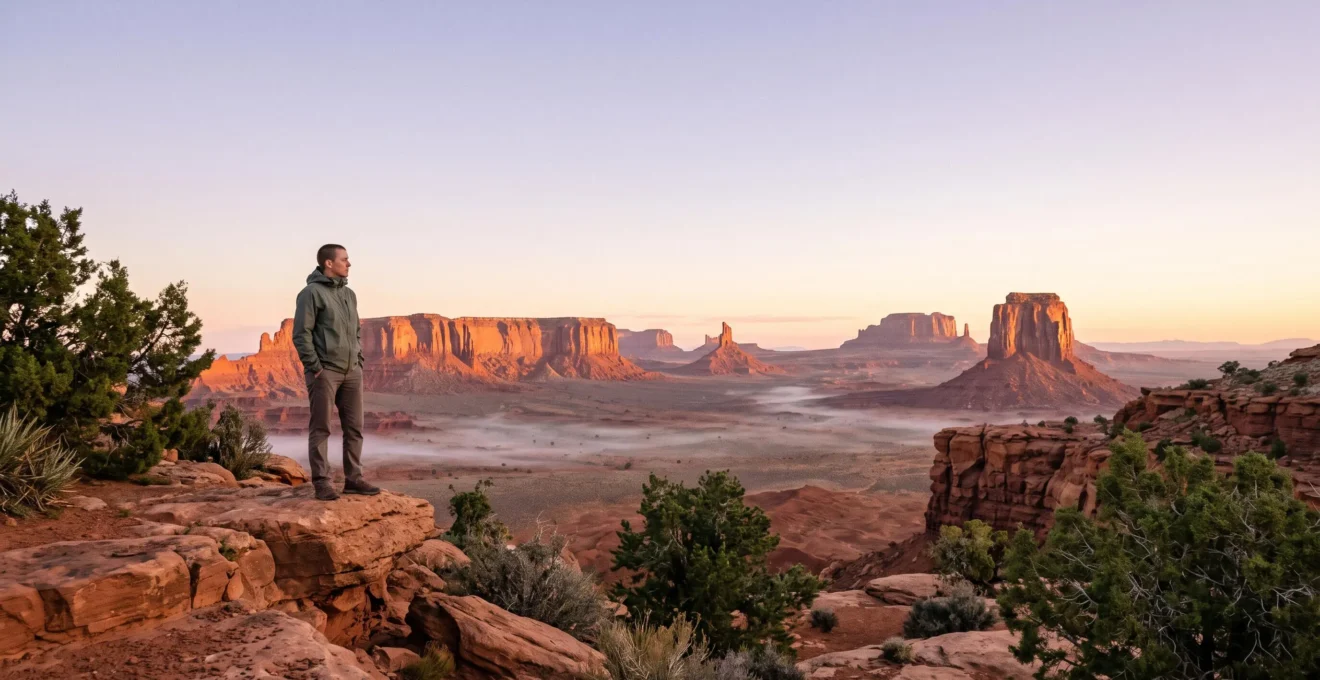
The widespread belief is that Sedona’s power is a passive force in the landscape; the truth is that a true connection is an active, intentional partnership with the land.
- The famous “vortex” energy is less a magical force and more an experience amplified by the unique geology, profound silence, and a visitor’s own mindfulness.
- Practical planning, from parking strategies to choosing between a Jeep and a hike, directly impacts your ability to access the quiet, reflective state Sedona offers.
Recommendation: Approach your visit not as a tourist consuming a sight, but as a respectful guest entering a sacred space, and you will discover the real magic of Sedona.
There’s a whisper that travels on the high-desert wind, a story carried from traveler to traveler: something is different about Sedona. It’s a place where the earth seems to breathe more deeply, where the light plays tricks on the senses, and where countless people report feeling a profound sense of peace, clarity, or energetic shift. Each year, this whisper draws millions, not just for the stunning crimson landscapes, but in search of an intangible connection, a spiritual experience that has become the town’s global signature.
Many guides and articles will point you to the famous vortex sites or offer basic hiking tips. They’ll tell you what to see, but rarely delve into *how* to see it. They speak of the energy but not its source. This approach treats Sedona as a collection of photo opportunities, a spiritual checklist to be completed. But what if the true key to unlocking Sedona’s essence isn’t found by simply standing in the “right” spot? What if the experience is not something you find, but something you co-create?
This guide is built on a different premise, one I’ve shared with travelers for years: the spiritual pull of Sedona lies in the intentional relationship you build with it. The land offers a mirror, reflecting the awareness and respect you bring. We will explore the famous vortexes and offer practical advice, but always through this lens. You will learn not just where to go, but how to arrive with purpose, how to navigate mindfully, and how to leave this sacred land as you found it, taking with you a connection that is far more lasting than a photograph.
This article will guide you through the practical and spiritual layers of a Sedona journey. We’ll demystify the vortexes, solve the most common logistical headaches, and explore the ethics of interacting with this fragile, powerful landscape, all to help you forge your own meaningful connection.
Summary: A Guide to Sedona’s Spiritual and Natural Wonders
- What Is an Energy Vortex and Where Can You Easily Find Them in Sedona?
- How Do You Park at Devil’s Bridge Without Arriving at 5 A.M.?
- Jeep Tour or Hiking: Which Option Lets You See the Most Red Rocks?
- Why Building Cairns Is a Mistake That Disrupts the Fragile Ecosystem
- When Should You Visit Cathedral Rock to See the Rock Ignite at Sunset?
- The Spirit of the Land: Why You Should Never Take a Rock from Sedona
- No Wi-Fi or 4G: How to Download Your Maps and Entertainment Before You Arrive
- Beyond the Trails: How to Visit Sedona’s Sacred Sites Respectfully
What Is an Energy Vortex and Where Can You Easily Find Them in Sedona?
The term “vortex” is perhaps the word most synonymous with Sedona’s mystical identity, drawing an estimated 3.5 million visitors each year who are curious about these famed energy centers. But what exactly is a vortex? Forget images of swirling portals. In Sedona, a vortex refers to specific sites where the earth’s energy is believed to be more concentrated and active. As the Sedona Visitor’s Bureau explains, these are thought to be “areas where the Earth’s energy is thought to be highly concentrated,” creating an environment conducive to meditation, healing, and spiritual self-exploration. Many visitors report feeling a subtle vibration, a sense of deep calm, or a tingling sensation at these sites.
This feeling isn’t just metaphysical; it’s rooted in the land itself. The immense formations of iron-rich sandstone, the twisted, ancient juniper trees, and the profound silence of the high desert all contribute to an atmosphere that encourages introspection. The “energy” is as much about what is absent—urban noise, digital distractions—as what is present. The four most recognized vortex sites are Airport Mesa (for its expansive views), Cathedral Rock (often associated with feminine energy), Bell Rock (for balance), and Boynton Canyon (a site of spiritual significance for local Indigenous tribes).
As you can see in this symbolic representation, the concept is about a focus of energy within the natural rock. To truly engage with a vortex, you must approach it with intention. It is not a passive experience. Find a quiet spot away from the crowds, sit on the warm rock, close your eyes, and simply breathe. Pay attention to the sounds of the wind, the feel of the sun on your skin, and the sheer presence of the ancient geology around you. This is where the real connection begins.
Your Essential Vortex Preparation Checklist
- Parking Pass: Purchase a Red Rock Pass ($5 daily) which is required for parking at most major trailheads.
- Desert Essentials: Pack more water than you think you need, sun protection (hat, sunscreen), and wear sturdy footwear for the rocky terrain.
- Layered Clothing: Be prepared for significant temperature swings; mornings can be cool even when midday is hot.
- Mindful Timing: Plan your visit for early morning or late afternoon to experience the softest light and a more reflective, less crowded atmosphere.
How Do You Park at Devil’s Bridge Without Arriving at 5 A.M.?
Devil’s Bridge is one of Sedona’s most iconic hikes, famous for the breathtaking photo opportunity on the natural sandstone arch. Its popularity, however, has created a significant logistical challenge: parking. The main Dry Creek Road lot is notoriously small and often full before 7:15 a.m., leading to frustrating searches and long walks along the roadside. But arriving before dawn isn’t the only way to experience the bridge. The key is to embrace a strategy of “mindful navigation” by using alternative routes or transportation.
The most effective strategy is to skip the main lot entirely and head for a “backdoor” route or utilize the town’s excellent shuttle system. The Mescal Trailhead, for example, offers a much more scenic and less crowded approach. This route adds a bit of distance, but it trades a dusty, exposed 4×4 road for a beautiful singletrack path through juniper and pine forest. Alternatively, the free Sedona Shuttle is a game-changer. Since its launch, more than a million people have used the transit system to reach trailheads without the stress of parking, a testament to its effectiveness. It runs Thursday through Sunday and drops you right at the Dry Creek Trailhead.
Choosing one of these alternatives is more than a practical hack; it aligns with the intentional spirit of a Sedona journey. Instead of starting your day with a competitive, stressful parking hunt, you can begin your hike with a sense of calm and anticipation. The following table breaks down your options to help you choose the path that best suits your needs.
| Access Route | Vehicle Needed | Round-Trip Distance | Parking Difficulty | Scenery |
|---|---|---|---|---|
| Dry Creek Road Trailhead (direct) | High-clearance 4×4 recommended for the bumpy Forest Road 152 | ~2 miles with 4×4 access to the base | Very high — lot often full by 7:15 am, cars spill onto Boynton Pass Road | Dusty, functional OHV road, little shade |
| Mescal Trailhead (backdoor route) | Any vehicle, paved lot | ~4.2 miles round trip | Moderate — lot fills up less than Dry Creek | Scenic singletrack through pine and juniper forest |
| Sedona Shuttle | None — free shuttle | Depends on drop-off point | Low — no parking search required | Same trail access, plus transit time to prepare mentally |
Jeep Tour or Hiking: Which Option Lets You See the Most Red Rocks?
Once you’ve sorted out your logistics, the next question is how to experience the vast, crimson backcountry. The two primary methods, off-road Jeep tours and traditional hiking, offer profoundly different ways to connect with the landscape. The best choice depends entirely on your intention. Are you a “Story Seeker,” eager to learn the history and geology of the land? Or are you a “Spiritual Immerser,” seeking quiet solitude and a personal connection?
A Jeep tour is an exhilarating way to cover a massive amount of ground in a short time. These tours take you on rugged, otherwise inaccessible backcountry trails, with guides providing a running commentary on local lore, ranching history, and the forces that shaped the red rocks. It’s an excellent option for families, visitors with limited mobility, or anyone on a tight schedule who wants a comprehensive overview. The experience is about narrative, history, and the thrill of the off-road adventure.
Hiking, in contrast, is an act of personal immersion. It’s a slower, quieter, and more intimate way to engage with the environment. On foot, you notice the small details: the scent of ponderosa pine after a rain, the texture of sandstone under your fingertips, the sound of your own breathing in the vast silence. It is the preferred method for those seeking reflection, meditation, or a physical challenge. As Arizona-based outdoor creator Danielle puts it in her review of the options, the two are not interchangeable. She gives this advice to those trying to decide:
I would NOT replace hiking with a Jeep Tour
– Danielle, Danielle Outdoors
Her point is that each serves a different purpose. One is not better than the other; they simply fulfill different needs. The table below helps frame this choice based on the kind of experience you are seeking, aligning with our theme of an intentional visit.
| Criteria | Jeep Tour (“Story Seeker”) | Hiking (“Spiritual Immerser”) |
|---|---|---|
| Ground covered | High — backcountry canyons, mesas, and multiple viewpoints in a few hours | Lower — focused on one trail or area at a time |
| Experience style | Guided narration on geology, ranching history and local lore | Personal, quiet connection with the landscape |
| Physical effort | Low — seated off-road ride | Moderate to high — walking, scrambling |
| Best suited for | Families, limited mobility, time-pressed visitors | Visitors seeking silence, reflection, or a spiritual encounter |
Why Building Cairns Is a Mistake That Disrupts the Fragile Ecosystem
As you hike through Sedona, you will undoubtedly see them: small, artful stacks of balanced rocks known as cairns. For many visitors, building one feels like a harmless, creative act—a way to leave a small personal mark, a meditation made tangible. However, this popular practice contradicts the most fundamental principle of interacting with sacred, wild land: Leave No Trace. Building unauthorized cairns is a mistake that, multiplied by millions of visitors, causes significant harm to a fragile ecosystem.
Official cairns, built by park rangers, are crucial navigational tools that mark trails in sparse landscapes. When visitors build their own “recreational” cairns, they can confuse hikers and lead them off-trail into dangerous or sensitive areas. More importantly, moving rocks disrupts the delicate desert environment. It displaces the thin, black, crusty layer of soil called cryptobiotic crust, which is a living community of organisms that prevents erosion and provides vital nutrients for desert plants. Disturbing this crust can take decades or even centuries to recover. The goal, as Yosemite National Park officials succinctly state, “is to leave no signs of human impact on the land.”
This macro view shows the delicate nature of the desert floor that is damaged by moving rocks. This isn’t just an ecological issue; it’s a spiritual one. The principle of “sacred reciprocity” suggests our connection to a place is a two-way street. By choosing not to alter the landscape, we show respect. This act of restraint allows the land to remain a pristine, silent canvas for everyone who follows. The most powerful spiritual marker you can leave is no marker at all.
Case Study: The Petroglyph National Monument Incident
The danger of this trend was made clear in an incident at Petroglyph National Monument. Rangers discovered an extensive area damaged by hundreds of unauthorized cairns, some several feet high. The National Park Service classified this act as vandalism, launching an investigation and highlighting how a seemingly innocent tourist activity can quickly scar a protected landscape. This serves as a powerful reminder of our collective responsibility in these sacred spaces, where the damage was a violation of federal regulations.
When Should You Visit Cathedral Rock to See the Rock Ignite at Sunset?
There are few sights in the American Southwest as iconic as Cathedral Rock bathed in the golden light of sunset. As the sun dips toward the horizon, its low-angled rays strike the iron-rich sandstone, causing the formation to glow with an intense, fiery red. It’s a moment of pure magic, a daily performance by nature that feels deeply spiritual. Capturing this moment, whether with a camera or just with your eyes, requires perfect timing. Arriving too early means harsh, flat light; too late, and you miss the peak color.
The key is to aim for the “golden hour,” the period shortly before sunset when the light is softest and warmest. The exact timing shifts with the seasons. In the summer, you’ll want to be settled into your viewing spot between 5:30 and 7:00 PM. In the winter, the window is much earlier, typically from 4:00 to 5:30 PM. It’s wise to arrive at least 45 to 60 minutes before this window begins to secure a parking spot at the Cathedral Rock Trailhead and hike to your chosen vantage point before the crowds peak.
While the view from the trail itself is spectacular, one of the best and most photographed viewpoints is actually across Oak Creek at Crescent Moon Picnic Site, a spot often referred to as Red Rock Crossing. This location offers a classic perspective of Cathedral Rock reflected in the creek, creating what Firefall Photography calls “one of the iconic images of the Southwest.” For those seeking a quieter experience away from the main trail, this alternative offers a more contemplative space to witness the daily spectacle of the rock igniting in the fading light.
- Summer Golden Window: Be at your viewpoint between 5:30 PM and 7:00 PM.
- Winter Golden Window: Plan to be in place between 4:00 PM and 5:30 PM.
- Pro Tip: Avoid midday visits entirely, as the overhead sun washes out the deep red colors of the rock.
The Spirit of the Land: Why You Should Never Take a Rock from Sedona
You may have heard the legend of Pele, the Hawaiian goddess of volcanoes, who is said to place a curse on anyone who removes volcanic rock from her islands. While Sedona doesn’t have a single, named deity like Pele, it operates on the same powerful, unspoken principle: what is of the land must stay on the land. Taking a rock, a piece of wood, or even a handful of red dirt as a souvenir is more than just a violation of Leave No Trace ethics; it is considered an act of deep disrespect to the spirit of the place.
This belief is woven into the fabric of both Indigenous traditions and modern spiritual thought. For the local tribes who have considered this land sacred for centuries, every rock and tree is part of a living whole. To remove a piece is to disrupt that wholeness. For the millions of spiritual seekers who visit, the rocks are seen as batteries of the earth’s energy, keepers of ancient memory. To take one is to steal a piece of that energy, not just for yourself, but from all future visitors who come seeking connection.
The true souvenir from Sedona is not a physical object. It is the feeling of peace you found sitting on a sun-warmed ledge, the clarity that came to you while watching a sunset, or the renewed sense of wonder at the earth’s beauty. These are weightless and infinitely more valuable. The best way to honor the geological resonance of this place is to leave it exactly as you found it, allowing its magic to remain intact for the next person. Resist the urge to pocket a beautiful stone; instead, take a photo, write in a journal, or simply commit the memory to heart.
No Wi-Fi or 4G: How to Download Your Maps and Entertainment Before You Arrive
In our hyper-connected world, it’s easy to assume that information is always a tap away. In Sedona, especially once you leave the main roads and head for the trailheads, this assumption can leave you stranded. Cellular service is notoriously spotty and often nonexistent in the canyons and backcountry areas where the most beautiful trails are located. There is no public Wi-Fi at the trailheads. This digital disconnect is a blessing for those seeking to unplug, but it can be a serious problem if you’re relying on your phone for navigation.
This is where intentional preparation becomes a matter of safety and convenience. Before you leave your hotel or rental, you must prepare for being offline. The single most important step is to download offline maps. Apps like Google Maps, AllTrails, and Gaia GPS all have features that allow you to save trail maps and surrounding areas directly to your phone. This means you’ll have full GPS functionality to track your location on the trail even without a single bar of service.
Think of it as part of your digital detox. By preparing in advance, you empower yourself to be fully present in the landscape without the anxiety of getting lost. This preparation extends beyond maps. If you enjoy listening to music or podcasts while you hike (though many prefer the natural silence), download them beforehand. If you’re traveling with children, make sure their favorite shows or games are available offline for the car ride to and from the trails. A few minutes of downloading in the morning can save you from hours of frustration later in the day and allow you to fully embrace the gift of being unplugged.
Key Takeaways
- Sedona’s spiritual power is an active experience, not a passive one, requiring a visitor’s intention and respect.
- Practical planning around parking and trail choice is essential for avoiding stress and creating a mindful experience.
- Respecting the fragile desert ecosystem by following Leave No Trace principles, especially not building cairns, is a fundamental spiritual practice.
Beyond the Trails: How to Visit Sedona’s Sacred Sites Respectfully
You have learned about the vortexes, planned your logistics, and understood the ethics of Leave No Trace. The final piece of the puzzle is tying it all together into a cohesive mindset of respect. Visiting Sedona’s sacred sites is not just about physical presence; it’s about the quality of that presence. Your conduct, your awareness, and your quiet reverence are what transform a simple hike into a pilgrimage. True connection happens when you move through the land not as a conqueror, but as a humble guest.
First, be mindful of your volume. Many people come to Sedona’s trails for silence and meditation. Loud conversations, music playing from a speaker, or shouting on the trail can shatter the profound peace that makes these places so special. Speak in low tones and give others a wide berth. If you see someone meditating or sitting in quiet contemplation, walk around them silently and honor their space. This simple courtesy is a powerful act of collective respect.
Second, stay on the designated trails. As we’ve discussed, the desert ecosystem is incredibly fragile. Veering off the path, even for a shortcut or a photo, can cause damage that lasts for generations. The trails have been carefully designed to minimize human impact. Trust their path and know that by staying on them, you are actively participating in the preservation of this beautiful landscape. This is a non-negotiable part of visiting safely and respectfully.
Now that you are equipped with both the practical knowledge and the spiritual mindset, you are ready to plan a journey that goes beyond the surface. Approach Sedona with an open heart and a respectful spirit, and it will surely share its magic with you.